
Chapter 6: Simon Sinek and the Boredom Walks
In this fast-paced world, we have lost the meaning of taking a pause. From opening our eyes in the morning until going to sleep late at night, humans are busy. We are not busy living, but merely busy in the sense that we are alive. The constant consumption of content has saturated our minds, leading us to view a pause as boredom.
This is a boredom that nobody wants in the present day. Because of this, boredom has become a negative term. Saying “I am bored” implies the stress of not doing anything and feeling like it is a waste of time, while scrolling endlessly doesn’t feel the same way.
Simon Sinek opposes this view of seeing boredom as a negative term. For him, it is a cradle of creativity. He reframes boredom as a hidden gift—a quiet doorway to creativity, clarity, and purpose. Human emotions are not bound by geography or culture, and hence, boredom is universal.
It doesn’t matter whether you are walking through the bustling streets of Delhi or pausing in the quiet lanes of Los Angeles; boredom can become a powerful ally. It is in silence, in pauses, and in moments of stillness that ideas begin to breathe.
Boredom as a Reset
Boredom is not emptiness; it is a reset button. When we step away from screens and noise, our mind wanders. It wanders between extremes, whether positive or negative. Normally, we are not able to handle this wandering and want to keep our brains busy all the time. That is the reason we do not want to give it a pause. This pause is exactly what we term as boredom.
We need to understand that this wandering is not aimless. No human emotion is useless. Every emotion is saying something about our psychology. This boredom—it is telling us that the work we are doing is either not interesting, or that the mind needs rest.
One can use this boredom to spark insights, connections, and direction. A quiet walk in a park, a pause on a balcony, or even a slow jog can become fertile ground for creativity.
Think of boredom as mental decluttering. Just as we clean our homes to make space, boredom clears the mind to welcome new ideas. Instead of resisting it, embracing boredom allows us to reset and recharge.
Quotes That Inspire
Simon Sinek reminds us: “Working hard for something we don’t care about is called stress; working hard for something we love is called passion.”
During moments of boredom, this distinction becomes sharper. We rediscover why we do what we do. Passion replaces pressure. Stress dissolves into clarity. His words remind us that silence is not wasted — it is where purpose whispers back to us.
Boredom and Creativity
The central theme is boredom and creativity. Research shows that boredom allows the brain to enter diffuse thinking, where breakthroughs occur. When urgency fades, creativity thrives.
- A student might discover a new way to solve a problem during a quiet pause.
- A leader might find clarity about a decision while walking in silence.
- An artist might sketch their best idea after a moment of stillness.
Boredom is not the enemy of productivity; it is the birthplace of innovation.
Motivational Walks
Sinek encourages motivational walks as a ritual. These walks are not about fitness but about reconnecting with purpose. Silence becomes a companion that helps us reflect, reset, and realign with our goals.
Walking without distraction allows the mind to wander freely. It is in these moments that we often rediscover our “why.” The act of walking becomes symbolic — a journey inward as much as outward.
Leadership Lessons from Silence
Finding Your Why
The journey of Finding Your Why often begins in silence. Boredom creates the conditions for rediscovering purpose — whether it is national pride, personal growth, or creative breakthroughs.
And yes, whether you are preparing for the CWG 2030 in Ahmedabad or the Olympics 2028 in Los Angeles, boredom walks can be the quiet rituals that sharpen focus and fuel vision.
Everyday Examples
Boredom is not reserved for athletes or leaders. It touches everyday life:
- A parent waiting at school pickup may find clarity about family priorities.
- A student staring out the window may suddenly connect ideas for an essay.
- A professional pausing between meetings may realize a new career direction.
In each case, boredom becomes a spark.
Silence as a Teacher
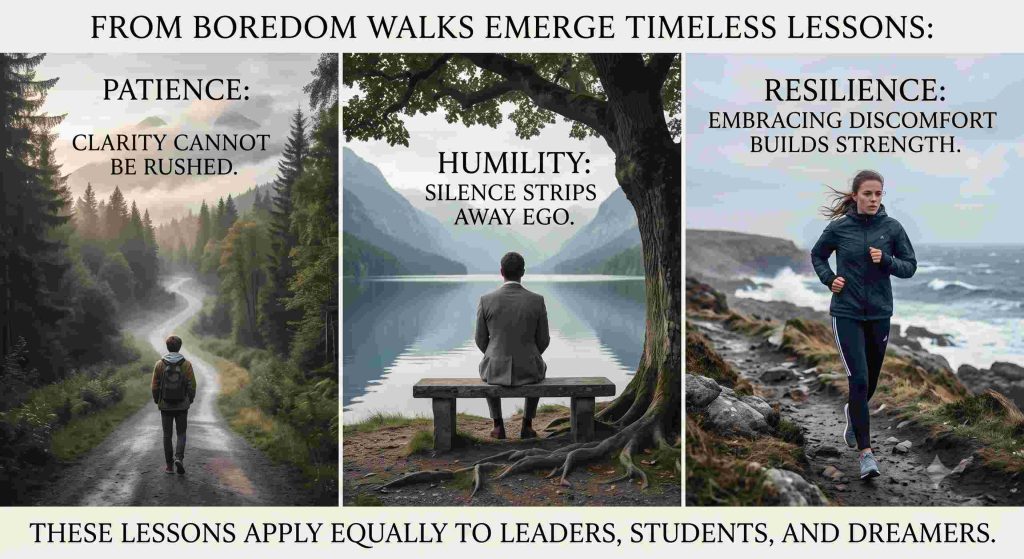
Silence teaches us patience. It reminds us that not all answers come instantly. In a culture obsessed with speed, boredom slows us down just enough to notice what truly matters.
It also teaches humility. In silence, ego fades. We are reminded that clarity is not about control but about listening — to ourselves, to others, and to the world around us.
Resilience Through Boredom
Resilience is built not in comfort but in discomfort. Boredom challenges us to sit with stillness, to resist the urge for constant stimulation. This discomfort strengthens us. It prepares us for challenges that require patience, endurance, and focus.

Conclusion
Simon Sinek’s boredom walks remind us that silence is not wasted time but the birthplace of vision. Boredom and creativity walk hand in hand, offering clarity to anyone willing to pause.
Whether you are a leader, an athlete, a student, or simply someone seeking direction, boredom can be your ally. It is not a gap to be filled but a gift to be embraced.
“Boredom walks are not wasted time; they are the corridors where purpose whispers back to us.”
Chapter1: The Signal of the Soul
Chapter2: The Hidden Gifts of Boredom
Chapter 3: The Escape from Boredom
Chapter 4: Bill Gates and Think Week
Chapter 5: Steve Jobs and the Power of Pauses