Nepal Flood Relief Scams: How Fraudsters Exploit Your Compassion (And How to Give Safely)
A Nation in Crisis
On the morning of August 26, 2026, a glacial collapse near Langtang Lirung in the Himalayas triggered a catastrophic flash flood down the Bhotekoshi and Trishuli river system. The water tore through Nepal’s Rasuwa, Nuwakot, Dhading, and Gorkha districts, sweeping away roads, bridges, and entire settlements.
The human cost is staggering: at least 626 people confirmed dead and 1,924 missing in Nepal, with 7 dead and 554 missing across the border in Tibet. More than 700 foreign nationals from two dozen countries are among those unaccounted for.
As the world watches search-and-rescue operations unfold, millions of people are reaching for their phones and wallets, wanting to help. Unfortunately, that instinct — the very best of human nature — is exactly what a smaller, colder group of people is counting on.
Nepal Police have already issued public warnings. Within days of the disaster, scammers began exploiting the crisis to divert donations and steal personal and financial information. This isn’t a hypothetical risk. It’s happening right now.
What the Scams Actually Look Like
According to Nepal Police, fraudsters are using several coordinated tactics:
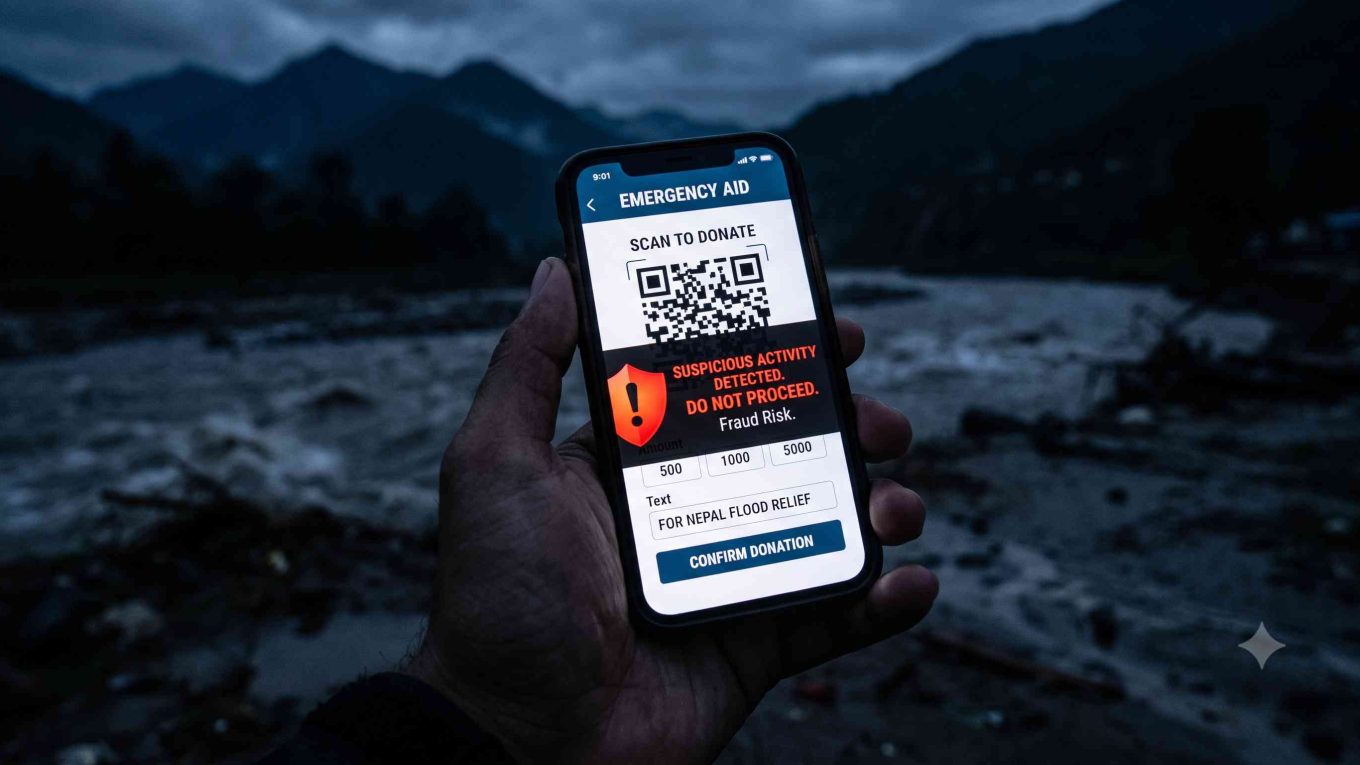
- Fake relief fund pages and QR codes. Scammers are creating pages, posts, and QR codes that copy the name, logo, and format of the “Prime Minister’s Disaster Relief Fund,” then asking people to deposit money into personal bank accounts or e-wallets instead of verified government channels.
- Impersonation calls. Some victims report being called and told they need to “register” for relief assistance, with the caller then requesting personal details or banking information.
- Fake victims and relatives. Scammers are posing as flood victims or their family members, sending urgent pleas for money to strangers and, in some cases, to people who may actually know someone in the affected region.
- Phishing links. Messages designed to look like relief or donation confirmations that are actually built to steal one-time passwords (OTPs) and login credentials.
Authorities and aid organizations have also appealed for something less obvious but equally important: sharing only verified information, not old donation links or unconfirmed reports, since misinformation itself can divert help away from where it’s needed.
Why These Scams Work So Well: The Psychology of Disaster Fraud
Understanding why disaster scams succeed is often more useful than just knowing they exist — because it explains why even careful, intelligent people fall for them.
1. Urgency bypasses scrutiny. “Act now, the window is closing” is one of the oldest manipulation tactics because it works. Urgency pushes people out of slow, deliberate thinking and into fast, reactive decision-making — exactly the state in which red flags get missed.
2. Empathy override. Watching a tragedy unfold creates a genuine need to do something, immediately. Scammers don’t need to convince you disaster relief matters — you already believe that. They just need to intercept the transaction before you pause to verify it.
3. Authority spoofing. A logo, an official-sounding name, or the words “Prime Minister’s Relief Fund” trigger an automatic trust response. Most people don’t consciously fact-check a government seal; they simply respond to the pattern of authority.
4. Social proof. A fake donation page with shares, comments, and “confirmed” replies looks pre-vetted by the crowd. If others appear to have already trusted it, it feels safer to trust it too — even though shares and comments can be fabricated or bought.
5. Compassion fatigue as a side effect. When people encounter a scam — or hear about one — some don’t just distrust that particular appeal. They quietly stop giving altogether. This means scammers don’t just steal money; they can suppress legitimate giving too, which is its own form of damage.
Recognizing these mechanisms doesn’t make you immune to them, but it does buy you the one thing scammers are trying to take away: a pause before you act.
Red Flags Checklist
Before you donate to any Nepal flood relief appeal, watch for:
- Requests to send money to a personal bank account or personal e-wallet rather than an official institutional account
- Unsolicited DMs, WhatsApp messages, or calls asking you to donate or “register” for relief
- QR codes shared on social media rather than sourced from an official government or embassy page
- Pressure to act immediately or lose the chance to help
- Any request for your PIN, card number, or one-time password (OTP) — no legitimate relief fund will ever ask for these
- Emotional appeals from “relatives” or “victims” you cannot independently verify
How to Give Safely
- Go directly to official government or embassy websites rather than clicking links shared on social media.
- If paying by QR code, confirm the recipient’s name on the payment confirmation screen before approving — don’t rely on the code image alone.
- Prefer established, audited international or national charities with a public track record over unfamiliar or newly created fundraising pages.
- If someone claims to be a flood victim or relative asking for urgent money, verify independently — call a known number, don’t rely on the messaging platform alone.
- Keep your donation receipt/voucher — legitimate funds provide one, and in Nepal, contributions to the official PM Disaster Relief Fund may even be tax-deductible.
If You Spot a Scam
Report it immediately to your nearest police office or Nepal Police’s Cyber Bureau, and flag the fraudulent page or account directly on the platform it appeared on (Facebook, WhatsApp, Instagram, TikTok, Viber). The faster these are reported, the fewer people fall victim.
The Bottom Line
The generosity flowing toward Nepal right now is real, and it’s needed. But generosity is also the exact resource scammers are trying to harvest. The defense isn’t cynicism — it’s a thirty-second pause: verify the source, confirm the name on the payment screen, and give through channels you can independently check.
Your compassion is not the vulnerability here. Rushing it is.
Stay wise, stay informed — verify before you give.
About the Author [Suyesh Gusain: physics graduate, mass communication postgraduate, and content writer with 6+ years of experience covering digital scams, consumer protection, and online safety.]