
When Tragedy Meets Deception: How Cyber Scammers Weaponize Natural Disasters from Assam to Nepal
Whenever nature unleashes its fury, the best and worst of humanity surface in tandem. While thousands of citizens open their hearts and wallets to aid distressed communities, organized cyber fraudsters and digital opportunists see human catastrophe through a cold lens: an opportunity for illicit profit.
In 2026, South Asia witnessed consecutive monsoon and flash-flood catastrophes—from the inundation across the Brahmaputra valley in Assam, India, to the sudden, deadly flash floods triggered by trans-Himalayan dam breaches and river surges in Rasuwa and Bhotekoshi, Nepal.
As the waters rose, so did a wave of digital deception. To ensure that your hard-earned money and genuine goodwill reach legitimate victims rather than malicious actors, here is an analysis of how disaster scams operate, how the pattern repeated across borders, and actionable steps to protect your contributions.
The Modus Operandi: Anatomy of Post-Disaster Fraud
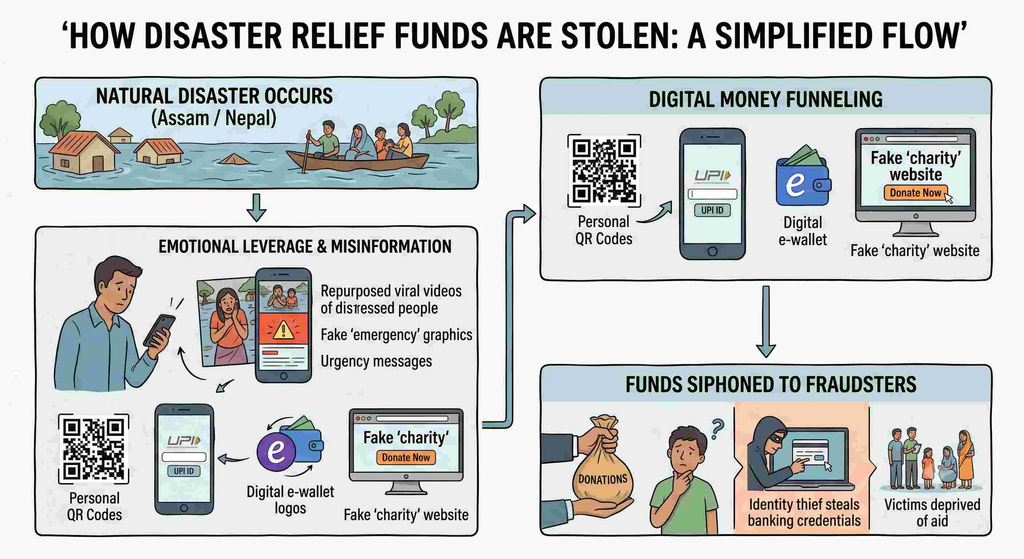
The patterns documented during the Assam floods and mirrored during the Nepal crisis reveal a repeatable, cross-border playbook utilized by scammers.
1. Fake Relief Drives & Rogue QR Codes
- The Mechanism: Fraudsters flood social platforms (Instagram Reels, Facebook Groups, TikTok, Viber, WhatsApp) with donation posters urging people to transfer funds directly via instant UPI QR codes or digital wallets (e.g., eSewa, Khalti, Paytm, PhonePe).
- The Reality: Instead of being routed to an institutional NGO account or state relief mechanism, the money flows directly into private bank accounts controlled by individuals.
2. Recycled & Sensationalized Footage
- The Mechanism: Scammers download dramatic flood and rescue footage from past disasters, uncredited ground reports, or unrelated international protests. They slap emotionally manipulative captions, dramatic audio tracks, and payment codes on top.
- The Reality: The imagery creates artificial urgency, bypassing donors’ critical thinking and verification instincts.
3. Impersonation of Official Government Funds
- The Mechanism: Bad actors register misleading usernames or construct lookalike websites masquerading as the Chief Minister’s Relief Fund (Assam) or the Prime Minister’s Disaster Relief Fund (Nepal). They clone official logos, press releases, and circular formats to legitimize fake deposit links.
4. Secondary Phishing & Data Theft
- The Mechanism: Some fraudulent campaigns do not stop at small donations. They send fake “victim registration forms” or financial support links claiming to register donors for tax rebates or volunteer drives, tricking users into entering banking credentials, OTPs, or credit card details.
A Cross-Border Precedent: Connecting Assam to Nepal
| Threat Indicator | Assam Flood Exploitation (India) | Rasuwa & Bhotekoshi Flood Alert (Nepal) |
| Primary Payment Channels Targeted | Personal UPI IDs, standalone QR graphics on Reels & X | Personal e-wallets, unauthorized individual bank transfers |
| Impersonation Tactic | Unauthorized local NGO claims & personal distress pleas | Impersonation of the Prime Minister’s Disaster Relief Fund |
| Exploitation of Vulnerability | Circulation of unblurred victim faces and distressing clips | Fake emergency calls asking for urgent cash for “stranded” relatives |
| Law Enforcement Response | Assam Police CID Cyber Cell monitored ~50 rogue handles | Nepal Police Cyber Bureau issued nationwide high-alert scam advisories |
When the Assam Police Cyber Cell began flagging dozens of unauthorized payment profiles misusing disaster imagery, the underlying vulnerability was clear: people donate impulsively out of empathy without checking registry credentials.
Within weeks, as Nepal faced severe flash flooding in northern river valleys, the exact same digital playbook emerged overnight. The Nepal Police Cyber Bureau had to issue an urgent public advisory warning that scam networks were attempting to capitalize on the tragedy through rogue donation handles and spoofed government accounts.
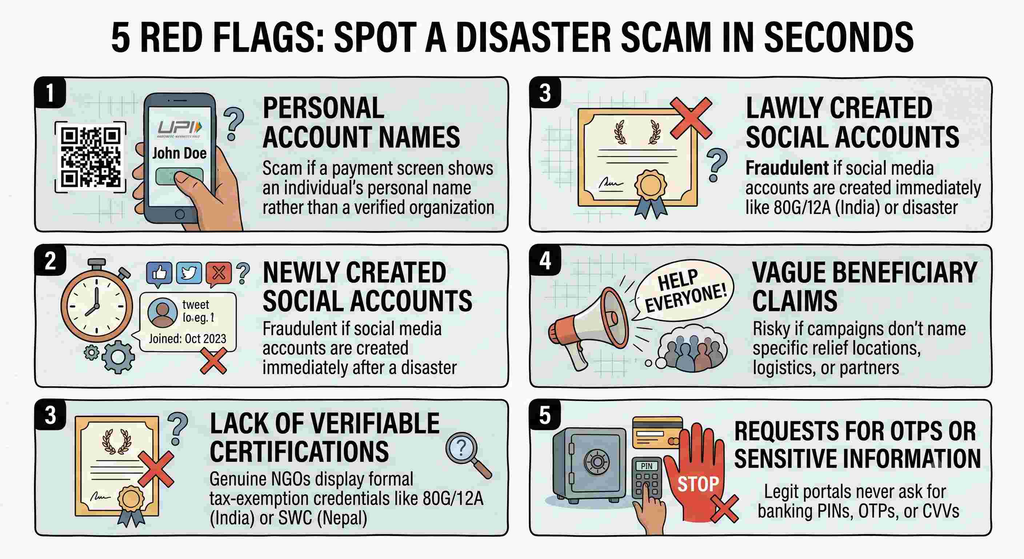
5 Red Flags: How to Spot a Disaster Scam in Seconds
- Personal Account Names on UPI/e-Wallets: If scanning a QR code shows an individual’s personal name rather than a verified trust/organization/state body, do not pay.
- Newly Created Social Accounts: Check account history. Handles created just days or hours after a disaster occurs that immediately solicit funds are almost always fraudulent.
- Lack of Verifiable Certifications: Legitimate NGOs display formal tax-exemption credentials (e.g., 80G/12A registration in India, or registered NGO affiliations under the Social Welfare Council in Nepal).
- Vague Beneficiary Claims: Campaigns claiming “100% of money goes to needy people” without naming specific relief camps, distribution logistics, or on-ground partners are high risk.
- Requests for OTPs or Sensitive Information: No legitimate relief portal will ever ask for your banking PIN, OTP, or CVV.
Safe Giving Checklist: How to Ensure Your Aid Reaches Real Victims
- Prioritize Official State Funds: Direct your relief aid strictly to verified state accounts:
- India: Chief Minister’s Relief Fund (Assam) or PM CARES / Prime Minister’s National Relief Fund via official
.gov.inportals. - Nepal: Prime Minister’s Disaster Relief Fund (PMDRF) verified exclusively through the official portal of the Office of the Prime Minister and Council of Ministers (
opmcm.gov.np).
- India: Chief Minister’s Relief Fund (Assam) or PM CARES / Prime Minister’s National Relief Fund via official
- Verify Crowdfunding Campaigns: Only donate through established platforms that enforce KYC verification and escrow disbursement to audited relief teams.
- Report Suspicious Accounts: If you encounter suspicious donation solicitations, do not just scroll past. Report the profile immediately to platform moderators and state cyber crime portals (e.g.,
cybercrime.gov.inin India or the Nepal Police Cyber Bureau).
Final Thought
Empathy during times of disaster is essential, but blind generosity funds fraud. By practicing digital due diligence and verifying every donation channel before pressing “Send”, you ensure that fraudsters are starved of opportunity and that every rupee goes to real families rebuilding their lives.
Author Bio
Suyesh Gusain is a researcher and writer specializing in digital consumer protection, cyber intelligence, and media literacy. Holding a background in Physics and Mass Communication, he investigates online fraud patterns, deceptive storefronts, and emerging digital manipulation tactics to help internet users navigate online spaces securely and ethically.