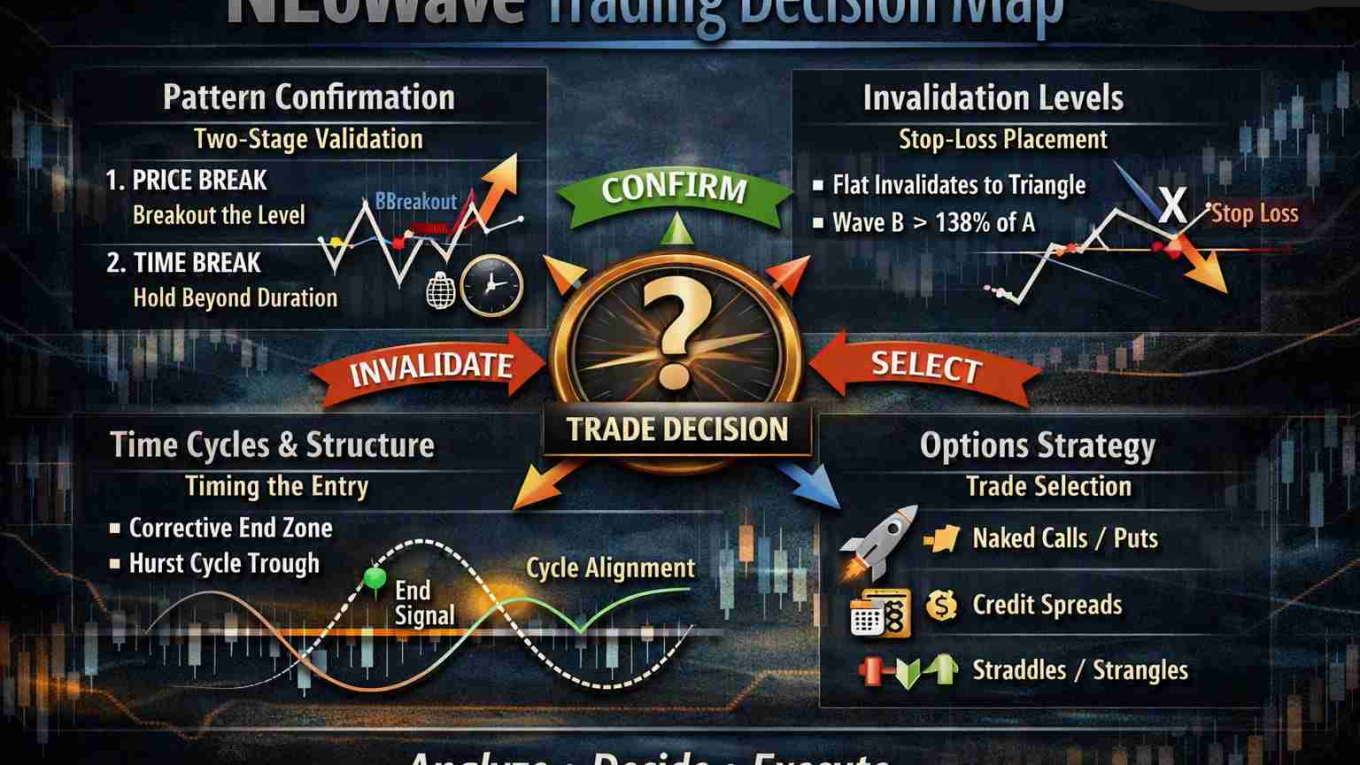
Part 6: Execution and Risk Management
After mastering NEoWave’s structural logic, the next step is execution — translating theoretical wave counts into actionable trading parameters. This chapter bridges analysis and application, showing how to manage risk and position sizing in equity derivatives trading using NEoWave principles.
6.1 Pattern Confirmation
Neely’s Two‑Stage Confirmation process ensures that a corrective pattern has truly completed before entering a trade.
- Stage 1 – Price Break: The market must break the structural boundary of the correction — for example, the upper line of a triangle or the end of Wave C in a flat. This confirms that the correction’s geometry has ended.
- Stage 2 – Time Break: The breakout must persist beyond the correction’s average time duration. If the correction lasted 10 days, the breakout should hold for at least 10–12 hours (in intraday terms) or 1–2 days (in swing terms).
Example: A flat correction ends near 19,800 on NIFTY. Price breaks above 19,820 (price confirmation) and holds for two sessions (time confirmation). The pattern is now validated, and the post‑corrective thrust is underway.
👉 Two‑Stage Confirmation prevents premature entries and filters false breakouts.
6.2 Invalidation Levels
Every NEoWave pattern has a precise invalidation point — the level where its structure fails. These points are ideal for stop‑loss placement.
- Flat to Triangle Transition: If a flat’s Wave B retraces beyond 138% of Wave A, the pattern invalidates and morphs into a triangle.
- Zigzag to Complex Correction: If Wave C fails to exceed Wave A’s end, the zigzag is invalid and may evolve into a diametric or double three.
- Diametric Failure: If any leg consumes disproportionate time, the symmetry breaks, signaling pattern failure.
Example: You identify a flat correction ending at 19,600. If Wave B retraces beyond 19,800, the flat is invalid. Your stop‑loss should sit just above 19,800 — the structural failure point.
👉 Invalidation levels are not arbitrary; they are derived from NEoWave’s geometry and time rules.
6.3 Time Cycles vs. Structure
Neely’s time‑based approach aligns beautifully with J.M. Hurst’s time cycle theory. Both emphasize that markets move in rhythmic intervals.
- Concept: Cross‑reference NEoWave corrective exhaustion zones (where time symmetry ends) with Hurst cycle troughs (where time cycles bottom).
- Application: When both align — a completed correction and a cycle trough — the probability of a reversal skyrockets.
Example: A diametric correction completes after seven equal legs lasting 14 days. Hurst analysis shows a 15‑day cycle trough due tomorrow. The overlap signals a high‑probability long entry.
👉 Combining NEoWave structure with Hurst cycles merges geometry and rhythm — a powerful timing edge.
6.4 Options Strategy Alignment
Once a correction completes, the next challenge is choosing the right derivative strategy. NEoWave helps determine the expected speed and magnitude of the post‑corrective thrust.
- Fast Thrust (Impulse Breakout): Use naked buying — calls or puts — to capture rapid directional movement.
- Slow Thrust (Neutral or Diametric Exit): Use credit spreads or calendar spreads to profit from time decay while maintaining directional bias.
- Uncertain Thrust (Triangle Breakout): Use straddles or strangles — volatility expansion plays that benefit from large moves either way.
Example: A neutral triangle completes on NIFTY options. You expect a sharp breakout but uncertain direction. A short‑term straddle captures volatility expansion while limiting directional risk.
👉 Aligning options strategy with NEoWave pattern speed transforms analysis into precision trading.
📊 Summary Table
| Concept | Focus | Application | Example |
|---|---|---|---|
| Pattern Confirmation | Validate completion | Two‑Stage (price + time) | Breakout holds beyond correction duration |
| Invalidation Levels | Define stop‑loss | Structural failure points | Flat invalidates if Wave B > 138% of A |
| Time Cycles vs. Structure | Timing synergy | Combine NEoWave + Hurst | Diametric ends near cycle trough |
| Options Strategy Alignment | Trade selection | Match thrust speed | Straddle for triangle breakout |
FAQs
How does Two‑Stage Confirmation reduce risk?
It filters false breakouts by requiring both price and time validation.
Why are invalidation levels superior to arbitrary stops?
They’re based on structural logic, not emotion — precise points where the pattern ceases to exist.
Can NEoWave and Hurst cycles conflict?
Yes, but when they align, the probability of success increases dramatically.
Which options strategy fits slow corrections?
Credit spreads or calendars — they profit from time decay while waiting for breakout confirmation.
Conclusion
Execution is where NEoWave theory meets trading reality. By applying Two‑Stage Confirmation, structural invalidation, time‑cycle alignment, and options strategy selection, traders can convert complex wave analysis into disciplined risk management.
- Confirm patterns before acting.
- Place stops at structural failure points.
- Time entries using both geometry and cycles.
- Choose derivatives that match expected thrust speed.
“NEoWave transforms analysis into action — precision replaces prediction.”