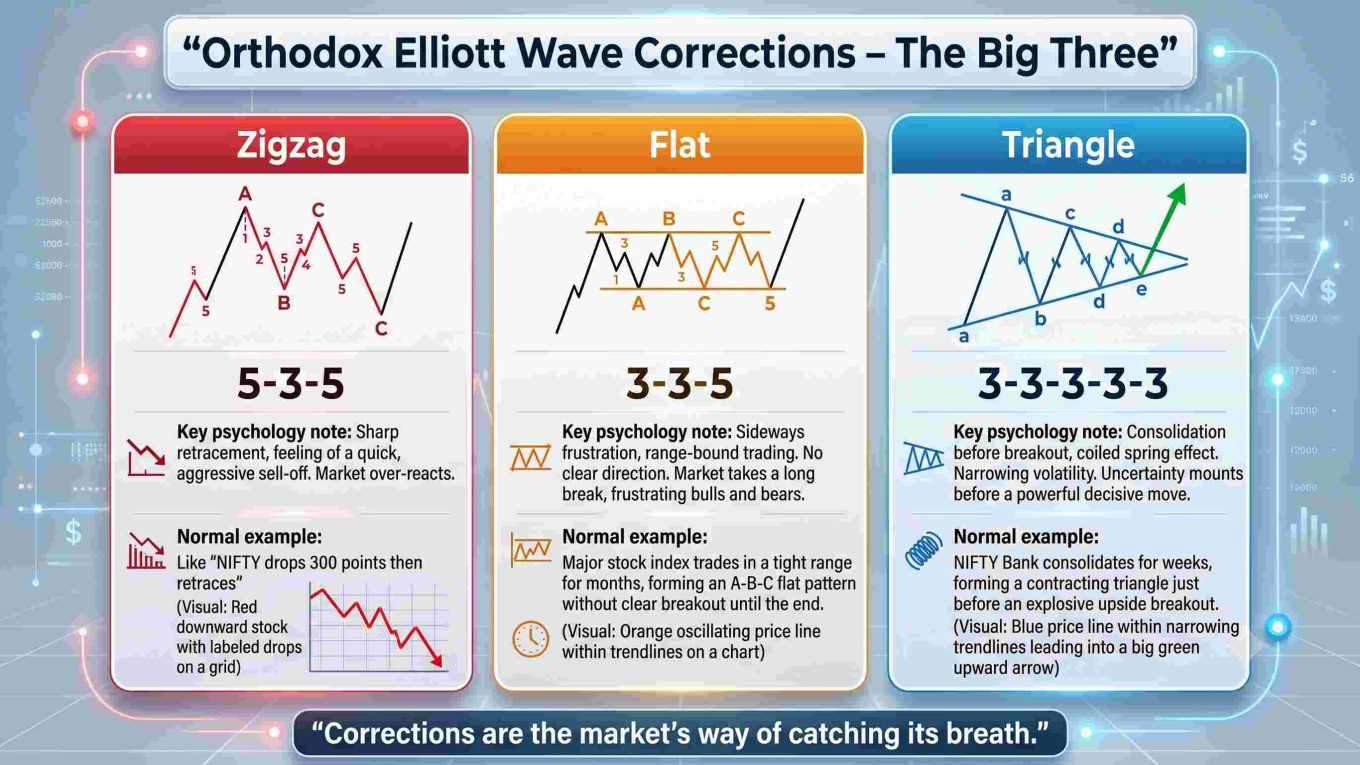
Part2: Orthodox Elliott Wave Corrections – The Big Three
Corrective waves are the “pause” phases of market action. In Elliott Wave Theory, three baseline structures form the core of all corrective price action: zigzags, flats, and triangles. These are the building blocks of more complex corrections, and understanding them is essential for traders. Let’s break them down with simple, normal examples so the concepts feel practical.
2.1 Zigzags (5‑3‑5 Structure)
- Structure:
- Wave A = 5 sub‑waves (impulse or diagonal)
- Wave B = 3 sub‑waves (counter‑trend)
- Wave C = 5 sub‑waves (impulse)
- Types:
- Single Zigzag (A‑B‑C): One clean 5‑3‑5 move.
- Double Zigzag (W‑X‑Y): Two zigzags connected by an X‑wave.
- Triple Zigzag (W‑X‑Y‑X‑Z): Three zigzags chained together, rare but very time‑consuming.
- Momentum & Fibonacci:
- Wave C usually has strong momentum, often equaling Wave A or extending to 1.618 × Wave A.
- Example: NIFTY drops 300 points in Wave A, retraces 150 points in Wave B, then falls another 300–480 points in Wave C.
👉 Zigzags are sharp, deep, and fast — they often trap traders expecting a shallow correction.

2.2 Flats (3‑3‑5 Structure)
- Structure:
- Wave A = 3 sub‑waves
- Wave B = 3 sub‑waves
- Wave C = 5 sub‑waves
- Types of Flats:
- Regular Flat: Wave B retraces close to the start of Wave A, Wave C ends near Wave A’s end.
- Example: Market dips 100 points (A), recovers 90 points (B), then dips another 100 points (C).
- Expanded (Irregular) Flat: Wave B overshoots the start of Wave A, creating false optimism. Wave C then breaks down sharply.
- Example: Market dips 100 points (A), rallies 120 points (B), then crashes 150–200 points (C).
- Running Flat: Wave B is strong, and Wave C fails to retrace fully. This shows extreme bullish momentum.
- Example: Market dips 100 points (A), rallies 120 points (B), then dips only 80 points (C).
- Regular Flat: Wave B retraces close to the start of Wave A, Wave C ends near Wave A’s end.
👉 Flats are sideways corrections — they frustrate traders by consuming time without major price progress.

2.3 Triangles (3‑3‑3‑3‑3 Structure)
- Structure: Triangles consist of five legs (A‑B‑C‑D‑E), each subdivided into three waves. They represent consolidation before a breakout.
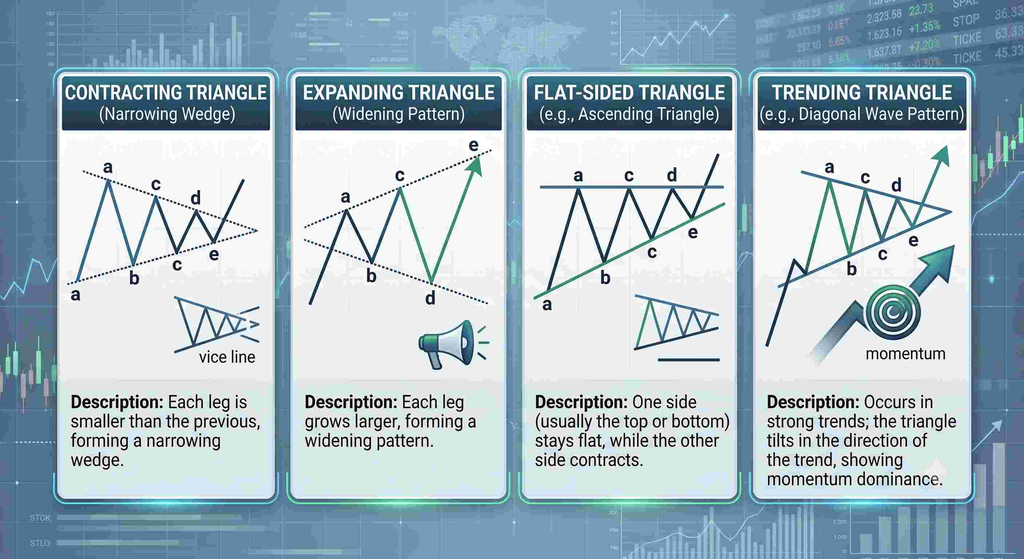
- Types of Triangles:
- Contracting Triangle: Each leg is smaller than the previous, forming a narrowing wedge.
- Example: Price swings shrink from 100 → 80 → 60 → 40 → 20 points.
- Expanding Triangle: Each leg grows larger, forming a widening pattern.
- Example: Price swings expand from 50 → 70 → 90 → 110 → 130 points.
- Barrier Triangle: One side (usually the top or bottom) stays flat, while the other side contracts.
- Running Triangle: Occurs in strong trends; the triangle tilts in the direction of the trend, showing momentum dominance.
- Contracting Triangle: Each leg is smaller than the previous, forming a narrowing wedge.
- The “Thrust” Measurement:
- After a triangle completes, the breakout (thrust) often equals the widest part of the triangle.
- Example: If the widest swing inside the triangle was 200 points, expect a breakout thrust of ~200 points.
👉 Triangles are time‑consuming but powerful — they store energy before a sharp breakout.
📊 Quick Comparison
| Correction | Structure | Psychology | Example |
|---|---|---|---|
| Zigzag | 5‑3‑5 | Sharp, deep retracement | Fast 500‑point drop |
| Flat | 3‑3‑5 | Sideways, time‑consuming | Dip, rally, dip again |
| Triangle | 3‑3‑3‑3‑3 | Consolidation before breakout | Shrinking swings before thrust |
FAQs
Which correction is most common?
Zigzags are the most frequent, especially in Wave 2 positions.
Why do flats frustrate traders?
Because they consume time without major price progress, leading to false breakouts.
How do triangles help traders?
They signal consolidation and allow traders to project the breakout thrust.
Conclusion
The Big Three corrections — zigzags, flats, and triangles — are the backbone of Elliott Wave analysis.
- Zigzags = sharp retracements.
- Flats = sideways frustration.
- Triangles = consolidation before thrust.
“Corrections are the market’s way of catching its breath before the next sprint.”