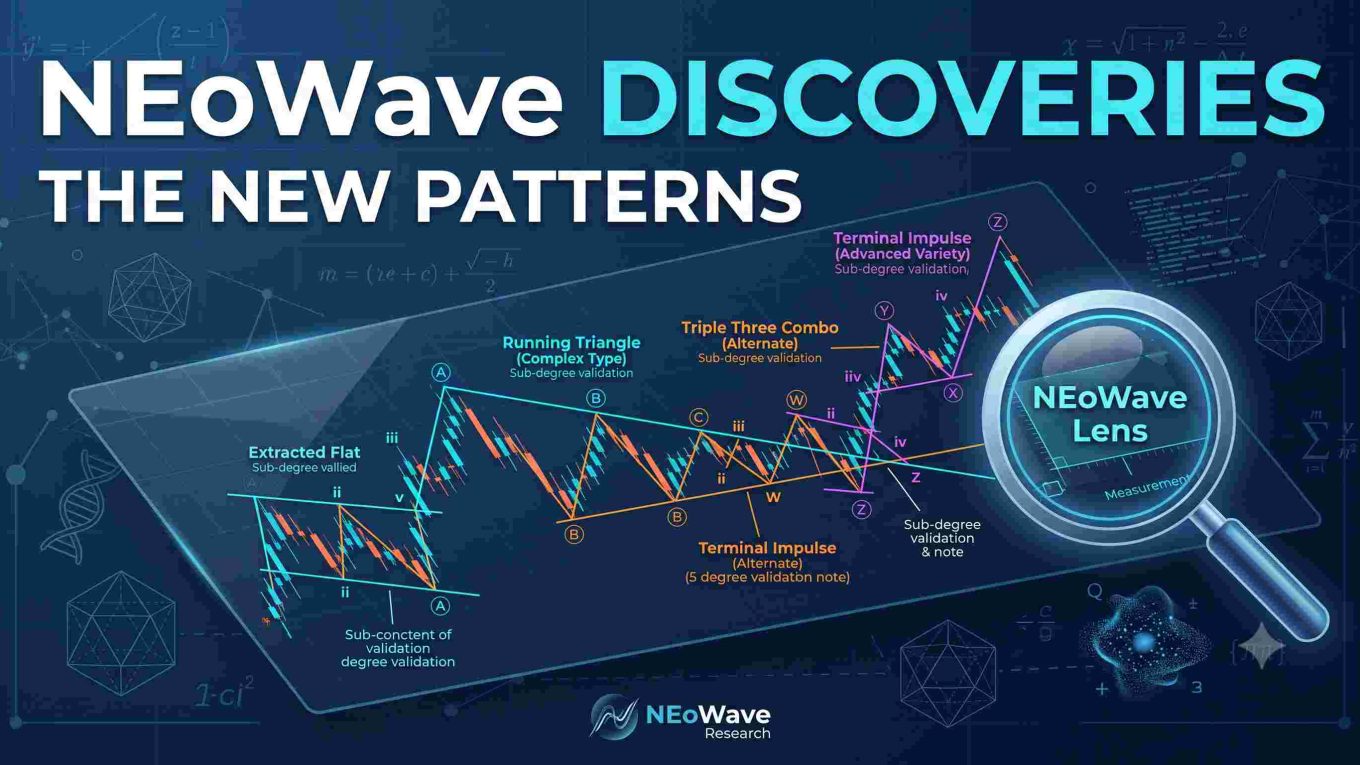
Part 4: NEoWave Discoveries – The New Patterns
This is the stage where NEoWave diverges completely from orthodox Elliott Wave. Glenn Neely introduced entirely new geometric structures to explain modern market behavior, especially the prolonged sideways phases that classical Elliott often struggled to categorize. These discoveries — Diametrics, Symmetricals, Neutral Triangles, and Extracting Triangles — add depth and precision to corrective analysis.
4.1 Diametrics (7‑Legged Structures: a‑b‑c‑d‑e‑f‑g)
- Definition: A diametric is a seven‑legged corrective structure shaped like a diamond. Each leg is labeled a‑b‑c‑d‑e‑f‑g.
- Types:
- Bow‑Tie Diametric: Starts contracting, then expands outward.
- Diamond Diametric: Starts expanding, then contracts inward.
- Key Feature – Time Symmetry: Each leg consumes nearly identical amounts of time, creating balance.
Example: Imagine NIFTY consolidating for seven weeks. Each week produces a swing of similar duration, forming a diamond‑like pattern. The market doesn’t move much in price but consumes significant time.
👉 Diametrics explain why markets sometimes “waste time” in balanced sideways structures before resuming trend.
4.2 Symmetricals (9‑Legged Structures: a‑b‑c‑d‑e‑f‑g‑h‑i)
- Definition: A symmetrical is a nine‑legged corrective structure.
- Characteristics:
- Prolonged sideways consolidation.
- No contraction or expansion — boundaries remain parallel.
- Psychology: Traders feel trapped because price oscillates within parallel lines for a long time.
Example: A stock trades between ₹100 and ₹110 for nine weeks, producing nine swings without breaking out. The boundaries remain parallel, frustrating both bulls and bears.
👉 Symmetricals highlight the market’s ability to consume time without directional progress.
4.3 Neutral Triangles
- Definition: A unique triangle discovered by Neely where Wave C is the longest leg.
- Difference from Classical Triangles:
- In contracting triangles, Wave A is usually longest.
- In expanding triangles, Wave E is longest.
- In neutral triangles, Wave C dominates.
- Implication: This structure signals unusual balance of forces, where the middle leg consumes the most time and price.
Example: A triangle forms in NIFTY where Wave A lasts 3 days, Wave B lasts 4 days, but Wave C stretches to 7 days. The remaining legs (D and E) are shorter.
👉 Neutral triangles emphasize that corrections can bend classical expectations, requiring new rules.
4.4 Extracting Triangles
- Definition: A rare NEoWave triangle with alternating structures and distinct time‑consumption rules.
- Characteristics:
- Each leg alternates in form (zigzag, flat, etc.).
- Time consumption is carefully balanced — no leg dominates excessively.
- Psychology: Extracting triangles reflect markets “pulling energy” from alternating corrective forms before a breakout.
Example: A triangle forms where Wave A is a zigzag, Wave B is a flat, Wave C is another zigzag, and so on. Each leg consumes similar time, creating a balanced but complex sideways structure.
👉 Extracting triangles show how markets can alternate corrective forms while still respecting time symmetry.

📊 Comparison Table
| Pattern | Legs | Boundaries | Key Feature | Example |
|---|---|---|---|---|
| Diametric | 7 | Contracting + expanding | Time symmetry | Diamond‑like sideways consolidation |
| Symmetrical | 9 | Parallel | Prolonged sideways | Stock stuck between ₹100–₹110 |
| Neutral Triangle | 5 | Contracting | Wave C longest | Middle leg dominates |
| Extracting Triangle | 5 | Alternating | Balanced time | Zigzag + flat alternation |
FAQs
Why did Neely create new patterns?
Because classical Elliott couldn’t explain prolonged sideways markets or unusual time balances.
Are Diametrics common?
They are rare but critical when markets form diamond‑like consolidations.
How do symmetricals affect traders?
They trap traders in prolonged sideways ranges, consuming time without price progress.
What makes neutral triangles unique?
Wave C is longest, breaking classical triangle expectations.
Conclusion
NEoWave’s new discoveries — diametrics, symmetricals, neutral triangles, and extracting triangles — represent a leap beyond orthodox Elliott Wave. They explain modern market behavior where corrections consume time more than price and where geometry becomes the key to recognition.
- Diametrics = balanced diamond‑like corrections.
- Symmetricals = prolonged sideways consolidations.
- Neutral triangles = middle leg dominance.
- Extracting triangles = alternating corrective forms with time symmetry.
“Markets don’t just move in price; they move in time. NEoWave’s new patterns capture this truth.”