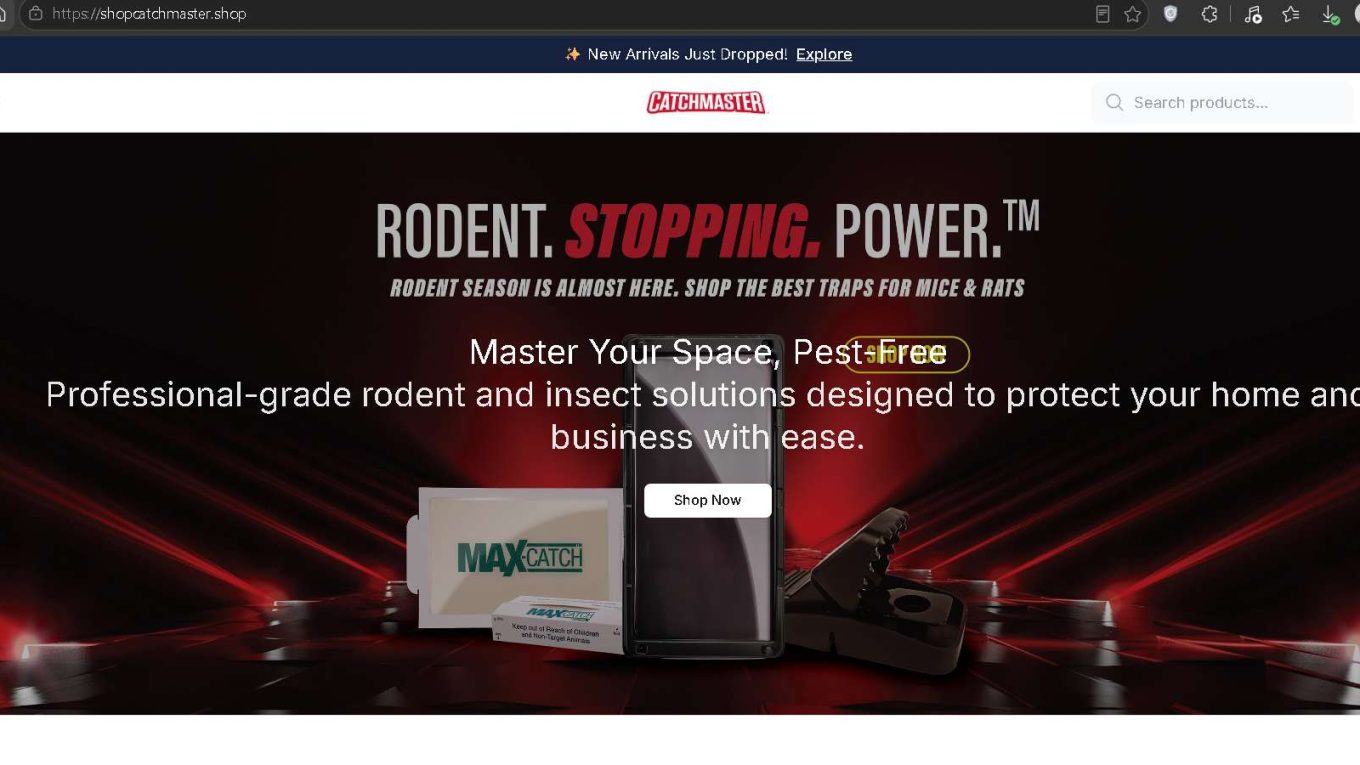
ShopCatchmaster.shop Scam Review – Fake Catchmaster Clone Exposed
Quick Summary: ShopCatchmaster.shop is a fraudulent clone of the real Catchmaster.com, using copied visuals, fake branding, and a deceptive “.shop” domain to trick buyers into paying for non‑existent pest‑control products. It hides ownership, lacks secure payment, and should be avoided entirely. Always shop only at verified Catchmaster.com.
When shoppers search for pest‑control solutions online, they expect reliability, safety, and professional‑grade products. That’s exactly what ShopCatchmaster.shop pretends to offer. The site mimics the branding of the real Catchmaster.com, a respected manufacturer of rodent and insect traps. But behind its polished visuals and familiar logo lies a deceptive trap of its own — a fraudulent clone designed to exploit consumer trust.
The website’s sleek design, bold tagline “Rodent. Stopping. Power.™,” and product images copied from Catchmaster’s legitimate catalog create an illusion of authenticity. Yet, every pixel and promise on this clone site is engineered to mislead buyers into paying for non‑existent products.
The Deceptive Domain Game of ShopCatchmaster
Scammers often rely on subtle domain manipulations to fool unsuspecting customers. In this case, the difference between Catchmaster.com and ShopCatchmaster.shop is just a few letters — but that tiny variation carries massive consequences.
The “.shop” extension is frequently abused by fraudulent operators because it sounds commercial and trustworthy. To the average buyer, “ShopCatchmaster.shop” appears legitimate, even professional. But domain records reveal no verified business registration, no corporate address, and no traceable ownership. The site’s anonymity is its first and loudest alarm bell.
How the Scam Works
The mechanics of ShopCatchmaster.shop follow a familiar pattern seen across hundreds of brand‑impersonation scams:
- Brand cloning — The scammers copy Catchmaster’s logo, slogans, and product photos directly from the official site.
- Fake inventory — They list pest‑control products like “MAXCATCH” and “Rodent Glue Boards” that are never shipped.
- Phishing checkout — Payment forms capture credit‑card and address details without encryption.
- No customer support — The “Contact Us” page either leads to a dead email or a generic form that never receives replies.
- Data harvesting — Collected information is sold or reused for future scams.
Each step is designed to mimic legitimacy while quietly draining victims’ wallets and exposing their personal data.
Red Flags That Expose the Fraud
| Indicator | Description |
|---|---|
| Hidden WHOIS data | The domain registration hides all ownership details — a hallmark of scam sites. |
| No SSL certificate chain | Although the URL shows “https,” the certificate is self‑signed and unverifiable. |
| Unrealistic discounts | Offers like “70% off professional traps” are bait to lure quick purchases. |
| Copied product descriptions | Text lifted word‑for‑word from Catchmaster.com. |
| No verified business address | Only a vague “online store” mention, no physical location. |
| No social‑media presence | Legitimate brands maintain active verified accounts; this clone has none. |
The Risk Spectrum
Victims of ShopCatchmaster.shop face multiple layers of risk:
- Financial loss: Payments vanish without any product delivery.
- Identity theft: Personal details entered during checkout can be reused for phishing or credit‑card fraud.
- Device compromise: Some scam sites inject tracking scripts or malware disguised as “order confirmation.”
- Reputation damage: Businesses that unknowingly link to or promote such sites risk losing customer trust.
Why Catchmaster.com Is the Only Legitimate Source
The authentic Catchmaster brand operates exclusively through Catchmaster.com and verified retailers such as Amazon, Home Depot, and Lowe’s. These platforms provide secure payment gateways, transparent return policies, and verified product authenticity.
In contrast, ShopCatchmaster.shop lacks every hallmark of legitimacy — no verified SSL, no corporate registration, and no traceable customer service. It’s a digital counterfeit designed to exploit the credibility of a trusted name.
The Psychology Behind Brand‑Impersonation Scams
Scammers understand that consumers equate familiarity with safety. When a site looks professional and uses recognizable branding, buyers lower their guard. This psychological shortcut — known as cognitive trust bias — is what ShopCatchmaster.shop weaponizes.
By echoing Catchmaster’s tone, visuals, and slogans, the site bypasses skepticism and triggers impulse buying. Victims believe they’re supporting a known brand, not realizing they’re feeding a fraudulent network.
Technical Breakdown
A deeper look into the site’s infrastructure reveals:
- Server overlap: Hosted on the same IP range as multiple known scam domains.
- No DNSSEC protection: Makes it easier for attackers to spoof or redirect traffic.
- Unverified SSL issuer: Indicates a self‑generated certificate, not one from a trusted authority.
- No structured data markup: Legitimate e‑commerce sites use schema for product visibility; this clone doesn’t.
These technical gaps confirm that ShopCatchmaster.shop is not a professional retail operation but a hastily assembled phishing portal.
Expert Commentary
Cybersecurity analysts note that brand‑impersonation scams have surged by over 300% in the past two years. Pest‑control and home‑maintenance niches are particularly targeted because they attract urgent buyers — people who need quick solutions and rarely double‑check domain authenticity.
ShopCatchmaster.shop fits this pattern perfectly: a polished façade hiding a hollow backend.
Consumer Impact
Victims often report:
- No order confirmation emails.
- Payment deductions without receipts.
- Unresponsive customer support.
- Redirects to unrelated “offer” pages.
These experiences underline the importance of verifying domain authenticity before purchasing.
How to Stay Safe
- Always verify the domain before buying.
- Search for reviews using “[site name] scam” queries.
- Use credit cards with fraud protection instead of debit cards.
- Avoid deals that sound too good to be true.
- Report suspicious sites to the FTC or Cyber Crime Portal India.
Conclusion
ShopCatchmaster.shop is not a legitimate retailer — it’s a digital counterfeit exploiting the reputation of Catchmaster.com. Its copied visuals, fake branding, and deceptive “.shop” domain are designed to mislead buyers into paying for products that don’t exist.
The safest path is simple: trust only verified sources. When it comes to pest‑control products, Catchmaster.com and its authorized retailers are the only genuine options.
“In the digital marketplace, trust is earned through transparency — not imitation.”
✍️ Author Bio
Suyesh Gusain — Scam‑site analyst and consumer‑safety content creator. With a background in Mass Communication, Suyesh specializes in exposing fraudulent e‑commerce clones and educating buyers through structured, SEO‑aligned scam reviews.
FAQs
1. Is ShopCatchmaster.shop a scam site?
Yes. It is a fraudulent clone impersonating Catchmaster.com. The site copies branding, lists fake inventory, and collects payments without delivering products. Buyers risk financial loss and identity theft.
2. Does ShopCatchmaster.shop sell real Catchmaster products?
No. The products displayed are copied from Catchmaster.com but never shipped. The site exists only to harvest payments and personal data. Genuine Catchmaster products are available only at Catchmaster.com and verified retailers.
3. Is ShopCatchmaster.shop safe for US buyers?
No. US buyers face high risks of payment fraud and phishing. The site lacks secure checkout, verified business registration, and customer support. Always purchase pest‑control products from trusted US retailers like Home Depot or Amazon.
4. Can Canadian shoppers trust ShopCatchmaster.shop?
No. Canadian buyers should avoid this domain. It offers fake discounts and unsecured payment methods. The official Catchmaster brand does not operate through ShopCatchmaster.shop.
5. Is ShopCatchmaster.shop a phishing risk for UK customers?
Yes. UK buyers entering card details risk phishing attacks and identity theft. The site’s checkout is unsecured, and personal data may be reused for future scams.
6. Where should Australian buyers purchase Catchmaster products?
Australian buyers should only purchase from Catchmaster.com or verified platforms like Amazon AU. ShopCatchmaster.shop is a fraudulent clone and should be avoided to prevent financial and personal data loss.
Every safe click counts. If this post helped, a coffee gesture fuels more scam‑busting investigations.

Call to Action
Please share this article to spread awareness. Follow us on Facebook, Twitter, and Instagram for more scam alerts. If you doubt the legitimacy of any website or investment plan, DM us on social media — we’ll help you verify.
“Scammers evolve daily. Subscribe to our scam‑alert list and stay one step ahead.”