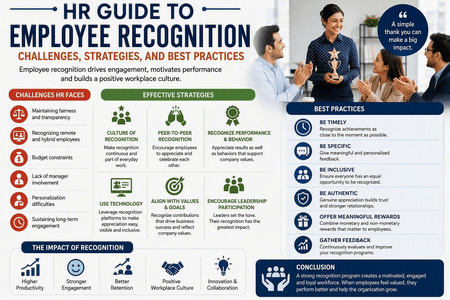
HR Guide to Employee Recognition: Challenges, Strategies, and Best Practices
Introduction
Employee recognition has become one of the most important components of modern Human Resource Management. In today’s competitive job market, organizations are constantly seeking ways to improve employee engagement, boost productivity, and retain top talent. While compensation and benefits remain essential, employees increasingly value appreciation and acknowledgment for their contributions.
Employee recognition refers to the act of appreciating employees for their efforts, achievements, behaviors, and commitment to organizational goals. When employees feel recognized, they are more motivated, engaged, and committed to delivering high-quality work. On the other hand, a lack of appreciation can lead to disengagement, reduced productivity, and higher turnover rates.
However, creating an effective employee recognition program is not always easy. HR professionals often face challenges related to fairness, consistency, budget limitations, and evolving workplace dynamics. This guide explores the importance of employee recognition, the challenges HR teams encounter, and the best strategies for building a successful recognition culture.
Why Employee Recognition Matters
Employee recognition is more than simply thanking employees for their work. It is a strategic tool that directly impacts organizational performance.
A strong recognition culture helps organizations:
- Improve employee engagement
- Increase workplace productivity
- Enhance job satisfaction
- Reduce employee turnover
- Strengthen workplace relationships
- Build a positive organizational culture
- Encourage innovation and collaboration
When employees believe their contributions are valued, they are more likely to go beyond their basic responsibilities and contribute positively to the organization’s success.
Common Challenges HR Faces in Employee Recognition
1. Maintaining Fairness and Transparency
One of the biggest challenges for HR is ensuring recognition programs are fair and unbiased.
Employees may feel demotivated if they believe recognition is influenced by favoritism rather than performance. When the same individuals are repeatedly rewarded, other employees may question the credibility of the program.
Solution: Develop clear criteria for recognition and communicate these standards openly across the organization.
2. Recognizing Hybrid and Remote Employees
The rise of remote and hybrid work models has made employee recognition more complicated.
Employees working from home may have fewer opportunities to interact with managers and colleagues, making their contributions less visible.
Solution: Utilize virtual recognition platforms, digital appreciation programs, and online team meetings to celebrate achievements.
3. Limited Budget Constraints
Not every organization can afford expensive reward programs, bonuses, or incentive schemes.
Many HR departments struggle to balance recognition efforts with budget limitations.
Solution: Focus on meaningful non-monetary recognition such as public appreciation, certificates, leadership mentions, or professional development opportunities.
4. Lack of Manager Involvement
Employee recognition should not be solely an HR responsibility. Managers play a critical role in appreciating their team members.
Unfortunately, some managers fail to prioritize recognition due to workload or lack of training.
Solution: Educate leaders about the business impact of recognition and encourage them to make appreciation part of their management style.
5. Personalization Difficulties
Every employee is unique. What motivates one employee may not motivate another.
Some individuals prefer public recognition, while others value private appreciation.
Solution: Gather employee preferences and offer different recognition methods that cater to diverse workplace needs.
6. Sustaining Long-Term Engagement
Many recognition programs start with enthusiasm but lose momentum over time.
Employees may become less engaged if recognition efforts become repetitive or predictable.
Solution: Continuously refresh recognition initiatives and seek employee feedback to keep programs relevant and impactful.
Effective Employee Recognition Strategies
1. Create a Culture of Continuous Recognition
Recognition should not be reserved for annual performance reviews or special occasions.
Employees appreciate regular acknowledgment of their contributions. Small, consistent acts of recognition often have a greater impact than occasional large rewards.
Organizations should encourage leaders to express appreciation frequently and authentically.
2. Implement Peer-to-Peer Recognition
Recognition does not need to come exclusively from management.
Peer recognition programs empower employees to appreciate each other’s efforts and accomplishments, strengthening workplace relationships and collaboration.
Benefits include:
- Increased teamwork
- Stronger employee connections
- Improved morale
- Enhanced workplace culture
3. Recognize Both Performance and Behavior
Many organizations focus solely on results when recognizing employees. However, recognizing positive workplace behaviors is equally important.
Examples include:
- Team collaboration
- Innovation
- Leadership
- Customer service excellence
- Mentoring colleagues
- Supporting company values
This approach reinforces organizational culture and encourages desirable workplace behaviors.
4. Use Technology for Recognition Programs
Modern HR technology can significantly improve employee recognition efforts.
Recognition platforms help organizations:
- Track employee achievements
- Provide instant feedback
- Encourage peer appreciation
- Analyze recognition trends
Technology also ensures employees working remotely receive equal opportunities for acknowledgment.
5. Align Recognition with Organizational Values
Recognition should support the company’s mission, vision, and values.
When employees are rewarded for behaviors that align with business objectives, they are more likely to repeat those behaviors.
For example, if innovation is a core value, employees who introduce creative solutions should be recognized accordingly.
6. Encourage Leadership Participation
Recognition has a greater impact when it comes from senior leaders.
A simple message of appreciation from an executive can significantly influence employee motivation and commitment.
Leadership involvement demonstrates that employee contributions are valued at every level of the organization.
Best Practices for Successful Employee Recognition
Be Timely
Recognition should occur as close to the achievement as possible.
Immediate acknowledgment reinforces positive behavior and helps employees connect their actions with the recognition they receive.
Be Specific
Generic praise such as “Good job” is often less meaningful than detailed feedback.
Instead, explain exactly why the employee is being recognized.
Example:
“Your efforts in streamlining the customer onboarding process reduced processing time by 20% and significantly improved customer satisfaction.”
Specific recognition makes appreciation more impactful.
Be Inclusive
Every employee should have an equal opportunity to be recognized.
Inclusive recognition programs help prevent feelings of favoritism and ensure all contributions are valued regardless of role, department, or location.
Be Authentic
Employees can easily recognize insincere praise.
Recognition should be genuine, heartfelt, and based on actual accomplishments.
Authentic appreciation builds trust and strengthens employee relationships.
Combine Monetary and Non-Monetary Rewards
While financial rewards can be motivating, many employees value acknowledgment, career growth opportunities, and meaningful appreciation just as much.
Examples of non-monetary recognition include:
- Certificates of achievement
- Public appreciation
- Professional development opportunities
- Flexible work arrangements
- Extra time off
Gather Employee Feedback
Regularly evaluate recognition programs to determine their effectiveness.
Employee surveys and feedback sessions can help HR identify areas for improvement and ensure programs continue to meet employee expectations.
The Future of Employee Recognition
As workplaces continue to evolve, employee recognition programs are becoming more personalized and technology-driven.
Future trends include:
- AI-powered recognition platforms
- Personalized reward experiences
- Real-time feedback systems
- Increased focus on employee well-being
- Recognition programs for remote and global teams
Organizations that embrace these innovations will be better positioned to attract, engage, and retain top talent.
Conclusion
Employee recognition is no longer an optional HR initiative; it is a business necessity. Effective recognition programs increase employee engagement, improve workplace productivity, strengthen company culture, and reduce turnover.
Although HR professionals face challenges such as maintaining fairness, managing remote workforces, and ensuring long-term program effectiveness, these obstacles can be overcome through thoughtful planning and strategic execution.
By implementing consistent recognition practices, leveraging technology, involving leadership, and personalizing appreciation efforts, organizations can create a culture where employees feel valued and motivated to perform at their best.
Ultimately, employee recognition is not just about rewarding achievements. It is about fostering a workplace where people feel respected, empowered, and inspired to contribute to organizational success every day.
Author Bio
Sweta Rawat is an HR professional with over 2.5 years of experience and an MBA in Human Resources. She writes on modern HR practices, employee engagement, and workplace culture, blending professional expertise with creative insight.