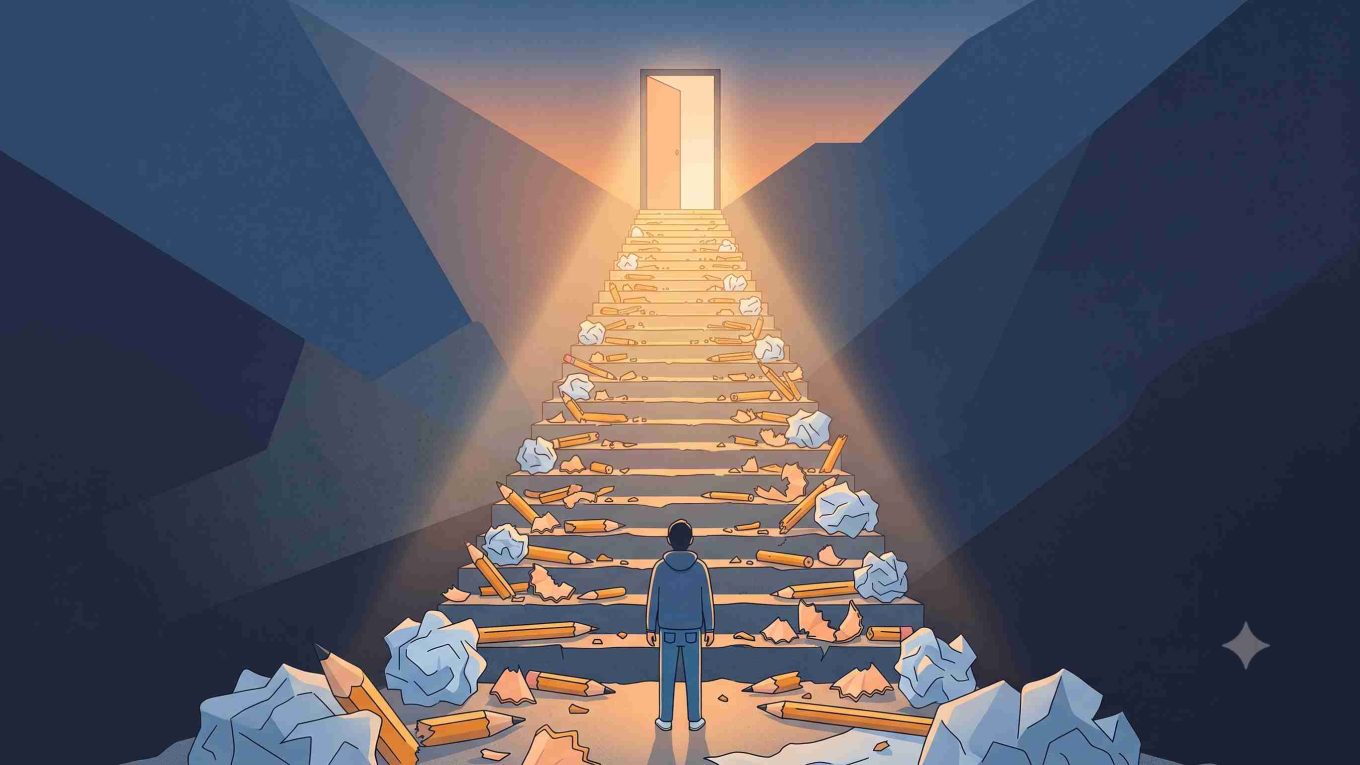
How to Turn Failure Into Success: Lessons From People Who Failed First
A Story About Failing Before Succeeding
Real life stories of failure to success almost always follow the same quiet pattern: the failure comes first, and it doesn’t feel meaningful at the time — it just feels like failure. Rohan failed his first attempt at a government exam he had spent two years preparing for. He didn’t just miss the cutoff — he missed it badly. For weeks, he avoided calls from relatives who kept asking, gently, “so what’s next?” He felt like the two years were erased.
But going back over his mistakes, he realized something uncomfortable: he had never actually practiced writing full-length papers under time pressure. He had memorized content but never tested himself the way the real exam would test him. The failure wasn’t about intelligence — it was about a gap in his preparation he’d never have found any other way.
The next year, he passed. Not because failure “motivated” him in some vague, inspirational way — but because it showed him, specifically, what to fix.
Why Failure Often Comes Before Success
There’s a reason almost every well-known success story has a failure sitting quietly underneath it: failure is often the fastest way to find out what doesn’t work.
Success rarely comes from a straight line of correct decisions. It usually comes from a series of attempts, several of which fail, each one narrowing down what actually works. Failure isn’t the opposite of progress — for most people, it’s a required part of the process, whether they wanted it to be or not.
This doesn’t mean failure feels good, or that anyone should chase it on purpose. It means that when failure happens — and for almost everyone, it eventually does — it can either be treated as proof that something is wrong with the person, or as information about what’s wrong with the approach. Those are two very different conclusions to draw from the same event.
How to Turn Failure Into Motivation Instead of Shutting Down
1. Separate the failure from your identity. Failing at something is not the same as being a failure. This sounds like a small wording difference, but it changes everything about how someone responds afterward. “I failed this attempt” leaves room for a next attempt. “I am a failure” doesn’t.
2. Get specific about what actually went wrong. Vague self-blame (“I’m just not good enough”) doesn’t lead anywhere useful. Specific analysis does. Rohan’s turning point wasn’t feeling motivated — it was realizing exactly one gap in his preparation. Specificity turns failure into a to-do list instead of a verdict.
3. Give yourself a real amount of time to feel bad about it. Trying to skip straight to “lessons learned” without any grieving period usually backfires. It’s normal, and useful, to feel disappointed for a while before analyzing anything.
4. Look for the smallest next attempt, not the perfect comeback. Big comeback stories are usually built from small, unglamorous next steps, not one dramatic turnaround moment.
5. Talk to someone who has failed at the same thing. People who’ve been through the same kind of failure tend to give far more useful perspective than people who haven’t — both on how to fix the specific problem and on how to survive the feeling of it.
Real-Life Pattern: Failure as Data, Not Verdict
Across almost every field — sports, business, academics, the arts — the same pattern repeats. People who eventually succeed usually don’t have fewer failures than people who give up. They often have more. The difference isn’t the number of failures. It’s what each failure was allowed to mean.
Treated as a verdict (“this proves I can’t do this”), failure tends to end the attempt. Treated as data (“this shows me what to change“), failure tends to extend it — sometimes for exactly as many attempts as it takes.
This pattern shows up in well-documented cases, too. It’s widely reported that a young Michael Jordan was left off his high school varsity basketball team before going on to become one of the sport’s greatest players, and that several major publishers rejected the first Harry Potter manuscript before it was accepted. Neither story is about talent appearing overnight — both are about a rejection that got treated as information rather than a final verdict.
What This Doesn’t Mean
This isn’t “fail forward” as an empty slogan, and it isn’t a suggestion that failure is secretly good or something to be grateful for. Some failures are genuinely costly — financially, emotionally, in time that can’t be gotten back — and none of that should be minimized.
It also doesn’t mean every failure leads to eventual success. Some attempts really do end. Some doors really do close. The point isn’t that failure guarantees a comeback — it’s that when a comeback is possible, it’s almost always built out of exactly the information the failure provided.
Frequently Asked Questions
How do you turn failure into success?
By separating the failed attempt from your sense of self-worth, getting specific about what went wrong, and using that information to make one small, concrete next attempt rather than trying to fix everything at once.
Why is failure important for How to deal with continuous problems in life? – WISDOM GANGA?
Failure often reveals gaps or mistakes that would be difficult to identify any other way. Most successful outcomes are built on a series of attempts, several of which failed first and narrowed down what actually works.
How long should you grieve a failure before moving on?
There’s no fixed timeline, and trying to skip the disappointment entirely usually backfires. Most people benefit from allowing themselves a genuine period to feel upset before analyzing what went wrong.
Does everyone who fails eventually succeed?
No. Not every failure leads to a comeback, and some attempts genuinely end. The value of treating failure as information is that it makes a future comeback possible when circumstances allow — not that it guarantees one.
Coming Back to Rohan
Rohan still remembers exactly how it felt to see his failed result — the specific silence in the house that evening. He doesn’t describe that year as a gift. But he’s also clear that he wouldn’t have passed the second time without exactly that failure showing him what to change. The failure and the success aren’t separate stories. The second was built directly out of the first.