
The Gambler’s Fallacy vs. Regression to the Mean: The Probability Trap
By Suyesh Gusain (B.Sc. Physics Hons., NISM Certified Research Analyst & Equity Derivatives)
Disclaimer: This article is strictly for educational and analytical purposes. It does not constitute financial, investment, or trading advice.
On August 18, 1913, at the Casino de Monte-Carlo, a roulette ball landed on black. Then it landed on black again. And again.
By the time the streak reached fifteen consecutive blacks, a frenzy swept across the gaming floor. Bettors piled millions of francs onto red, convinced that the laws of nature demanded an immediate correction. Surely, after fifteen blacks, red was “due.”
The ball landed on black nineteen times. Then twenty-two. It finally stopped on black on the 26th spin. The casino walked away with a historic fortune, leaving behind bankrupt players who had fallen victim to one of the most persistent cognitive traps in human psychology: the Gambler’s Fallacy.
To understand why smart people lose fortunes to streaks, we must dissect the difference between independent probabilistic events and true statistical regression to the mean.
The Illusion of Memory: Gambler’s Fallacy
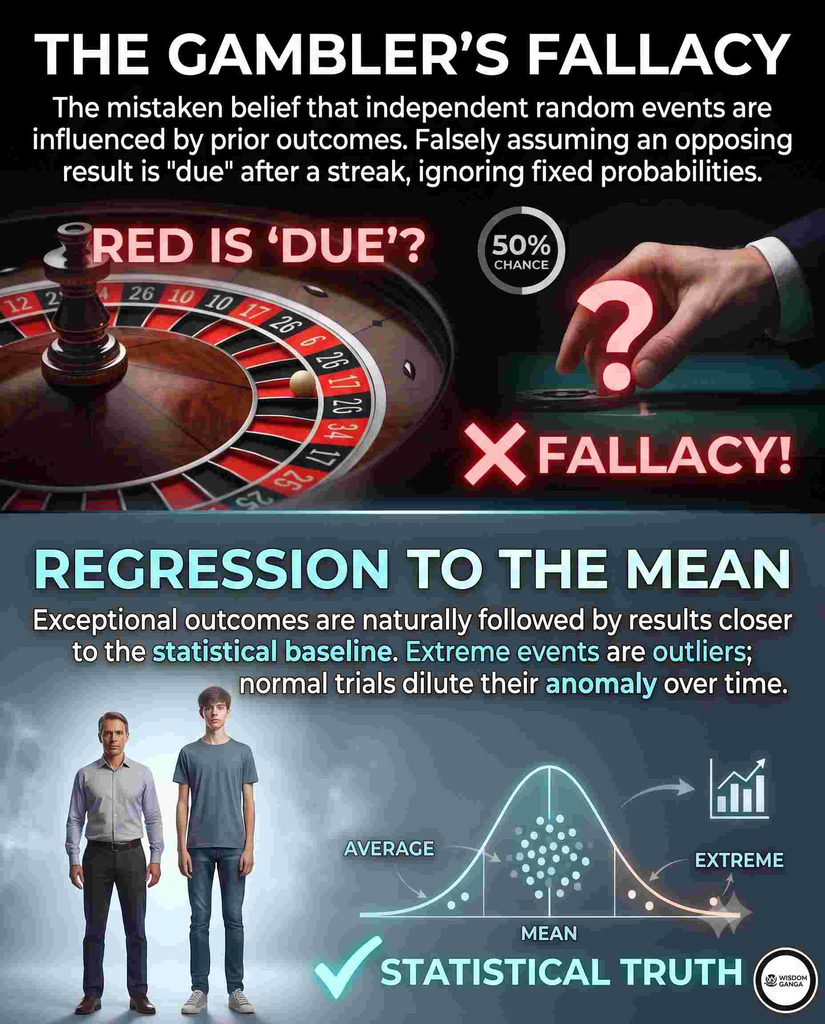
The Gambler’s Fallacy rests on a simple cognitive error: the belief that past events alter the probability of future random events in a memoryless system.
A standard roulette wheel, a fair coin, and a pair of dice have no memory. They possess no consciousness, no scorecards, and no sense of equilibrium.
When a fair coin lands on heads five times in a row, the probability of the sixth flip landing on heads is still precisely:
P(Heads) = 0.50 (50%)
The sequence H-H-H-H-H-T is no more or less likely than H-H-H-H-H-H. Each trial is governed by statistical independence, where:
P(A ∩ B) = P(A) × P(B)
Human intuition revolts against this reality because our brains evolved to recognize patterns and self-correcting mechanisms in nature. If you stretch a rubber band, physical tension builds until it snaps back. When we watch a streak of red numbers or consecutive losses, we intuitively project that physical tension onto the system, assuming a “snap back” is inevitable.
In pure probability, there is no tension. There is only the next trial.
Enter Regression to the Mean: When Numbers Actually “Correct”
If random streaks do not correct themselves, why does everyone talk about mean reversion?
The answer lies in Regression to the Mean, a statistical phenomenon first identified by Sir Francis Galton in 1886. Galton observed that extremely tall parents tended to have children who were shorter than them, closer to the population average, while exceptionally short parents had taller offspring.
Regression to the mean states that extreme measurements are naturally followed by results closer to the statistical average.
The critical distinction is mechanism:
- The Gambler’s Fallacy assumes an active, compensatory force balances past extremes (e.g., “We had 5 tails, so the coin must produce more heads now to balance out”).
- Regression to the Mean relies on no compensation at all. The extreme event was simply an outlier heavily influenced by transient variance or luck. Subsequent events merely reflect standard, baseline probabilities, which naturally dilute the anomaly over time.
Comparing the Mechanics
| Attribute | Gambler’s Fallacy | Regression to the Mean |
| System Type | Independent, memoryless trials (coins, dice, roulette) | Correlated trials influenced by underlying skill/parameters |
| Underlying Driver | Cognitive bias expecting future compensation | Mathematical dilution of non-replicable variance (luck) |
| Future Expectation | Opposing outcome is “due” | Future outcome simply reverts toward the true baseline |
| Common Arena | Casinos, lottery picks, naive betting systems | Sports performance, corporate earnings, trading returns |
The Danger in Trading and Risk Management
Confusing these two concepts creates severe vulnerabilities in financial decision-making.
1. Catching Falling Knives
A trader sees a stock decline for nine consecutive sessions and buys aggressively because “it cannot drop ten days in a row.” This is the Gambler’s Fallacy applied to markets. Market regimes are not static coin flips; downward streaks often reflect fundamental deteriorations or liquidity dislocations. The asset has no obligation to rebound simply because it fell yesterday.
2. Misjudging Outlier Performance
An investment manager records a phenomenal 80% return in a single volatile year. Allocators flood the fund with capital, anticipating repeat performance. Within two years, the returns plummet back to the broad market benchmark.
The initial outperformance was not pure alpha; it was extreme positive variance. Over a larger sample size, performance regressed to the manager’s true statistical average.
Takeaway
Nature does not balance random trials through moral obligation or physical momentum. Streaks do not create overdue outcomes—they merely produce noise.
Surviving in uncertain environments requires recognizing that while statistical averages dilute extremes over time, the current trial remains completely indifferent to what happened on the last.
To see how probabilistic frameworks shape decision-making under uncertainty, explore our deep dives:
Frequently Asked Questions (FAQ)
What is the difference between the Gambler’s Fallacy and the Law of Large Numbers?
The Law of Large Numbers states that as the number of trials approaches infinity, the observed average will converge toward the expected mathematical probability. The Gambler’s Fallacy misinterprets this by believing the convergence happens over a small sample size through active correction of past deviations. In reality, large samples dilute past variance rather than reversing it.
What is the “Hot Hand” Fallacy?
The Hot Hand Fallacy is the mirror inverse of the Gambler’s Fallacy. While the Gambler’s Fallacy assumes a streak must end, the Hot Hand Fallacy assumes that because an individual has experienced success in several trials, they are “hot” and more likely to continue succeeding, even when the underlying process is governed by randomness.
How does regression to the mean affect trading systems?
In quantitative trading, strategies that rely on mean reversion identify price excursions that deviate significantly from historical distributions. However, regression to the mean only functions when the underlying asset’s structural baseline remains stable. If the underlying asset experiences a permanent regime shift, expecting mean reversion can lead to compounding losses.
Why do people confuse the Monte Carlo fallacy with mean reversion in financial markets?
The Monte Carlo fallacy (the Gambler’s Fallacy) occurs when investors mistakenly treat asset prices like memoryless coin flips, believing a prolonged losing streak must reverse simply because “it is due.”
In contrast, legitimate mean reversion in financial markets relies on economic equilibrium mechanisms—such as valuation multiples, supply-demand adjustments, or corporate balance sheets—pulling anomalous prices back toward an underlying fundamental baseline.
Confusing the two leads traders to average down on structurally broken assets whose baseline has permanently shifted rather than temporarily drifted.
How can quantitative traders avoid the Gambler’s Fallacy during drawdowns?
Quantitative traders avoid the Gambler’s Fallacy by maintaining strict adherence to probabilistic trade sizing and sample size validation rather than altering bets based on recent sequence outcomes.
Instead of assuming a losing streak makes a winning trade imminent and increasing leverage (martingale sizing), systematic traders verify that their current drawdown fits within the historical Monte Carlo distribution of their strategy’s edge, preserving fixed-fractional or Kelly allocations to prevent emotional overexposure.
Author Bio
Suyesh Gusain is an analytical researcher and digital publisher specializing in algorithmic systems, data verification, and digital media ethics. Holding degrees in Physics (B.Sc. Hons) and Mass Communication (M.A.), Suyesh bridges the gap between rigorous mathematical analysis and accessible consumer education. His work centers on decoding complex algorithmic architectures, statistical probability, and digital integrity for modern audiences.
Please share your thoughts on this article in the comments below. If you found it helpful, make sure to share it with others and follow Wisdom Ganga on social media for more updates!