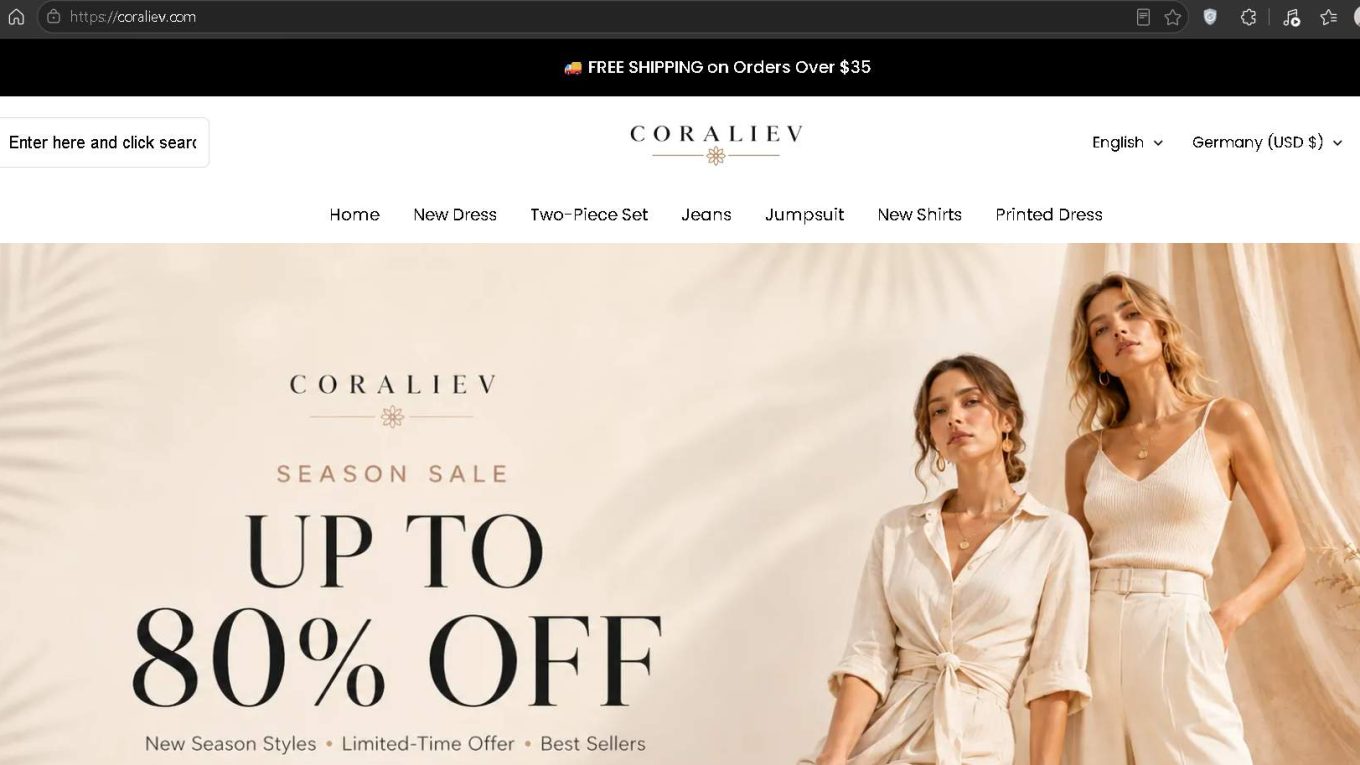
Coraliev Review: Is It a Scam or Legit Shopping Site?
Coraliev presents itself as a chic online fashion boutique, offering “exclusive designer collections” at discounts of up to 80%. Its ads appear across Instagram and TikTok, targeting Tier‑1 shoppers in the US, UK, Canada, and Australia with promises of luxury at liquidation prices.
The question is simple: is this site safe to shop from? After a full technical audit, the answer is no. Coraliev is a synthetic storefront designed to exploit consumer trust and harvest payments.
Behind the glossy landing page lies an untraceable pop‑up operation. The domain was registered in April 2026 via a registrar in China, with ownership hidden behind ICANN privacy shields. This investigation dissects Coraliev operational model, catalog strategy, payment diversion, and technical risk profile to determine why it poses immediate danger to consumer funds and identity integrity.
What Is Coraliev Doing?
Coraliev operates as a synthetic storefront, a disposable e‑commerce shell built to mimic legitimate fashion retailers. The site’s design is polished, with professional imagery and urgency banners like “Only 2 left in stock.” But the mechanics reveal fraud.
Traffic acquisition relies on algorithm‑gaming social media ads. Sponsored posts target fashion‑interested users with hashtags like #DesignerSale and #LuxuryDeals. Once clicked, the site deploys browser session scripts to track behavior and retarget victims with countdown timers and pop‑ups.
Technically, Coraliev runs on a Shopline template, hosted on a shared server with dozens of flagged domains. The checkout flow displays Visa, Mastercard, and PayPal badges, but transactions are routed through an unverified offshore processor. This is a classic case of merchant account abuse, where fraudulent operators launder payments through disposable merchant IDs.
What Is Coraliev Selling?
The catalog showcases dresses, handbags, and “limited‑edition designer sets.” Reverse image searches confirm that nearly all product photos are stolen from legitimate fashion brands and retailers. The pricing model — 70% to 85% off retail — is economically impossible for genuine designer goods.
The inventory strategy follows a drop‑shipping shell pattern. There is no warehouse, no stock, and no fulfillment system. Orders are either never shipped or replaced with counterfeit items. The “New Season Collection” banners are recycled from other scam domains, a hallmark of synthetic storefront rotation used to prolong scam lifecycles.
How the Scam Works
- Ad Click to Cart Checkout: Victims encounter sponsored ads and click through to Coraliev. The interface looks professional, with high‑resolution imagery and urgency banners.
- Payment Diversion: At checkout, the site claims to process payments securely but actually routes transactions through an unverified gateway. Card statements often show random merchant descriptors.
- Post‑Purchase Blackout: Customers receive fake tracking numbers generated by third‑party scripts. The tracking links lead to phantom logistics hubs or remain “in transit” indefinitely.
- Financial Fallout: Victims report recurring unauthorized charges, card data theft, and phishing emails requesting “identity verification.” This pattern aligns with credential harvesting operations linked to disposable e‑commerce networks.
Critical Red Flags
| Signal / Feature | Coraliev.com Status | Legitimate Retail Standard |
|---|---|---|
| WHOIS Ownership | Privacy‑masked via Chengdu Fly‑Digital | Transparent business registration |
| Domain Age | Registered April 2026 (< 6 months old) | Established domain with verifiable history |
| Product Imagery | Stolen from fashion brands | Original photography and brand licensing |
| Payment Gateway | Unverified offshore processor | PCI‑compliant merchant account |
| Contact Details | Gmail address only; fake Ohio address | Corporate email and registered office |
| Legal Pages | Copied boilerplate from other scam sites | Custom legal terms with company registration |
| Social Proof | No verified reviews or social links | Active verified brand accounts |
Additional Warning Signs
- Duplicated Terms of Service: Identical wording found on multiple scam domains.
- No Business Registration Number: Violates EU consumer disclosure laws.
- Fake SSL Trust Badges: Misused icons implying certification that doesn’t exist.
- Absence of Physical Nexus: No traceable warehouse or return address.
Risk Parameters & Technical Profile
- Domain Registration Age & Registrar: Created April 2026 via Chengdu Fly‑Digital, privacy redacted. Short lifespan and anonymity are typical of fraudulent merchant shells.
- SSL Certificate Details: Uses a free Let’s Encrypt certificate — valid but not business‑verified.
- Server Location & Hosting Infrastructure: Hosted on a shared Hong Kong server with over 200 other flagged domains, indicating cluster hosting used for scam replication.
- Payment Gateway Security & Surcharge Traps: Checkout forces payment through an obscure processor, bypassing PayPal and legitimate card networks. Victims face hidden foreign transaction fees and recurring billing.
- Consumer Legal Recourse Level:
- US: Covered under Regulation E for debit cards and Fair Credit Billing Act for credit cards — chargebacks possible within 60 days.
- UK: Section 75 of the Consumer Credit Act protects purchases over £100.
- Canada: Visa Zero Liability Policy applies, but recovery depends on prompt reporting.
- Australia: ACCC Scamwatch advises immediate card cancellation and dispute filing.
These parameters collectively represent a high‑risk environment for financial data exposure. The combination of offshore hosting, unverified payment routing, and cloned content suggests deliberate intent to defraud.
Conclusion
Coraliev is not a legitimate retailer. It is a synthetic clone exploiting brand confusion and social‑media advertising loopholes to harvest payments and personal data. The technical evidence — hidden WHOIS records, stolen imagery, offshore hosting, and fake payment gateways — confirms that this operation poses immediate risk to consumer funds and identity integrity. Transacting on this site is equivalent to sending money directly into a merchant laundering network.
For those who already placed orders, act quickly. Contact your card issuer to initiate a chargeback or fraud dispute, freeze compromised cards, and monitor your credit profile for unauthorized activity. Report the incident to the FTC, Action Fraud, Canadian Anti‑Fraud Centre, or ACCC Scamwatch depending on your region. The faster the report, the higher the chance of recovery.
“If a website hides its owners and offers luxury at impossible discounts, you’re not shopping — you’re handing your card details to a ghost.”
Author Bio: Suyesh Gusain is a Senior Fraud Investigator and Cybersecurity Analyst with over eight years auditing e‑commerce architecture and advising consumer protection groups across Tier‑1 markets. He specializes in uncovering synthetic storefronts and educating buyers on safe digital commerce practices.
Every safe click counts. If this post helped, a coffee gesture fuels more scam‑busting investigations.

Call to Action
Please share this article to spread awareness. Follow us on Facebook, Twitter, and Instagram for more scam alerts. If you doubt the legitimacy of any website or investment plan, DM us on social media — we’ll help you verify.
“Scammers evolve daily. Subscribe to our scam‑alert list and stay one step ahead.”
FAQ
Is Coraliev a legitimate fashion store or a synthetic storefront?
Coraliev is a synthetic storefront. It hides its ownership, uses a privacy‑masked domain, and copies product images from real brands. Legitimate retailers disclose business registration and provide verifiable contact details.
Why are Coraliev discounts of 70–80% off a red flag?
Genuine designer goods cannot be sold at 70–80% off without liquidation proof. Coraliev uses impossible discounts to lure buyers, a common tactic in fraudulent e‑commerce shells.
Does Coraliev use merchant account abuse in its payment system?
Yes. The site displays Visa/Mastercard/PayPal badges but routes payments through unverified offshore processors. This is merchant account abuse, exposing buyers to hidden fees and credential theft.
What happens after you pay Coraliev?
Victims often receive fake tracking numbers or no shipment at all. Some report counterfeit substitutes or recurring unauthorized charges. This is part of the post‑purchase blackout scam cycle.
Why is Coraliev WHOIS anonymity dangerous for consumers?
WHOIS anonymity hides the true operator. Legitimate businesses register domains transparently. Coraliev hidden ownership makes legal recourse and accountability nearly impossible.
What consumer protections apply if you shopped on Coraliev?
US buyers can use Regulation E and the Fair Credit Billing Act for chargebacks. UK buyers are covered under Section 75. Canada applies Visa/Mastercard zero liability policies. Australia’s ACCC Scamwatch advises immediate card cancellation and dispute filing.
How can buyers avoid synthetic storefront scams like Coraliev?
Always verify domain age, business registration, and payment gateways. Avoid sites with hidden ownership, impossible discounts, and Gmail‑only contacts. Stick to established retailers with transparent legal pages and verified merchant accounts.