Is Zenbril Scam? Technical Audit of the Cloned Drop-Shipping Shell
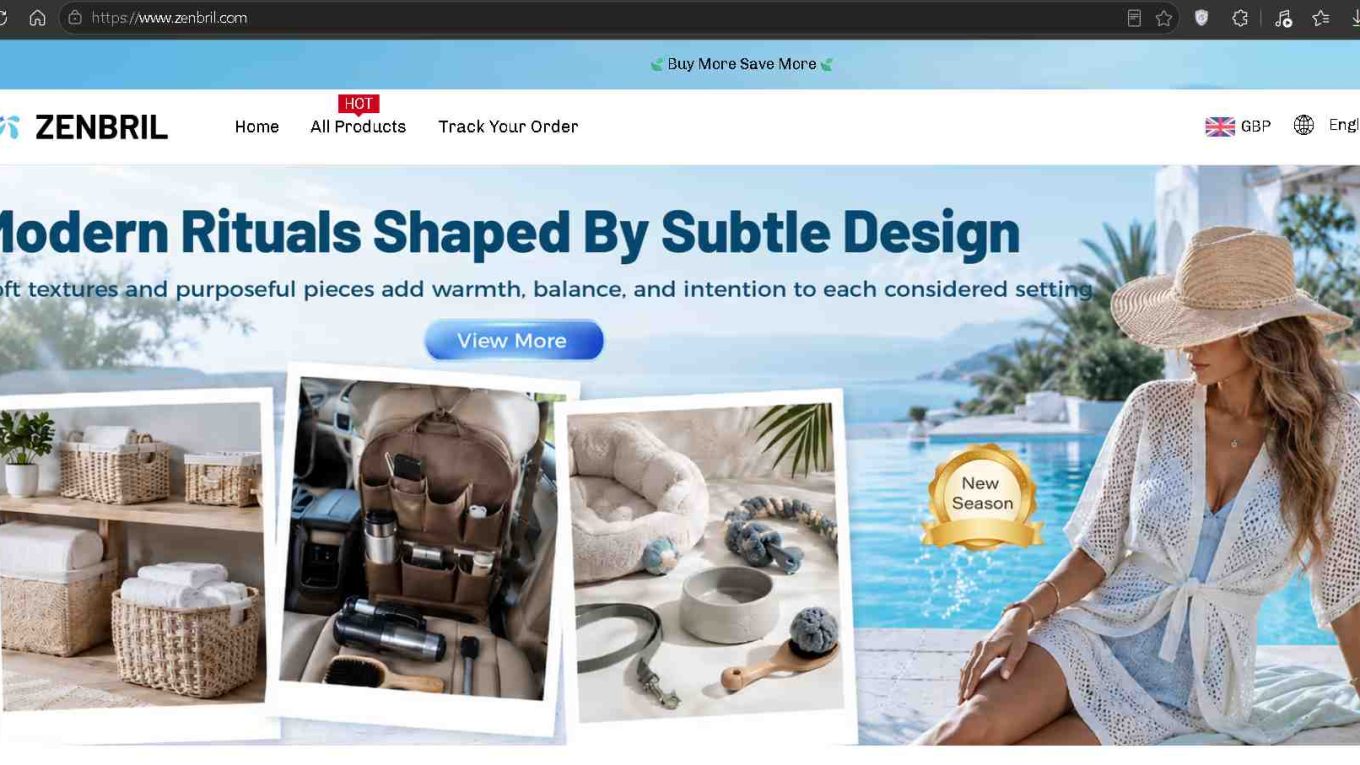
Zenbril markets itself to online shoppers as an upscale lifestyle and design boutique centered on modern living. Targeting consumers across the United States, the United Kingdom, Canada, and Australia, the storefront uses serene imagery of luxury poolside villas and promotes concepts like “Modern Rituals Shaped By Subtle Design.”
The site pairs this high-end aesthetic with aggressive multi-buy incentives, such as floating “Buy More Save More” banners and multi-item bundle discounts. Beneath the polished promotional exterior, the actual catalog reveals a disorganized collection of unrelated goods.
Despite advertising secure payment processing via major credit cards, this platform operates as an untrusted drop-shipping shell. It is fundamentally unsafe for regular retail transactions.
Our forensic investigation indicates that Zenbril functions as a synthetic storefront designed to capture consumer transactions while drop-shipping low-grade factory items or failing fulfillment entirely. The platform conceals its true operational origins behind anonymized domain registrations and fails to provide verifiable corporate credentials.
It populates its storefront with scraped multimedia collateral and generic e-commerce templates. This technical audit analyzes the site’s network infrastructure, breaks down the merchant billing diversion mechanisms, and provides direct chargeback guidance for consumers under international banking protections.
What Is Zenbril Doing?
Zenbril operates as an ephemeral drop-shipping shell built to divert consumer payments and harvest personally identifiable information (PII). The operators acquire incoming traffic primarily by purchasing programmatic social media placements on algorithmic networks such as Meta platforms (Facebook and Instagram), TikTok, and Pinterest.
These sponsored campaigns showcase problem-solving household gadgets or automotive accessories, framing them as exclusive designer innovations at clearance rates.
When a shopper visits the site, the platform executes a session within a templated storefront architecture. It uses dynamic currency switchers (displaying prices in GBP, USD, or EUR), real-time order tracking plugins, and floating cart drawers to mimic an enterprise brand. Behind this front, the storefront lacks authentic commercial infrastructure.
It maintains no domestic distribution facilities or dedicated logistics agreements in Western consumer markets. Its operational model relies on capturing retail-level markups and routing unvetted transactions through high-risk payment aggregators before negative chargeback thresholds trigger domain abandonment.
What Is Zenbril Selling?
The digital catalog displays an incoherent mix of merchandise that directly contradicts its luxury design branding. While the primary banner copy highlights “purposeful pieces” and “soft textures,” clicking into the inventory reveals generic white-label products imported from bulk overseas clearinghouses:
- Automotive Accessories: Backseat leather organizers, car gap storage pockets, skull headlight covers, and anti-glare visor extenders.
- Kitchen & Household Gadgets: Rapid meat-thawing defroster trays, silicone stretch lids, handheld plastic bag heat sealers, and plastic spice racks.
- Pet Supplies & Novelties: Hanging door bouncing mouse toys, pet paw cleaners, and plush circular dog cushions.
- Storage & Home Organization: Woven rope laundry hampers and multi-tier shoe racks.
This inventory profile is economically unfeasible for an authentic, independent lifestyle house. Legitimate design studios do not curate automotive skull headlamps alongside kitchen thaw plates and cat toys under a single brand.
The items are sold at inflated prices compared to identical wholesale listings on Chinese direct-to-consumer platforms (such as AliExpress or 1688), with the platform using scraped factory photography and video loops without original licensing.
How the Scam Works
The operational lifecycle follows a four-stage extraction process:
- Ad Click to Cart Checkout: Shoppers encounter sponsored advertisements highlighting problem-solving gadgets. Clicking the link routes the buyer to an optimized product landing page that automatically applies tiered volume discounts (such as “Buy 2 Save 15%” or “Buy 3 Save 20%”) to increase the average order value.
- The Payment Diversion: During checkout, the customer submits their full name, home address, and card details. Although the site displays familiar Visa, Mastercard, and PayPal badges, transactions often route through unvetted third-party merchant aggregators. Bank statements frequently display ambiguous corporate billing descriptors or foreign corporate shells rather than a verifiable entity matching the Zenbril domain.
- The Post-Purchase Blackout: Once payments settle, consumers face logistics issues. The platform issues automated tracking numbers tied to opaque cross-border freight consolidators. Packages routinely experience multi-week delays. When parcels do arrive, consumers frequently report receiving low-value, substandard imitations made from cheap plastic or synthetic fabrics that bear little resemblance to the professional photos on the website.
- The Refund and Store Credit Trap: When disappointed buyers request returns, customer service representatives hide behind evasive policy clauses. The platform frequently refuses to provide domestic return labels, demanding that the consumer pay international shipping fees back to an overseas warehouse—costs that often exceed the item’s purchase price. Alternatively, they offer useless store credit notes or fractional refunds of 10% to 20%, stalling until statutory bank dispute deadlines lapse.
Critical Red Flags
| Signal / Feature | Zenbril.com Status | Legitimate Retail Standard |
| Catalog Coherence | Disjointed mix (car accessories, kitchen thaw trays, cat toys) | Curated inventory matching a defined retail niche |
| Corporate Transparency | Zero corporate registration, tax ID, or physical address | Registered corporate entity with verifiable physical headquarters |
| Policy Documentation | Broken template text missing designated data controller fields | Legally vetted Terms of Service compliant with GDPR and CCPA |
| Customer Support | Single unverified email address (cs@zenbril.com) | Multi-channel support (direct telephone, live chat, postal address) |
| Return Structure | Restrictive return barriers, overseas shipping, or credit traps | Clear 30-day cash refund policy with domestic return processing |
- Broken Privacy Boilerplate: The site’s legal documentation features unfinished placeholder text, directing users to “contact our at zenbril.com” without naming a Data Protection Officer or business entity.
- WHOIS Registry Shielding: Registry records show the domain uses commercial proxy masking to conceal the registrant’s name, corporate entity, and true geographic location.
- Absence of a Physical Nexus: The site lists no physical corporate headquarters, warehouse address, or telephone support line anywhere across its pages.
Risk Parameters & Technical Profile
- Domain Registration Age & Registrar: Registered anonymously through a commercial registrar utilizing WHOIS privacy masking to prevent identification of the operating entity.
- SSL Certificate Configuration: Employs a basic Domain Validated (DV) certificate. This validates session encryption between client and server but offers zero background vetting of the business entity operating the website.
- Hosting Infrastructure: Deployed on distributed cloud servers behind reverse-proxy firewalls, masking origin server IP addresses and slowing administrative takedowns.
- Payment Gateway Security: Operates without standard enterprise direct-gateway merchant agreements. Payment routing relies on third-party merchant account aggregators, exposing users to unauthorized billing descriptors and potential subscription rebills.
- Consumer Legal Recourse Level: Operates with zero corporate presence within US, UK, Canadian, or Australian regulatory jurisdictions, leaving consumers with zero domestic legal recourse in small claims courts.
These technical indicators confirm a high-risk profile for consumer capital. Submitting payment card details to this platform exposes banking data to unauthorized processing channels and potential card-not-present (CNP) fraud.
Conclusion
Zenbril displays all the hallmarks of an untrustworthy drop-shipping shell and synthetic retail storefront. Its disconnect between luxury lifestyle branding and cheap dropshipped gadgets, combined with anonymized registry details and evasive return policies, confirms that it operates well outside standard commercial consumer standards.
Ordering from this site puts consumer funds at serious risk of non-delivery or receipt of substandard goods.
If you have already placed an order on Zenbril, take immediate defensive financial steps. Contact your credit card issuer or bank to report the transaction as merchant fraud and request a card cancellation and replacement.
Initiate an administrative chargeback citing non-delivery or merchandise not as described under Regulation E, the Fair Credit Billing Act (FCBA), or UK Section 75 consumer protections. Decline any offers of store credit, and monitor your accounts for unauthorized secondary charges.
“A glossy homepage cannot disguise an incoherent catalog; when a storefront pairs luxury lifestyle imagery with generic bulk gadgets and an anonymous support inbox, you are looking at a drop-shipping shell designed to keep your cash.”
👉 For more shady sites exposed, check our Shopping Scam Directory — your quick guide to staying safe online.
Every safe click counts. If this post helped, a coffee gesture fuels more scam‑busting investigations.

Call to Action
Please share this article to spread awareness. Follow us on Facebook, Twitter, and Instagram for more scam alerts. If you doubt the legitimacy of any website or investment plan, DM us on social media — we’ll help you verify.
“Scammers evolve daily. Subscribe to our scam‑alert list and stay one step ahead.”