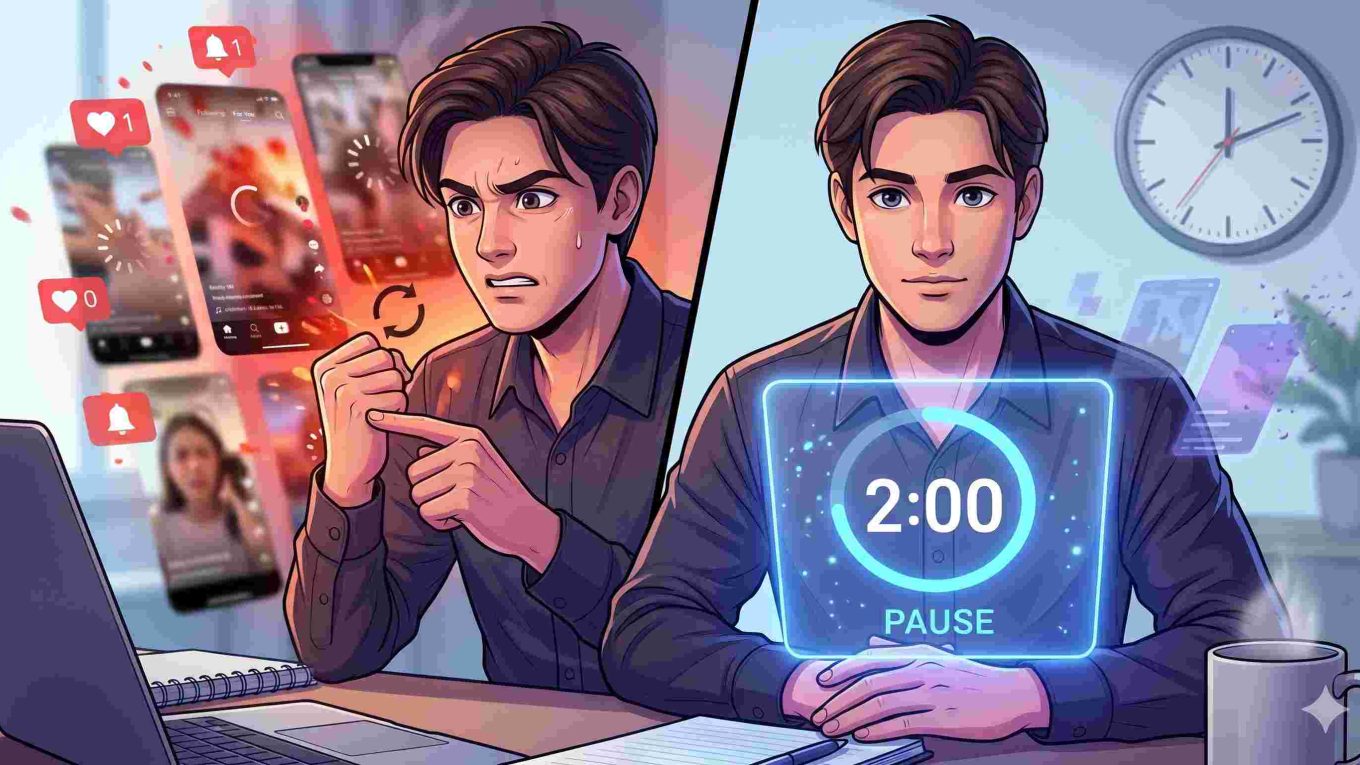
Why You Lose Your Patience So Fast (And the 2-Minute Habit to Fix It)
“Why” is always a tricky question to answer. And understanding the reason behind losing patience is even trickier—perhaps the trickiest of all. Lately, I found myself spending most of my time scrolling through reels, until I finally realized how deeply this habit was playing with my mind.
It seems everyone is on edge these days. The relentless short-video format heavily influences our shrinking attention spans. However, we cannot use this as an excuse to lose patience. The root of the problem is internal, yet we constantly focus outward. We tend to stigmatize struggles related to the mind. The reality, however, is much more nuanced: not everyone is going through a clinical mental health crisis; rather, we all just navigate our own varying degrees of mental turbulence.
We often view meditation as the ultimate medicine to cure mental problems, but this is where we miscalculate. Meditation is a preventive measure. It works highly effectively when we practice it during calm periods, but during bad times, our minds are simply too unstable, rendering forced meditation a futile effort.
When we fail to control ourselves and beat ourselves up over a loss of patience, we mistakenly label it a moral failing, a sign of weak character, or just a bad mood. Even those who seemingly possess ironclad willpower often rely on external crutches—like a drink or two during the week—just to temporarily stabilize their minds.
In truth, impatience is a conditioned neurological reflex. By understanding this—and recognizing exactly why the brain demands instant feedback—we can implement a simple 2-minute habit to regain our mental discipline. We can apply this technique to stop making impulsive decisions and, ultimately, take our power back.
The Neuroscience of “Now” (Why Your Brain Snaps)
To fix anything, we must first understand its root cause. The same applies to impatience. What is the actual machinery behind losing patience? Today, we live in an incredibly fast-paced world, but the human mind did not evolve for this level of constant stimulation. It is like forcing a 5G connection through a 2G mobile phone: the hardware simply cannot handle the bandwidth, and the system crashes.
The technological ecosystem built around us is designed to deliver instant rewards. From fast food to same-day delivery, the craving to complete tasks in record time has become our baseline normal. Technology was originally developed to simplify our lives and give us more free time to spend with family, friends, and, most importantly, ourselves. Yet, from where I stand, it has failed many of us. Instead of reclaiming our time, we surrender it right back to our screens.
Every time you click a button, swipe a screen, or order a package, you get an immediate result. This creates a powerful dopamine feedback loop, effectively eliminating the natural friction between an action and its result. Because of this, when a reward or response is delayed, your brain registers the pause as a literal “error.”
We subconsciously sense that the system is broken. Conditioned for instant gratification, the brain perceives this delay as a threat, triggering a mild “fight or flight” response. In this state, the body releases cortisol (the stress hormone). Your heart rate increases slightly, fueling a sense of anxiety that rapidly escalates into losing your patience.
What is truly fascinating—and unsettling—is what happens next. The explosive act of losing your temper often triggers a twisted release of dopamine. I believe this is why so many people feel a fleeting sense of relief or power after shouting or snapping at others. It is a sad way of living, but it is the reality we are currently facing.
The Hidden Costs of a Short Fuse
Just as every action has a reaction, there is a steep price we pay for our impatience.
- Destruction of Long-Term Strategy: The inability to tolerate waiting leads to forced, impulsive actions. When you cannot wait for the right setup in business, the right timing in a conversation, or the full picture of a problem, you abandon solid strategies for the sake of just doing something. Action feels better than waiting, even if it is the wrong action.
- The Erosion of Analytical Focus: Impatience creates artificial time pressure. This narrows your mental perspective, leading to poor risk assessment and careless mistakes.
- The Burnout Factor: Living in a state of chronic urgency is exhausting. It drains your mental bandwidth, leaving you burned out before the real, meaningful work of the day even begins.
The Core Solution: The 2-Minute Habit
The outer world is out of our control, but our inner world can be managed. It is hard to change a habit instantly, as the desire for “instant” results is the very root of the problem. Therefore, we need a deliberate method, and one of the most effective is the 120-second pause.
Here is how to execute it:
- Identify the Trigger: Pay attention to your body. Notice the physical signs of impatience—a tight chest, a hovering finger over a mouse, rapid breathing, or the urge to interrupt someone speaking.
- Step Back: Physically break the circuit. Remove your hands from the keyboard, put your phone face down on the table, or take a literal step back from whatever you are doing.
- Hold the Line: Set a mental (or literal) timer for two minutes. Do absolutely nothing but observe the urge. Breathe normally. Let the discomfort wash over you without acting on it.
Why it Works: In neuroscience, the amygdala is your reactive, emotional brain, while the prefrontal cortex is your logical, disciplined brain. When you are triggered, the amygdala takes over. A two-minute delay acts as a circuit breaker; it is just enough time for your prefrontal cortex to come back online, process the situation logically, and override your emotional impulse.
Building “Patience Stamina” in the Real World
Patience is a muscle. Like every muscle, it is built over time. However, it cannot be developed in the heat of frustration, impatience, or an argument. Character is not built during a crisis; it is simply executed. Your patience stamina is improved by actively embracing the micro-frictions of daily life.
- Practice in Low-Stakes Environments: The next time you are stuck in a long checkout line, do not pull out your phone to distract yourself. Stand there. When you get a notification, wait two minutes before opening it. These small acts of resistance build the mental discipline required for high-stress situations.
- Reframe the Wait: Impatience stems from the narrative that you are being delayed or held back. Shift your internal script from “I am stuck waiting” to “I am actively observing.” Waiting is not passive; it is an active state of gathering information, regulating your nervous system, and maintaining your composure.
The Ultimate Form of Self-Control
Self-control generally correlates with willpower. It is not easy, but it is certainly not impossible. Life moves fast, but we need to slow down. Our brains simply cannot match this relentless momentum, which creates anxiety and mental health problems.
From personal experience, I can vouch that mental health is the most critical foundation; everything else comes second. Therefore, the more time you spend cultivating a healthy mind, the simpler and more peaceful your life will become.
You can practice patience everywhere by bringing awareness to your actions. Most people lack the patience to wait in line—use that exact time to improve yours. It might seem like a small shift, but it will profoundly improve your personal relationships.
Be happy! Be wise!
Over to You: We are all navigating this fast-paced world together, and building patience is a shared journey. I would love to hear your perspective. What is the one daily friction that instantly triggers your impatience, and how do you usually handle it? Drop a comment below and share your feedback—let’s keep this conversation going!