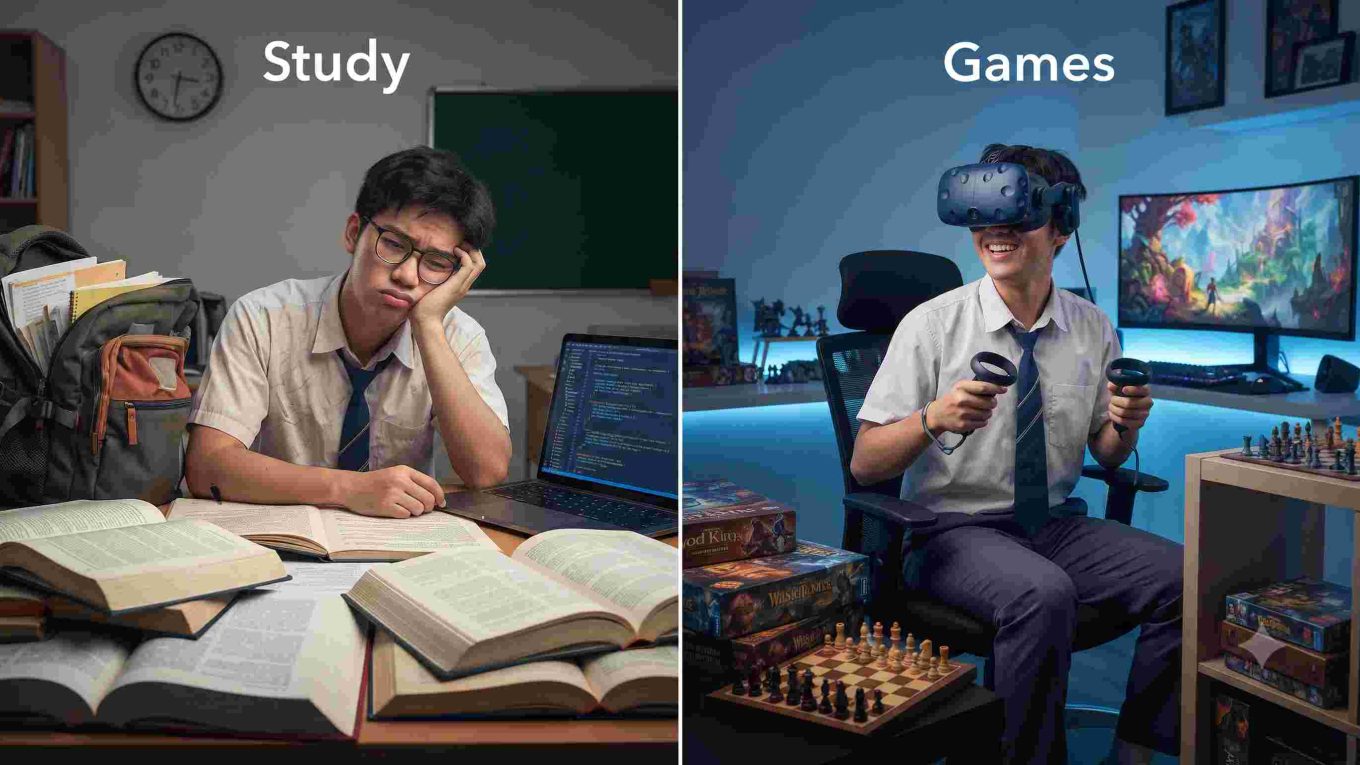
Why Learning Feels Boring Instead of Playful Like Games
Who is a teacher? The simple answer is someone who teaches in a school, college, or tuition center. But is that truly the right definition? I remember my mother telling us that in her school days, students who took private tuition were often scolded by their schoolteachers.
In our time, however, life took a 180-degree turn; now, teachers often scold students who don’t take their private tuition, especially when the school teacher and the tuition tutor are the same person.
The Business of Grades
A good friend of mine once told me that he earned good marks simply because he joined his school teacher’s private coaching. It is the easiest and most effective way to secure high marks on a report card, which is exactly what parents and society demand.
Consequently, it isn’t about a teacher’s morality anymore, but rather the business of supply and demand. Parents and society focus almost exclusively on whether a child secures high grades, never questioning what they actually learned in the process.
Marks, which should be a metric for knowledge, have become nothing more than a tool to test a student’s memory. Throughout my entire life, I never encountered a teacher whom I could truly approach with questions—not just about the subject, but about the deeper thoughts and ideas that interested me.
It happens to almost everyone, but most of the time, students don’t ask questions for two main reasons: first, they haven’t studied the subject, and second, they fear that the teacher or their peers will make fun of them. Nobody wants to become a laughingstock.
The True Purpose of Teaching
It isn’t that every teacher was bad, but they often failed to do what a teacher truly should. In my opinion, a teacher’s main job is not just to deliver the curriculum, but to make the student curious about it. First and foremost, we must understand why students generally hate studying and why we can’t make learning as fun as playing cricket. It all comes down to a lack of curiosity.
When I was in school, I never liked history, geography, or social science; those subjects felt subjective and boring. The teachers knew what to teach, but they never knew how to teach it. In school, teachers taught to finish the syllabus, and students studied simply to get marks. Everything was being done “by the book,” but it was leading us in the wrong direction.
A teacher’s job is not to force students to memorize a course, but to help them understand the subject. When a student truly understands, learning becomes playful. From my experience, finding the right teacher at the right time is one of life’s greatest fortunes.
गुरू गोविन्द दोऊ खड़े, काके लागूं पांय। बलिहारी गुरू आपने, गोविन्द दियो बताय॥ “Both the Guru and Govind (God) are standing before me. Whom should I bow to first?” “I bow to my Guru first, for he is the one who showed me the path to God (Govind).”
Above is the Doha of famous Indian Philosopher ‘Kabir Das’. He has explained very beautifully in single life, who is the teacher. The teacher is the one who showed the path towards God. The main point of understanding here is ‘Showed the path’. Any person who showed you the path towards the betterment in your life, is your teacher.
The Struggles of Language and Assessment
For many students from average schools, English was always a challenge. We were never taught the fundamentals; instead, we solved “fill-in-the-blank” exercises based on how the words sounded together rather than on actual grammar. Surprisingly, we were right 60% of the time, simply because language naturally tends to flow smoothly.
Similarly, our assessment system is flawed. We took weekly unit tests and major exams twice a year, resulting in a hierarchy of “good,” “average,” and “poor” students. Yet, in all my years, I never saw a teacher use that data to help a student identify their scope for improvement or explain where they needed to put in more effort.
The PTM Ritual and the Identity Struggle
Parent-Teacher Meetings (PTMs) rarely focus on academic growth; they are battles of identity. Parents want to hear only positive things about their children, students want to avoid complaints to keep their parents happy, and teachers simply want the meeting to end so they can go home. Nobody is truly concerned about actual learning.
Furthermore, in our society, teaching is often viewed as a “convenient” job for women, not because of their passion for education, but because the school day ends early, allowing them to manage their households. I have even witnessed teachers knitting sweaters during class time rather than preparing lessons. While people find these stories funny, it is a serious issue. Students no longer respect teachers because they see teaching as a mechanical job that the teachers are mandated to perform.
The Missing “Ras” (Essence)
Because of this, finding a good teacher is difficult, and fewer people aspire to join the profession. The present society has stopped celebrating the teacher profession. Earlier people were aspired to become teacher because the society used to give celebrity treatment to the teachers.
It was also true that at that time teaching was not a business but service towards society. The time education transformed from service to business, teacher as profession lost its respect and become a position for a job.
Education has become mechanical, and the “Ras”—the flavor, essence, or joy—is missing from our studies. Students today may score higher marks, often crossing the 90% bracket, but they lack a sense of “life” itself.
We are essentially creating robots for multinational corporations. I was shocked when my nephew, only in the 8th grade, spoke about participating in various activities just to build a “portfolio” for future college admissions and job prospects. He is already stressed about his life four years from now.
I wanted to tell him not to be so serious; he should enjoy his youth and live spontaneously while he has no real responsibilities. The world changes so fast that his current planning might be irrelevant by the time he grows up. It is disturbing to see students taking the question, “Where do you see yourself in five years?” so seriously at such a young age.
Summary
The modern education system has shifted its focus from deep understanding to superficial success. By treating education as a business, schools have traded curiosity for a pursuit of grades. This mechanical approach strips the “Ras” (the essence and joy) from learning, leaving students well-prepared for corporate requirements but ill-equipped to live a meaningful, present-focused life.
Real education should spark curiosity and foster understanding, helping students grow as human beings rather than just building portfolios for a distant, uncertain future.
Note: this article is not to target teachers for not performing, the whole idea is that teachers are not working as a ‘Compass’ anymore. There may be many reasons, and system failure is one of them. Above points are just my opinion, if anybody has anything to say, either good or bad, please share it in the comment box.