Vintimewatch Under the Lens: Why a ‘Vintage Watch’ URL Is Peddling Disposable Menswear
Shoppers scrolling past sponsored social media feeds in the US, UK, Canada, and Australia are increasingly bumping into an odd retail setup called Vintimewatch. The site pitches casual men’s linen shirts, neutral hoodies, and minimalist street apparel at deeply marked-down rates, promising friction-free international fulfillment.
The surface looks like a sleek direct-to-consumer boutique eager to clear out warehouse excess. If you are wondering whether Vintimewatch is a trustworthy retail business or a payment trap designed to capture card data, the answer is unequivocal: it is unsafe, unauthorized, and shows every hallmark of a disposable retail fraud shell.
The website is a textbook synthetic storefront engineered to exploit hasty impulse buys. Beneath the polished product catalog lies a stark technical mismatch: an old or discarded watch-themed domain hastily re-skinned with apparel imagery ripped from legitimate fashion labels.
This audit breaks down the server infrastructure, domain records, checkout paths, and fulfillment mechanics behind Vintimewatch so consumers can protect their funds before authorizing a transaction.
What Is Vintimewatch Doing?
Vintimewatch operates as an ephemeral e-commerce node. Its operators rely on automated campaign tools across platforms like Facebook, Instagram, and TikTok to funnel cheap mobile clicks directly into unvetted product pages. The goal is simple: capture browsing traffic, push a false sense of scarcity, and rush visitors through a checkout funnel before they spot the irregularities.
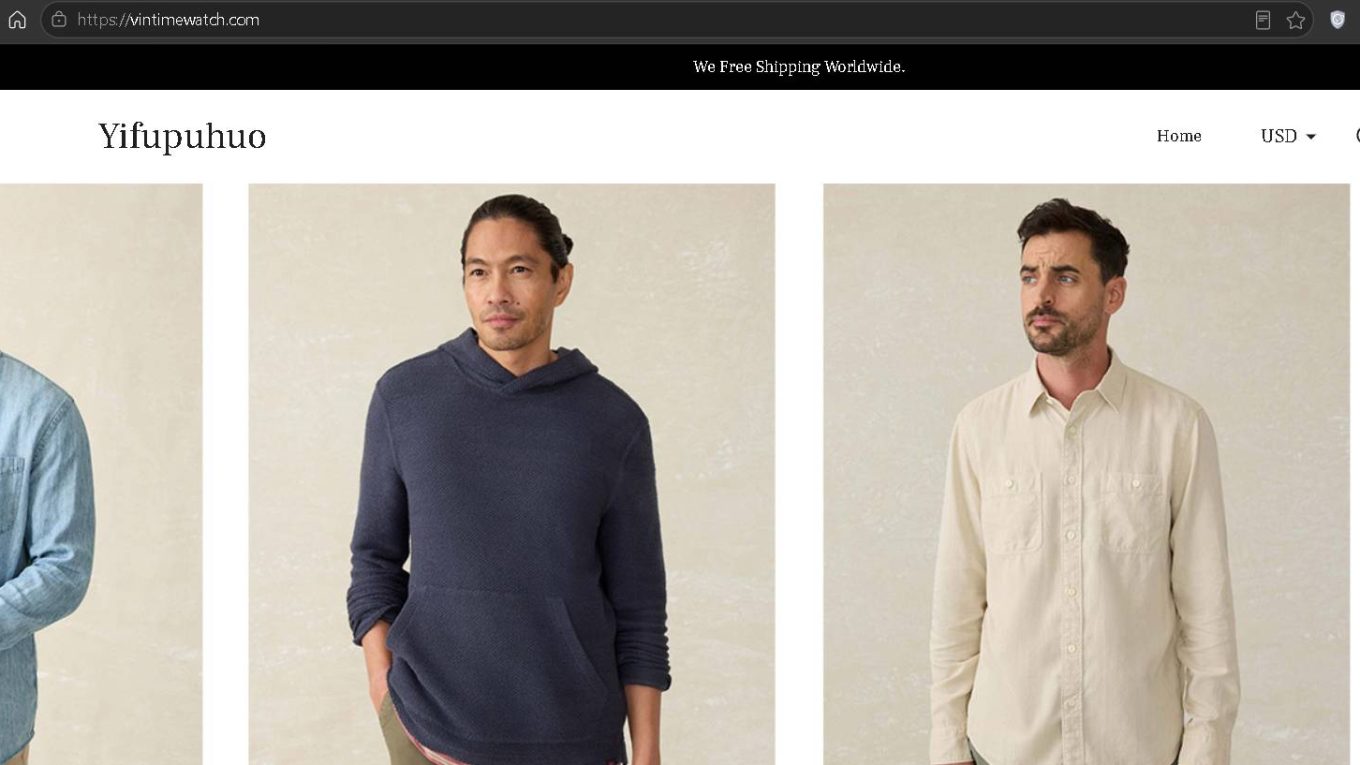
The site is built on a templated web setup that mimics modern e-commerce storefronts. However, the operational execution is messy. The headline domain name claims an association with watches, yet the page header openly displays the brand name “Yifupuhuo”—a common moniker linked to mass-produced catalog syndicates.
Broken English phrases like “We Free Shipping Worldwide” sit right at the top banner. These telltale technical glitches appear because threat actors deploy automated site builders that clone layouts in bulk without cleaning up placeholder content.
What Vintimewatch Selling?
The catalog on Vintimewatch features an assortment of men’s casual basics: washed chambray button-downs, slub hoodies, and lightweight linen tops. The visuals show clean, contemporary styling with models posed against neutral studio backdrops.
None of this inventory belongs to the operators of Vintimewatch. A quick reverse image search confirms that these assets are scraped directly from established Western apparel brands and catalog photo libraries. The site advertises these garments at massive markdowns—often 70% to 80% below typical retail values.
This pricing model is economically unviable. Manufacturing high-grade linen, packaging it, and offering free airmail shipping across the globe for twenty to thirty dollars per unit guarantees a net loss for any legitimate business. The impossibly cheap price tag exists solely as bait to extract credit card numbers.
How the Scam Works
The operational lifecycle of a synthetic storefront follows a precise, four-stage playbook designed to extract funds and minimize merchant chargeback exposure:
- Ad Click to Cart Checkout: Victims arrive via algorithmically targeted social media promotions highlighting blowout seasonal sales. The catalog pages display fake customer review counts and automated countdown timers that simulate running out of stock, prodding the customer to check out instantly.
- Payment Diversion: When the shopper enters checkout, the payment path routes through an unvetted third-party processing account or a detached merchant gateway shell. The checkout software captures full name, billing address, phone number, and complete card details (primary account number, expiration date, and CVV).
- The Post-Purchase Blackout: Once payment clears, the customer receives an automated confirmation receipt featuring a bogus order number. Days later, if any tracking information is provided at all, it points to a phantom logistics aggregator or generates a spoofed tracking code from an untraceable cross-border carrier. Weeks later, the buyer receives either nothing at all or a low-value token item—such as cheap polyester socks or a piece of foam—shipped to register a delivery confirmation with tracking services.
- The Financial Fallout: The primary financial hit is the loss of the original checkout amount. Worse, the customer’s exposed payment credentials are often compromised. Fraud rings routinely cycle stolen card profiles through micro-billing schemes, offshore unauthorized charges, or dark-web reselling networks weeks after the initial checkout.
Critical Red Flags
A close comparison between Vintimewatch and recognized retail compliance baselines reveals glaring vulnerabilities across every operational pillar.
| Evaluation Metric | Vintimewatch Status | Legitimate E-Commerce Standard |
|---|---|---|
| Domain-to-Brand Alignment | Watch-themed domain hosting “Yifupuhuo” apparel | Exact match between corporate identity and domain |
| WHOIS Registry Age | Weeks old; registrant identity completely hidden | Multi-year corporate registration with public contacts |
| Product Imagery | Scraped stock assets from external brand catalogs | Original, proprietary photography with model releases |
| Merchant Legal Nexus | No physical street address or verified legal entity | Verifiable registered office, company number, and jurisdiction |
| Site Grammar & Quality Control | Broken syntax (“We Free Shipping Worldwide”) | Clean, vetted professional copy across all templates |
| Customer Support Channels | Free webmail address or dead submission form | Dedicated business support desk, phone lines, and ticketing |
- Zero Corporate Footprint: The platform offers no verifiable business entity registration, corporate identification number, or physical facility address in any commercial registry.
- Recycled Template Architecture: The website relies on stock design templates previously tied to short-lived dropshipping shells and unverified merchant storefronts.
- Unmonitored Communication Lines: Inquiries sent to the provided customer service emails either bounce back as undeliverable or yield automated replies designed to stall until the merchant account moves offshore.
Risk Parameters & Technical Profile
- Domain Registration Age & Registrar: Registered in late August 2026 via Dynadot. The domain’s WHOIS records use full privacy proxies to conceal the real owners and geographic origin, a standard evasion tactic for throwaway storefronts.
- SSL Certificate Details: Uses a basic, automated Domain Validated (DV) SSL certificate issued through a free automated authority. It lacks any Extended Validation (EV) or Organization Validation (OV) that confirms corporate legitimacy.
- Server Location & Hosting Infrastructure: Hosted on offshore infrastructure routed through Alibaba Cloud routing nodes. These network hubs host clusters of similarly unverified e-commerce websites and rapid-turnover retail templates.
- Payment Gateway Security & Traps: The platform routes payments through transient gateway bridges rather than direct, verified corporate acquirers. This setup increases the risk of credit card skimming or recurring secondary charges without cardholder consent.
- Consumer Legal Recourse: Extremely low. Because the merchant operates outside the jurisdiction of Western regulators, consumers cannot resolve disputes via regular local legal routes. Relief depends entirely on private banking disputes.
These combined technical flags represent a critical risk to consumer finances. Placing an order on this infrastructure exposes buyers to direct loss of funds, unauthorized card usage, and potential identity theft.
Conclusion
Vintimewatch is an unauthorized apparel storefront masquerading as a retail outlet on a disconnected, repurposed domain name. Its stripped-down corporate data, stolen product visuals, and broken on-page text point directly to an untraceable drop-shipping shell designed to pocket card payments while providing no real consumer protections. Spending money on this website will lead to unfulfilled orders, worthless substitution deliveries, or hijacked payment details.
If you have already submitted your payment information on Vintimewatch, act immediately. Contact your credit card issuer or bank fraud division to challenge the transaction as fraudulent under Regulation E (for US debit accounts), the Fair Credit Billing Act, or Section 75 of the UK Consumer Credit Act. Instruct your bank to cancel the compromised card number and issue a replacement with a new CVV to stop secondary recurring charges. Finally, pull your credit reports to monitor for any unfamiliar credit checks or unauthorized balance changes.
End Quote
“When an online store’s domain name claims to sell watches but its catalog is full of discount linen shirts, you aren’t looking at a liquidation bargain—you are looking at a shell game designed to take your money.”
Author Bio
Written by an investigator specializing in digital financial crime, e-commerce architecture audits, and international consumer fraud patterns. With more than eight years of field research dissecting payment abuse networks, the author works closely with consumer defense advocates to dismantle malicious retail operations across Western banking corridors.
For more shady sites exposed, check our Shopping Scam Directory — your quick guide to staying safe online.
Every safe click counts. If this post helped, a coffee gesture fuels more scam‑busting investigations.

Call to Action
Please share this article to spread awareness. Follow us on Facebook, Twitter, and Instagram for more scam alerts. If you doubt the legitimacy of any website or investment plan, DM us on social media — we’ll help you verify.