
The Ultimate Guide to the Closing Auction Session (CAS): Mechanics, Strategies, and Market Impact
Key Takeaway: Effective August 3, 2026, the Securities and Exchange Board of India (SEBI), alongside the National Stock Exchange (NSE) and Bombay Stock Exchange (BSE), permanently transitioned the cash market closing price mechanism for all Futures & Options (F&O) stocks from a 30-minute Volume-Weighted Average Price (VWAP) calculation to a dedicated
Closing Auction Session (CAS). This structural evolution halts continuous equity trading at 3:15 PM, pools end-of-day orders into a dark matching engine to find a single maximum-volume Equilibrium Price at 3:35 PM, and extends derivatives (F&O) trading to 3:40 PM. This comprehensive guide breaks down the financial engineering, mathematical algorithms, global benchmarks, and tactical trading frameworks required to master the CAS environment.
Section 1: The Structural Evolution of Market Closings
To understand why SEBI implemented the Closing Auction Session in August 2026, market participants must examine the structural flaws inherent in previous market closing mechanisms. The official daily closing price is not merely a summary metric on a charting software; it is the fundamental financial benchmark used to settle trillions of rupees in derivative contracts, calculate Net Asset Values (NAV) for mutual funds and ETFs, evaluate margin requirements, and benchmark portfolio performance globally.
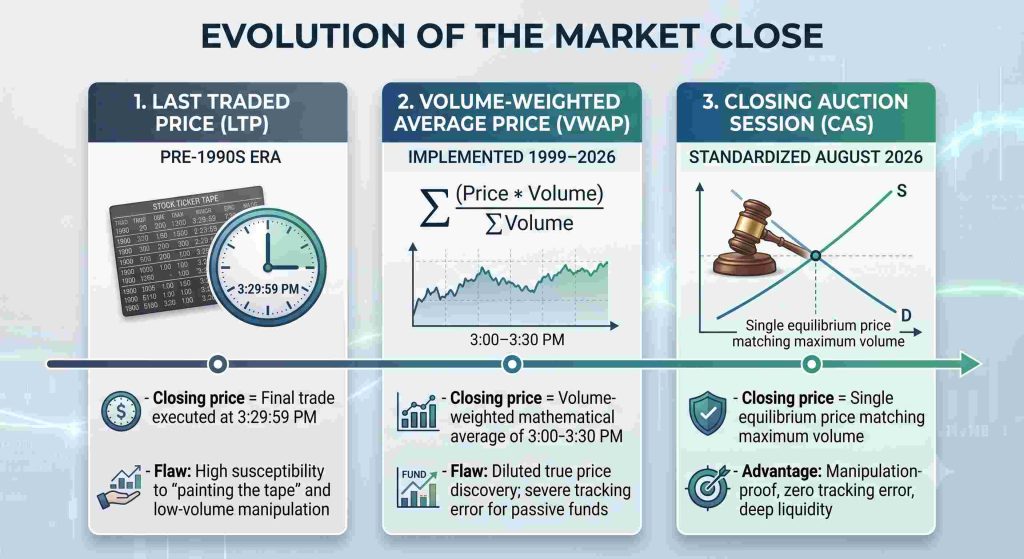
The Era of “Painting the Tape” (Last Traded Price)
In the early days of electronic stock exchanges, the closing price was simply the Last Traded Price (LTP) recorded right before the market closed. This created a massive incentive for predatory market participants to engage in an abusive practice known as “painting the tape.”
A trader could hold a massive long position in a stock or derivative contract and place a series of aggressive, small-lot buy orders above market value at 3:29:59 PM. Because the exchange used the final tick as the official close, that tiny transaction artificially inflated the asset’s closing value, manipulating portfolio valuations and derivatives settlements.
The Stopgap Measure: 30-Minute VWAP (1999–2026)
To neutralize single-tick manipulation, exchanges introduced the 30-minute Volume-Weighted Average Price (VWAP) calculation. Under this formula, the official closing price ($P_{close}$) was calculated using the sum of all trade values divided by the total volume transacted between 3:00 PM and 3:30 PM:
Closing Price Formula
What it means in plain words:
- Take every trade that happens between 3:00 PM and 3:30 PM.
- For each trade, multiply the price () by the volume ().
- Add all those values together.
- Then divide by the total volume of all trades in that period.
Simple Example:
- Trade 1: Price = 100, Volume = 50 →
- Trade 2: Price = 102, Volume = 30 →
- Trade 3: Price = 98, Volume = 20 →
Total = 5000 + 3060 + 1960 = 10,020 Total Volume = 50 + 30 + 20 = 100
So the closing price is 100.2.
Why the VWAP System Failed Modern Capital Markets
While the 30-minute VWAP successfully prevented single-tick price manipulation, the explosive growth of passive index funds, algorithmic execution desks, and institutional exchange-traded funds (ETFs) exposed critical operational flaws in the VWAP model:
- Dilution of True Sentiment: If major macroeconomic news or corporate announcements broke at 3:25 PM, aggressive buying pressure would push the spot price significantly higher. However, because the VWAP formula mathematically averaged those higher prices with the lower prices from 3:00 PM to 3:24 PM, the final published closing price lagged far behind true market reality.
- Tracking Error for Index Funds: Passive mutual funds and ETFs are mandated to replicate indices like the Nifty 50 or Bank Nifty by buying or selling underlying assets at the exact official close. Under a 30-minute VWAP system, fund managers were forced to algorithmically slice their orders across the entire 30-minute window to match the average. This created severe “tracking error”—the divergence between an ETF’s performance and the actual benchmark index.
- Liquidity Fragmentation: Because orders were spread continuously across 30 minutes, large institutional blocks frequently suffered extreme price slippage, as counterparty liquidity was fragmented across time rather than concentrated at a single price point.
The Modern Mandate: The Closing Auction Session (CAS)
Recognizing these structural deficiencies, SEBI mandated the transition to CAS for all equity shares available in the F&O segment starting August 3, 2026. CAS aggregates all end-of-day market orders and limit orders into a unified, dark order book. Instead of calculating a mathematical average over time, an advanced matching engine determines a single, discrete Equilibrium Price at which the maximum possible volume of shares can be cleared.
Section 2: Deep Microstructure Mechanics of the CAS
The CAS mechanism is a rigid, highly regulated process that alters the chronological structure of the trading day. Understanding the exact phases, algorithmic order-matching rules, and price-collar protections is essential for every market participant.
Chronological Breakdown of the Market Close
1.Reference Price Computation:3:00 PM – 3:15 PM.
During the final 15 minutes of continuous trading, the exchange matching engine calculates the Volume-Weighted Average Price (VWAP) of all executed trades. This value is assigned as the official Reference Price for the upcoming auction.
2.Session Freeze & Price Band Lock:3:15 PM – 3:20 PM.
Continuous cash market trading halts abruptly at 3:15 PM. The exchange establishes a strict dynamic price band of ±3% centered on the 3:15 PM Reference Price. Stop-Loss (SL) and Iceberg orders remaining in the system are automatically purged, and a 5-minute cooling-off period is observed.
3.Unrestricted Order Entry (Phase A):3:20 PM – 3:25 PM.
The auction order book opens. Institutional and retail participants can enter, modify, or cancel Limit Orders and Market Orders. All incoming orders must fall within the designated ±3% price band; any orders outside this collar are rejected instantaneously by the gateway.
4.Restricted Order Entry & Random Close (Phase B):3:25 PM – 3:30 PM.
To eliminate high-frequency algorithmic spoofing (placing massive fake orders to manipulate the indicative closing price and canceling them at the last millisecond), Phase B restricts order modifications. Traders can only enter or modify Limit Orders; Market Orders cannot be altered or canceled. The session terminates via an automated system random close between 3:28 PM and 3:30 PM.
5.Order Matching & Equilibrium Determination:3:30 PM – 3:35 PM.
The exchange algorithm executes the order-matching engine to discover the single Equilibrium Price that clears the maximum volume. Trades are matched, executed, and the official daily closing price is published across ticker feeds at 3:35 PM.
6.Derivatives (F&O) Market Close:3:40 PM.
While the underlying cash equity market completes settlement at 3:35 PM, the Equity Derivatives segment (Futures and Options) remains open for continuous trading until 3:40 PM, providing a dedicated 5-minute window for delta hedging and options square-offs against a finalized underlying cash price.
Algorithmic Determination of the Equilibrium Price
The matching engine follows a strict multi-tiered hierarchy to calculate the single official closing price during the 3:30 PM – 3:35 PM execution window. The algorithm evaluates the order book using four sequential rules:

Step-by-Step Numerical Example of Equilibrium Matching
To visualize how the matching engine processes an auction order book, consider the following simplified order book for Stock X during the CAS order entry window.
- 3:15 PM Reference Price: ₹500.00
- Dynamic Price Collar (±3%): ₹485.00 to ₹515.00
Consolidated Order Book Matrix
| Buy Orders (Bidders) | Bid Price (₹) | Ask Price (₹) | Sell Orders (Offerers) |
| Market Order (10,000 shares) | Market | Market | Market Order (8,000 shares) |
| Limit: 15,000 shares | ₹505.00 | ₹495.00 | Limit: 12,000 shares |
| Limit: 20,000 shares | ₹500.00 | ₹500.00 | Limit: 18,000 shares |
| Limit: 25,000 shares | ₹495.00 | ₹505.00 | Limit: 22,000 shares |
Algorithmic Execution Table
To find the Equilibrium Price, the matching engine aggregates cumulative buy demand (all buyers willing to pay at or above a given price) and cumulative sell supply (all sellers willing to accept at or below a given price):
| Candidate Price (₹) | Cumulative Buy Volume (Shares) | Cumulative Sell Volume (Shares) | Executable Volume (Shares) | Unmatched Surplus (Shares) |
| ₹495.00 | $10k (Mkt) + 15k + 20k + 25k = 70,000 | $8k (Mkt) + 12k = 20,000 | 20,000 | 50,000 (Buy Surplus) |
| ₹500.00 | $10k (Mkt) + 15k + 20k = 45,000 | $8k (Mkt) + 12k + 18k = 38,000 | 38,000 | 7,000 (Buy Surplus) |
| ₹505.00 | $10k (Mkt) + 15k = 25,000 | $8k (Mkt) + 12k + 18k + 22k = 60,000 | 25,000 | 35,000 (Sell Surplus) |
Analysis of the Result:
- Rule 1 Application: The matching engine evaluates the Executable Volume column across all candidate price points:
- At ₹495.00, executable volume = 20,000 shares.
- At ₹500.00, executable volume = 38,000 shares.
- At ₹505.00, executable volume = 25,000 shares.
- Outcome: The price point of ₹500.00 yields the absolute Maximum Executable Volume (38,000 shares). Therefore, ₹500.00 is declared the official daily closing price.
- Execution Priority: All 8,000 market sell orders and 12,000 limit sell orders at ₹495.00 are filled first, followed by 18,000 limit sell orders at ₹500.00. On the buy side, all 10,000 market buy orders and 15,000 limit buy orders at ₹505.00 are filled, while the remaining 13,000 buy allocation goes to limit buy orders at ₹500.00 based on price-time priority. The remaining 7,000 unfilled buy orders at ₹500.00 are unexecuted and expire.
Section 3: Global Benchmarking & Comparative Microstructure
The implementation of CAS in August 2026 brings Indian exchanges into full alignment with leading global financial centers. Dark auction matching mechanisms at the market close have been standard operating procedure across developed capital markets for decades.
International Comparison Matrix
| Jurisdiction / Exchange | Closing Mechanism Name | Auction Call Window | Random Close Protection | Derivatives Extension |
| India (NSE / BSE) | Closing Auction Session (CAS) | 3:20 PM – 3:30 PM IST | Yes (3:28 PM – 3:30 PM) | Yes (+10 mins until 3:40 PM) |
| United States (NYSE) | Market-on-Close (MOC) / Closing Cross | 3:50 PM – 4:00 PM EST | No (Strict cutoff with imbalance publishing) | Yes (Extended After-Hours session) |
| United Kingdom (LSE) | Closing Auction Call | 4:30 PM – 4:35 PM GMT | Yes (Last 30 seconds random uncrossing) | Yes (Extensive OTC / Index futures trading) |
| Hong Kong (HKEX) | Closing Auction Session (CAS) | 4:01 PM – 4:10 PM HKT | Yes (4:08 PM – 4:10 PM random close) | No (Synchronized derivative settlement) |
| Japan (TSE) | Itayose Closing Auction | 3:25 PM – 3:30 PM JST | No (Fixed call time) | Yes (OSAKA Futures extended trading) |
Comparative Analysis: Pre-2026 Rules vs. Post-2026 CAS Rules
The following structural comparison highlights how the August 2026 regulatory update transformed operational conditions for Indian market participants:
| Parameter | Legacy System (Pre-August 2026) | Modern CAS Framework (Post-August 2026) | Strategic Impact |
| Benchmark Formula | 30-minute VWAP (3:00 PM – 3:30 PM) | Single Maximum-Volume Equilibrium Price | Eliminates time-weighted averaging dilution |
| Cash Market Closing Time | 3:30 PM (Continuous) | 3:15 PM (Continuous) / 3:35 PM (Auction Close) | Restructures intraday trading workflows |
| F&O Derivative Closing Time | 3:30 PM | 3:40 PM | Provides a 5-minute window for risk-free hedging |
| Order Type Eligibility | All orders (Market, Limit, SL, Iceberg) | Limit and Market orders only (SL/Iceberg purged) | Prevents algorithmic order spoofing |
| Price Collar Limits | Standard daily circuit filters (5%, 10%, 20%) | Dynamic ±3% band centered on 3:15 PM VWAP | Prevents extreme fat-finger volatility at the close |
| Tracking Error for Index Funds | High (forced to slice orders across 30 mins) | Near Zero (single-tick execution at official close) | Massive operational benefit for passive ETFs |
| Intraday (MIS) Square-off Cutoff | 3:15 PM to 3:20 PM across brokers | 3:05 PM to 3:10 PM across brokers | Requires day traders to manage time strictly |
Section 4: The 3:35 PM to 3:40 PM F&O Extension: Derivatives Playbook
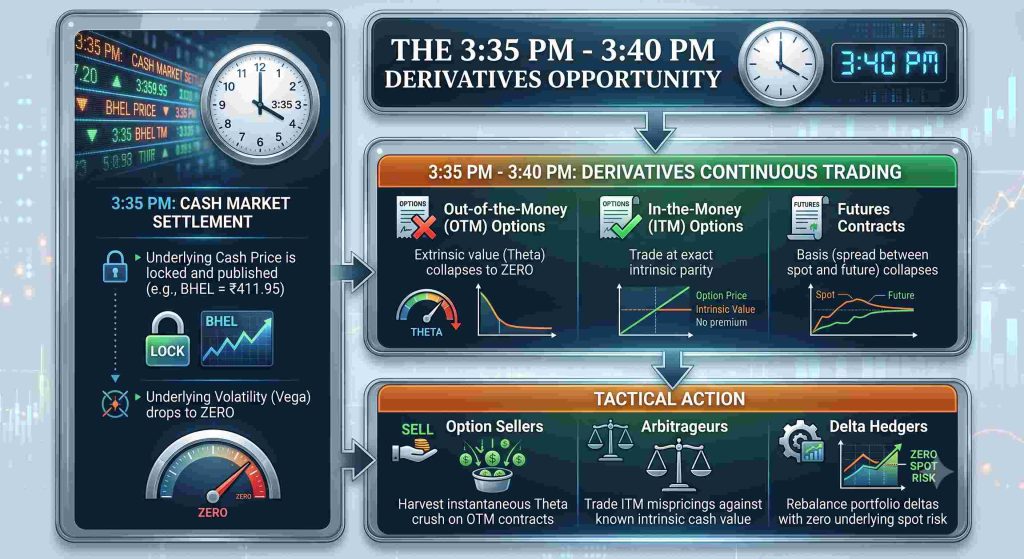
The 10-minute extension of the Equity Derivatives segment (F&O) to 3:40 PM, combined with the earlier 3:35 PM final settlement of the underlying cash market, creates a unique financial engineering opportunity.
From 3:35 PM to 3:40 PM, options and futures traders operate in a market where the underlying spot price is 100% frozen and published, yet derivative contracts continue to trade continuously.
Option Greek Dynamics During the 3:35 PM – 3:40 PM Window
1. The Sudden Drop in Time Value (Theta)
Usually, an option’s “time value” slowly fades away as it gets closer to its expiration date. However, at exactly 3:35 PM, the official closing price of the underlying stock is locked in and broadcasted to the market.
Because the stock price can no longer move, any options that are “out-of-the-money” (meaning they haven’t reached their target strike price) instantly lose their chance of ever becoming profitable. Since they have no future, all their remaining time value completely vanishes. Their prices fall off a cliff, dropping down to almost nothing (like ₹0.05) in a matter of seconds.
2. The End of Uncertainty (Volatility Crush)
Option prices are usually inflated by the market’s “volatility”—which is basically the guessing game of whether a stock will make a massive, unexpected jump.
At 3:35 PM, that guessing game is officially over. Because the final stock price is perfectly fixed, there is absolutely zero uncertainty left. As a result, all the extra price padding (the volatility premium) that was built into the options instantly disappears.
3. Guaranteed Pricing for “In-The-Money” Options
For options that have hit their target (in-the-money options), their value stops being a guessing game and becomes basic middle-school math. The option is now worth exactly the difference between the final locked stock price and the option’s strike price.
A Real-World Example:
If some slow or confused traders are still trying to buy that option for ₹2.30 on the screen, smart traders (arbitrageurs) will instantly sell it to them. Why? Because the smart traders know with 100% certainty that the contract will officially settle at ₹1.95, guaranteeing them a completely risk-free profit of ₹0.35 per share.
Let’s say a stock like BHEL locks in a final price of ₹411.95 at 3:35 PM.
If you hold a Call option with a strike price of 410, its true, undeniable value is now exactly ₹1.95 (₹411.95 minus ₹410.00).
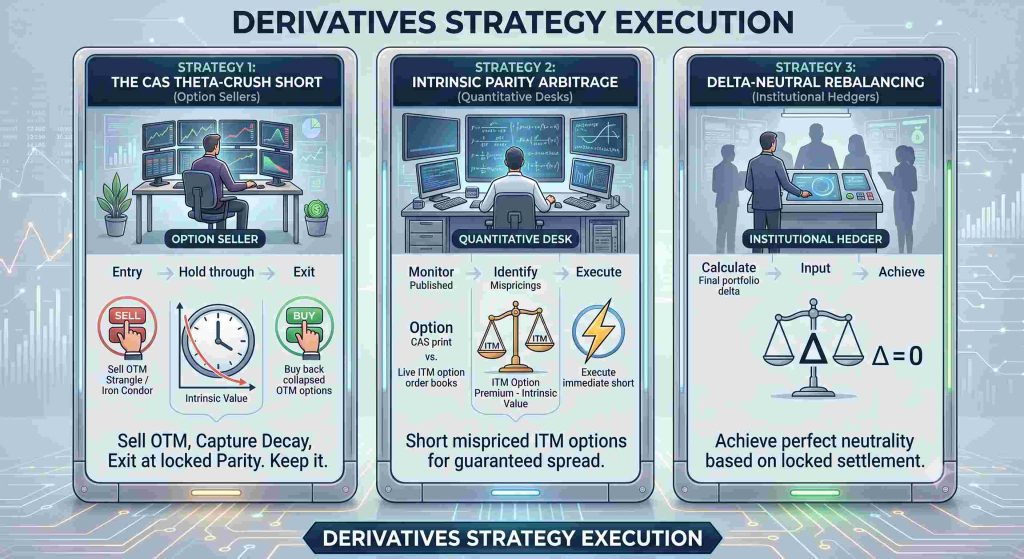
Quantitative Trading Strategies for the CAS Derivatives Window
What is the Closing Auction Session (CAS) in the Indian Stock Market?
The Closing Auction Session (CAS) is a structural market-closing mechanism mandated by SEBI for all F&O-enabled cash market securities on the NSE and BSE. Operating between 3:15 PM and 3:35 PM, CAS aggregates end-of-day buy and sell orders into an auction order book to determine a single official closing price based on Maximum Executable Volume (MEV).
When did SEBI mandate the Closing Auction Session?
SEBI and major Indian exchanges (NSE and BSE) officially implemented the standardized Closing Auction Session on August 3, 2026, permanently replacing the legacy 30-minute Volume-Weighted Average Price (VWAP) system for all equity stocks in the F&O segment.
Why does a stock price suddenly jump or drop at 3:35 PM?
The price change at 3:35 PM is not a real-time continuous market rally or crash. It is the single execution print generated by the exchange’s matching engine, which reconciles all accumulated institutional and retail buy/sell orders placed during the 3:20 PM – 3:30 PM auction window at a single Equilibrium Price.
What happens to unexecuted limit orders at 3:15 PM?
Standard Limit Orders remaining unexecuted at 3:15 PM are automatically transferred into the CAS auction order book, provided their limit price falls within the dynamic ±3% price band calculated from the 3:15 PM Reference Price. Stop-loss orders and iceberg orders are automatically canceled by the exchange system at 3:15 PM.
How late can I trade stock options and futures under the new CAS rules?
Trading for Equity Derivatives (Futures & Options) on the NSE and BSE is extended until 3:40 PM IST. This provides traders with a dedicated 5-minute continuous window (3:35 PM to 3:40 PM) to trade options against the finalized underlying cash equity closing price published at 3:35 PM.
Does CAS apply to all stocks listed on the NSE and BSE?
In its current operational phase, CAS applies strictly to all cash market equities that are eligible for Futures & Options (F&O) trading. Non-F&O securities continue to follow standard continuous trading protocols until 3:30 PM, though regulatory expansion to broader indices is expected.
How do brokers handle auto square-offs for intraday (MIS) trades under CAS?
Due to the continuous trading halt at 3:15 PM for CAS-eligible stocks, most major Indian stockbrokers (such as Zerodha, Groww, Angel One, and ICICI Direct) trigger automated Margin Intraday Square-off (MIS) routines between 3:05 PM and 3:10 PM to ensure positions are liquidated before the auction order book locks.
How does the CAS equilibrium price calculation handle tie-breakers?
If multiple prices yield the exact same Maximum Executable Volume (MEV), the matching engine applies three sequential tie-breakers:
1. Minimum Unmatched Quantity: Selects the price leaving the fewest unfilled shares.
2. Proximity to Reference Price: Selects the price closest to the 3:15 PM VWAP Reference Price.
3. Higher Price Bias: If prices are equidistant from the Reference Price, the algorithm selects the higher price point.
Why did Nifty Spot close nearly 200 points above Nifty Futures?
The reason Nifty Spot closed nearly 200 points above Nifty Futures lies in the mechanics of the new Closing Auction Session (CAS) and the way demand and supply imbalances were reflected at the end of the trading day.
During CAS, continuous trading in F&O stocks stops at 3:15 pm, and a 20‑minute auction determines the equilibrium closing price. On that day, heavy buy orders in the spot market pushed the auction‑derived closing price sharply higher, while futures contracts had already factored in broader sentiment and liquidity constraints earlier in the session.
This mismatch created a temporary divergence: the spot index reflected the weighted average of auction trades, while futures remained anchored to prior expectations. In short, auction‑driven demand inflated the spot close, while futures lagged, producing the unusual 200‑point gap.
How is the official closing price determined under CAS?
Under the Closing Auction Session (CAS), the official closing price is determined through a weighted average of all trades executed during the auction window, typically between 3:00 pm and 3:30 pm.
Each trade’s price is multiplied by its volume, and the sum of these values is divided by the total traded volume in that period. This ensures that larger trades carry more influence than smaller ones, reflecting true market demand and supply.
The resulting equilibrium price becomes the official close, replacing the last traded price, and is intended to provide a fairer, more transparent benchmark for investors.
Why did Sensex and Nifty diverge during CAS?
Sensex and Nifty diverged during the Closing Auction Session (CAS) because of differences in their composition, weightages, and separate order books maintained by BSE and NSE. While both indices share several heavyweight stocks.
Nifty includes 50 companies compared to Sensex’s 30, so sharp moves in additional constituents influenced Nifty more strongly.
Moreover, the CAS mechanism concentrates liquidity in a short auction window, and imbalances in buy or sell orders impacted each exchange differently. As a result, the closing prices of common stocks varied slightly across exchanges, leading to a temporary divergence between the two benchmarks.
Does CAS mean trading stops at 3:15 pm for F&O stocks?
Yes, under the Closing Auction Session (CAS), trading in F&O stocks stops at 3:15 pm on the NSE. After this cutoff, continuous trading halts and a special auction window runs until 3:30 pm to determine the equilibrium closing price.
During this period, only auction orders are matched, and no fresh trades occur in the regular market.
The weighted average of trades executed in this auction becomes the official closing price. This mechanism was introduced to ensure a fairer, more transparent benchmark, but it also means that active trading effectively ends at 3:15 pm for F&O stocks.
Why did Bank Nifty Spot and Futures show a 300‑point gap?
The 300‑point gap between Bank Nifty Spot and Futures occurred because of the Closing Auction Session (CAS) mechanism and the way futures pricing differs from spot.
At 3:15 pm, continuous trading in F&O stocks halts, and the auction determines the equilibrium closing price for the spot index. Heavy buy orders in key banking stocks during CAS pushed the spot index sharply higher, while futures had already settled based on earlier sentiment, liquidity, and cost‑of‑carry factors.
This mismatch created a temporary divergence, with the spot reflecting auction‑driven demand and futures remaining anchored, resulting in the unusual 300‑point gap.
Is CAS causing artificial volatility at market close?
Yes, the Closing Auction Session (CAS) can create what looks like artificial volatility at market close because it compresses liquidity into a short auction window. From 3:15 pm onward, continuous trading halts for F&O stocks, and only auction orders are matched to determine the equilibrium closing price.
If large buy or sell imbalances emerge in this narrow period, they can push the spot index sharply higher or lower compared to futures, creating sudden gaps.
While this volatility may appear artificial, it is actually a reflection of concentrated demand and supply being captured transparently in the closing auction.
How should traders interpret index graphs during CAS?
During the Closing Auction Session (CAS), traders should interpret index graphs with caution because the movements reflect auction‑driven equilibrium prices rather than continuous market trading.
From 3:15 pm onward, F&O stocks stop regular trading, and only auction orders are matched to determine the official close. This can cause sudden spikes or dips in the spot index that may not align with futures or intraday trends.
Therefore, traders should view CAS graphs as a snapshot of concentrated demand and supply imbalances, not as signals of fresh momentum, and avoid misreading these closing moves as new directional trends.
Will CAS impact derivatives trading beyond 3:35 pm?
No, the Closing Auction Session (CAS) does not impact derivatives trading beyond 3:35 pm. CAS is designed only to determine the official closing price of F&O stocks between 3:15 pm and 3:35 pm, after which the auction ends.
Futures and options contracts remain unaffected once the session closes, as their settlement continues to be based on the final spot closing price derived from CAS.
While CAS can create temporary gaps between spot and futures during the auction window, these differences do not carry forward into post‑3:35 pm trading, meaning derivatives markets resume normal settlement rules thereafter.
Are brokers prepared with the right technology for CAS?
Most brokers are prepared with the right technology for CAS, but the transition has required significant upgrades to their trading systems.
Since CAS halts continuous trading in F&O stocks at 3:15 pm and shifts to an auction mechanism until 3:35 pm, brokers need platforms capable of handling large volumes of auction orders, real‑time matching, and accurate calculation of weighted average prices.
Leading brokers have already integrated CAS modules into their terminals to ensure smooth execution, though smaller firms may still be adapting. Overall, the industry is technologically ready, but operational fine‑tuning continues to minimize closing volatility.
Is SEBI considering rolling back CAS after confusion?
SEBI is not considering rolling back the Closing Auction Session (CAS) despite initial confusion and volatility at market close. The regulator has clarified that CAS is a structural reform aimed at improving transparency and aligning Indian markets with global practices.
While traders witnessed sharp divergences between spot and futures in the early days, SEBI views these as teething issues rather than flaws in the system. Instead of withdrawal, SEBI is focusing on broker technology upgrades, clearer display of indicative auction prices, and investor education to ensure smoother adoption and reduce perceived artificial volatility during the closing session.
Why does the Nifty/Sensex look frozen or stuck after 3:15 PM?
The Nifty/Sensex look frozen or stuck after 3:15 pm because continuous trading in F&O stocks halts once the Closing Auction Session (CAS) begins.
From 3:15 to 3:35 pm, the indices no longer update tick‑by‑tick as they do during normal trading hours. Instead, they reflect indicative auction prices, which only change when significant buy or sell imbalances occur.
This makes the charts appear static or frozen, even though the auction is actively matching orders in the background. The final weighted average from this auction becomes the official closing price, explaining the apparent pause in index movement.
Why are my pending Stop-Loss (SL) and Iceberg orders getting cancelled automatically at 3:15 PM?
Your pending Stop‑Loss (SL) and Iceberg orders get cancelled automatically at 3:15 pm because the Closing Auction Session (CAS) begins at that time, halting continuous trading in F&O stocks. Once CAS starts, the exchange does not allow pending conditional or algorithmic orders like SL or Iceberg to remain active, since only auction orders are permitted during the 20‑minute window.
This ensures that the closing price is derived solely from the auction mechanism without interference from pre‑set triggers. As a result, any such pending orders are automatically cancelled when CAS begins, and traders must re‑enter them afterward.
I placed an order at 3:22 PM. Why hasn’t it filled yet?
Your order placed at 3:22 pm did not fill because by that time the Closing Auction Session (CAS) was already in effect. After 3:15 pm, continuous trading in F&O stocks halts, and only auction orders are accepted until 3:35 pm.
Regular limit, market, stop‑loss, or iceberg orders are not executed during this window, as the exchange only matches auction bids to determine the equilibrium closing price.
That’s why your order remains pending or appears inactive—it is outside the auction mechanism. To participate, you must place an eligible auction order during CAS instead of a normal trade.
Why did my trading terminal stop accepting orders before exactly 3:30 PM?
Your trading terminal stopped accepting orders before 3:30 pm because once the Closing Auction Session (CAS) begins at 3:15 pm, only auction‑specific orders are permitted until the session ends at 3:35 pm.
Regular market, limit, stop‑loss, or iceberg orders are automatically disabled during this period to ensure that the closing price is derived solely from the auction mechanism. Many brokers also impose a short cutoff before 3:30 pm to process and validate auction orders smoothly.
That’s why your terminal appeared to block new entries—it was complying with CAS rules to maintain transparent closing price discovery.
Why are some stocks trading normally until 3:30 PM while others stop at 3:15 PM?
Some stocks continue trading normally until 3:30 pm because they are not part of the F&O segment, while others stop at 3:15 pm due to the Closing Auction Session (CAS) rules.
CAS applies only to F&O stocks, where continuous trading halts at 3:15 pm and shifts into an auction mechanism to determine the closing price.
Non‑F&O stocks, however, remain in the regular market session until 3:30 pm, so their charts and trades look active. This difference in treatment creates the impression that some stocks are “frozen” early while others keep trading until the standard market close.
How do intraday (MIS) auto square-off timings change with CAS?
With the introduction of the Closing Auction Session (CAS), intraday (MIS) auto square‑off timings have shifted earlier because brokers must close positions before continuous trading halts at 3:15 pm for F&O stocks.
Traditionally, MIS positions were squared off closer to 3:20–3:25 pm, but under CAS, brokers now initiate auto square‑off around 3:10–3:12 pm to ensure all trades are settled before the auction begins.
This adjustment prevents pending intraday positions from being stuck during CAS, where only auction orders are allowed. As a result, traders need to exit or manage MIS positions earlier than before.
Why is there an error saying my price is out of the allowed band after 3:15 PM?
The error saying your price is out of the allowed band after 3:15 pm occurs because once the Closing Auction Session (CAS) begins, the exchange enforces strict price bands around the indicative equilibrium price. Unlike normal trading, where broader limits apply, CAS only accepts auction orders within a narrow range to ensure fair closing price discovery.
If you place an order outside this permitted band, the system rejects it automatically. This mechanism prevents extreme bids or offers from distorting the closing price, which is calculated as the weighted average of matched auction trades during the CAS window.
Do the trading hours for Futures & Options (F&O) change because of CAS?
No, the trading hours for Futures & Options (F&O) do not change because of the Closing Auction Session (CAS). The official market hours remain from 9:15 am to 3:30 pm.
What changes is the trading mechanism: continuous trading in F&O stocks halts at 3:15 pm, and from 3:15 to 3:35 pm, only auction orders are allowed to determine the closing price.
This makes it seem like F&O trading ends earlier, but in reality, the session is still part of the official market hours, with CAS specifically designed for transparent closing price discovery.
What is the difference between LTP, Reference Price, and Equilibrium Price now?
The difference lies in how prices are defined during the Closing Auction Session (CAS).
The Last Traded Price (LTP) is simply the final price at which a stock traded before CAS began at 3:15 pm.
The Reference Price is the base price used in CAS, usually the LTP or a weighted average, which sets the band for acceptable auction orders.
The Equilibrium Price is the final discovered price during CAS, determined by matching buy and sell orders to maximize traded volume. Thus, LTP reflects continuous trading, Reference Price anchors the auction, and Equilibrium Price becomes the official closing value.