Return to Player (RTP) and House Edge Explained: The Mathematics Behind Casino Payouts
Every casino game—whether a mechanical slot machine in Nevada, a European roulette wheel, or an online digital card table—is governed by precise mathematical laws. While marketing campaigns often emphasize luck, streaks, and intuition, the underlying infrastructure relies entirely on probability theory and statistical modeling.
Understanding the mechanics of casino payouts comes down to two foundational concepts: Return to Player (RTP) and the House Edge.
Together, these metrics establish the built-in mathematical boundaries of every game. Here is a clear, step-by-step breakdown of how these numbers are calculated, what they mean over time, and why the math works the way it does.
1. What Is Return to Player (RTP)?
Return to Player (RTP) represents the theoretical percentage of all wagered money that a game pays back to players over an extended period.
If a slot machine or digital card game carries a published RTP of 96%, it means that over hundreds of thousands or millions of simulated rounds, the game is mathematically calibrated to return $96 for every $100 wagered across the entire player base.
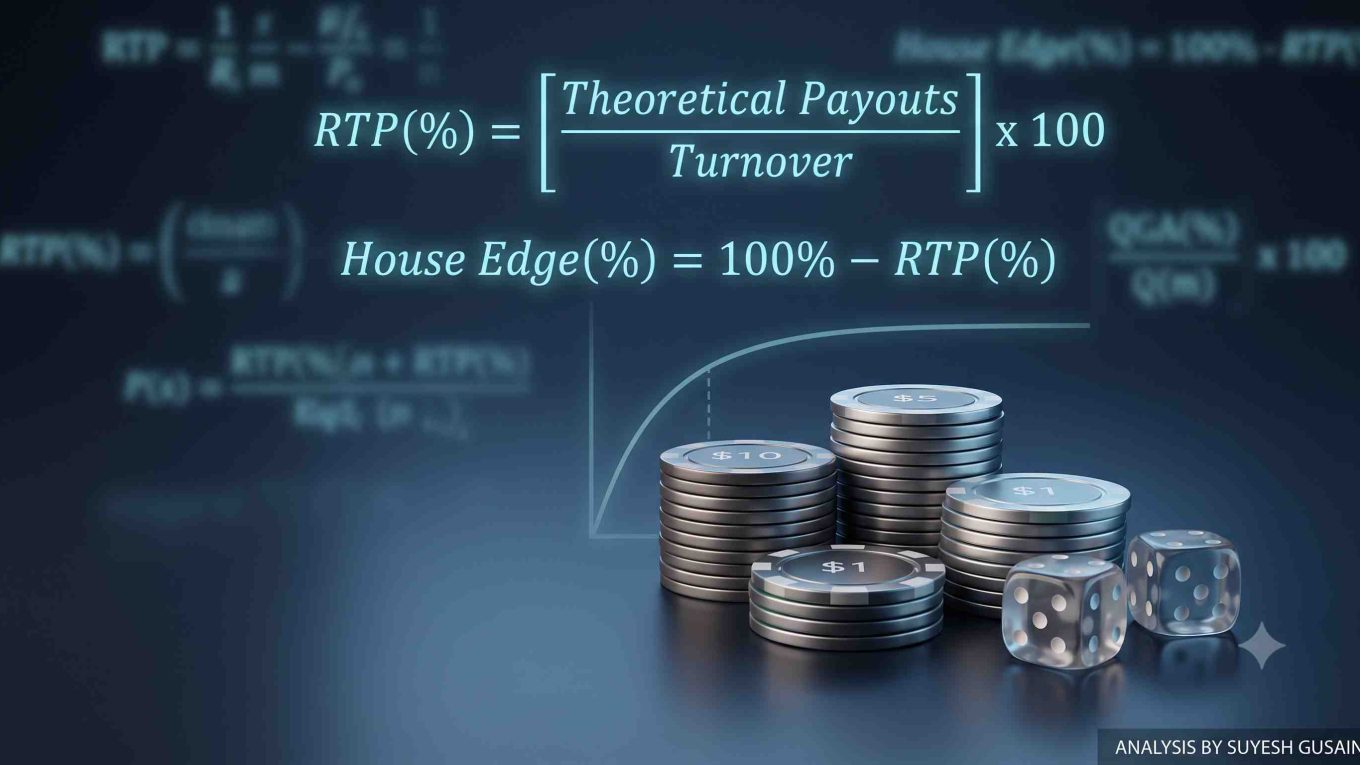
The formula for calculating RTP is straightforward:

The Common Misunderstanding About RTP
A frequent misconception is assuming that RTP applies to a single session. If you deposit $100 into a machine with a 96% RTP, you will not automatically walk away with $96 after an hour. In a short session, a player might double their money or lose their stake entirely.
RTP is an aggregate metric, calibrated through the Law of Large Numbers. It only mirrors reality when measured across millions of individual spins or hands.
2. What Is the House Edge?
The House Edge is simply the inverse of RTP. It is the mathematical advantage that the game operator maintains over time.
Because the house edge is built directly into the game’s rules, payouts, and payout ratios, the operator does not need to “cheat” or alter software to earn a margin. The laws of probability guarantee their revenue over a sufficient sample size.

If a game has an RTP of 96%, the house edge is 4%. This 4% represents the gross margin the house mathematically expects to retain over the long term.
3. Game-by-Game Comparison: The Mathematical Advantage
Different games feature wildly different margins based on their structure. Games that involve player decisions (like Blackjack) depend on adherence to mathematically optimal strategy, while purely mechanical games (like Roulette) have fixed margins regardless of how you play.
| Game Variant | Average RTP | Built-in House Edge | Key Factor Determining the Odds |
| Blackjack (Basic Strategy) | ~99.50% | ~0.50% | Optimal decision-making based on statistical probability tables. |
| Baccarat (Banker Bet) | 98.94% | 1.06% | Fixed draw rules; 5% commission offsets the Banker’s slight positional lead. |
| European Roulette | 97.30% | 2.70% | Single zero pocket ($1/37$ probability of landing on green). |
| American Roulette | 94.74% | 5.26% | Dual green pockets ($0$ and $00$) nearly double the house advantage. |
| Standard Video Slots | 92.00% – 96.50% | 3.50% – 8.00% | Hardcoded algorithmic pay tables configured by software providers. |
The Roulette Example: Why One Pocket Changes Everything
A standard European roulette wheel has 37 numbered pockets (1 to 36, plus a single green 0). If you place a bet on a single number, the wheel pays out at 35 to 1.
However, the true mathematical odds of hitting that number are 1 in 37. That slight gap between the true odds (37 to 1) and the payout odds (35 to 1) creates the 2.70% house edge.
When American casinos added a second green pocket (00), the total number of pockets increased to 38, but the payout for a single number stayed at 35 to 1. That single modification caused the house edge to jump from 2.70% to 5.26% without changing the core mechanics of the game.
4. The Hidden Variable: Volatility and Variance
If two games both feature a 96% RTP, does that mean they play the same way? Not at all. The missing link is volatility (often called variance in statistical analysis).
Volatility dictates how that 96% return is distributed across time:
- Low Volatility: The game pays out small, frequent wins. Your balance tends to fluctuate gently, making extended play sessions more common.
- High Volatility: Payouts occur far less frequently, but the potential top prizes are significantly larger. A player might experience dozens of dry rounds punctuated by a substantial multiplier.
Low Volatility:   [Win] [Loss] [Win] [Win] [Loss] [Win]   <- Consistent, small values
High Volatility:  [Loss] [Loss] [Loss] [Loss] [BIG WIN]    <- Sparse, high-value spikes
Both models can average out to the exact same 96% RTP over ten million rounds, but the individual player experience differs dramatically due to variance.
5. How Is Fairness Verified? (PRNGs and Audits)
Modern digital games do not use mechanical reels or physical cards. Instead, their outcomes are determined by Pseudorandom Number Generators (PRNGs).
A PRNG is a complex mathematical algorithm that generates long sequences of numbers at intervals of milliseconds, even when no one is actively playing. The moment a player initiates an action (such as hitting “Spin” or “Deal”), the algorithm records the exact numerical seed generated at that microsecond and translates it into visual symbols or cards.
Independent Testing and Compliance
To operate legally in regulated international jurisdictions (such as the UK, Malta, Gibraltar, or individual US states), software developers must submit their source code to Accredited Testing Facilities (ATFs).
Independent auditing bodies—such as eCOGRA, Gaming Laboratories International (GLI), and iTech Labs—run the following verification procedures:
- RNG Mathematical Audits: Running hundreds of millions of automated game simulations to verify that card draws and reel combinations show no statistical bias or predictable patterns.
- Payout Verification: Comparing actual real-world payout logs against theoretical design models to ensure the declared RTP matches real-world performance within acceptable statistical error tolerances.
- Information Security Audits: Checking that the random number generation occurs securely on central servers, preventing external manipulation or client-side tampering.
The Takeaway
Behind the flashing lights and immersive sound design, all casino games function as structured mathematical equations.
RTP and House Edge establish the mathematical baseline, volatility determines the pacing and distribution of returns, and certified random algorithms ensure that every individual outcome remains independent and unbiased. In the end, luck may dictate the results of any single round, but mathematics always dictates the long run.
Disclaimer: This article is intended strictly for educational, historical, and mathematical analysis. It does not constitute financial advice, gaming advice, or an endorsement of real-money gambling platforms.
Author Bio
Suyesh Gusain is an analytical researcher and digital publisher specializing in algorithmic systems, data verification, and digital media ethics. Holding degrees in Physics (B.Sc. Hons) and Mass Communication (M.A.), Suyesh bridges the gap between rigorous mathematical analysis and accessible consumer education. His work centers on decoding complex algorithmic architectures, statistical probability, and digital integrity for modern audiences.
FAQ Section
What is a good RTP percentage for online games?
In modern digital gaming, an RTP of 96.00% or higher is considered competitive and player-friendly. Games with an RTP between 94.00% and 95.99% fall into the industry average range, while any title falling below 94.00% maintains a significantly higher house edge.
Can a player change or lower the house edge?
In pure games of chance—such as roulette, baccarat, or mechanical slots—the house edge is fixed mathematically by the rules and cannot be altered. In decision-based games like Blackjack or Video Poker, playing according to mathematically optimal strategy minimizes the house edge to its lowest theoretical baseline (around 0.50%), but it cannot be reduced to zero.
Does a 96% RTP mean you get $96 back from a $100 session?
No. RTP is calculated across hundreds of thousands or millions of simulated rounds under the Law of Large Numbers. In short, individual sessions, player results fluctuate wildly due to mathematical variance—a player could double their stake or lose it entirely within a few rounds.
What is the practical difference between RTP and volatility?
RTP defines how much money a game theoretically pays back over millions of rounds, while volatility (or variance) dictates how often and in what size those payouts occur. A low-volatility game pays out small, frequent wins, while a high-volatility game distributes payouts sparsely in larger amounts, even if both games share an identical 96% RTP.
Can online casinos manipulate or lower the RTP on their own?
Regulated online operators cannot alter game algorithms or pay tables on their servers. All games run on certified software hosted by game providers and audited by accredited testing facilities like eCOGRA and Gaming Laboratories International (GLI). While some developers offer multiple approved RTP tiers, the active percentage must be clearly disclosed within the game’s official rules.