
New UPI Charges Explained: Is UPI Still Free for You?
If you live in India today, chances are you barely carry cash anymore. From paying ten rupees for your morning cup of tea at a street stall to buying groceries, splitting a dinner bill, or ordering a new laptop online, Unified Payments Interface (UPI) has quietly become a part of everyday life. It is fast, works on almost every phone, and has always felt wonderfully simple.
Because UPI is such an essential habit, recent headlines about new fees and banking rules have left many people feeling anxious. You might have seen news updates mentioning MDR rates, transaction limits, or percentage fees and wondered: “Am I going to be charged every single time I scan a QR code at checkout? Is free UPI coming to an end?”
The quick and reassuring answer is no. For you as an everyday consumer, UPI remains completely free.
The National Payments Corporation of India (NPCI) and the Ministry of Finance have introduced an updated Merchant Discount Rate (MDR) policy. While it sounds complicated, it is simply a behind-the-scenes framework that determines how businesses and banks share the technical costs of running digital payments.
To help clear the air, here is a friendly, step-by-step breakdown of how these rules work, why they were introduced, what stays completely free, and what businesses will actually pay.
What Exactly Is MDR?
Before looking at the numbers, it helps to understand what “MDR” actually stands for.
Merchant Discount Rate (MDR) is the small service fee that a business pays to banks and payment companies whenever a customer pays digitally. Whenever you scan a QR code in a supermarket, several systems work together in a fraction of a second. Your bank checks your balance, sends the money through NPCI’s secure digital network, and deposits it into the shopkeeper’s account.
Setting up and maintaining those ultra-fast servers, cybersecurity firewalls, and customer support teams costs money. MDR is the fee that helps pay for that digital plumbing. Importantly, this has always been an expense meant for businesses—not an extra charge added to your shopping receipt.

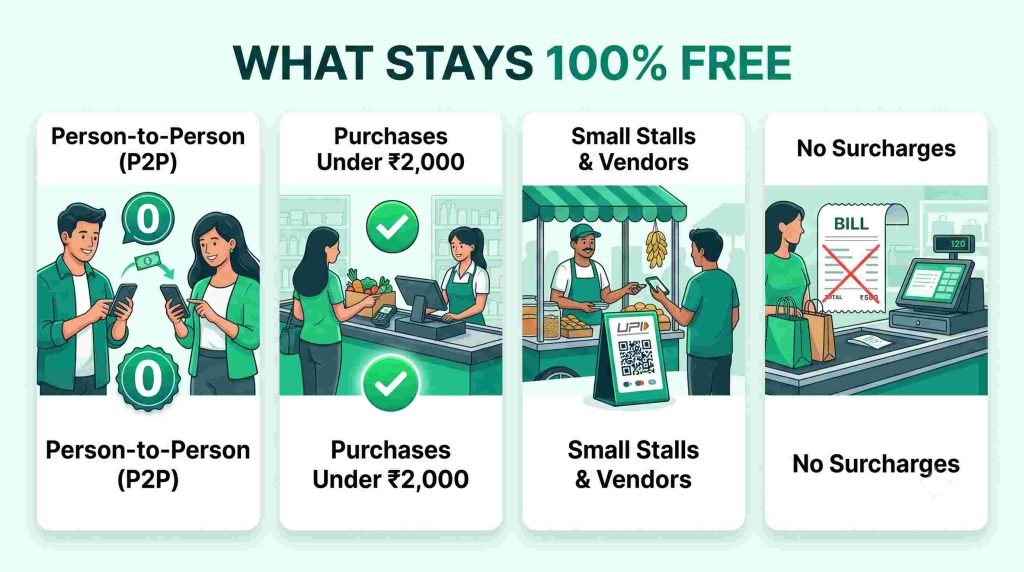
What Stays 100% Free for Everyday People
The most important part of this new policy is that everyday digital habits do not change at all. The government and the NPCI have built strong protections around ordinary users and small sellers.
- Sending money to people (P2P): Sending funds to your friends, family members, roommates, domestic help, or landlord costs zero rupees. Whether you send ₹50 for snacks or ₹25,000 for your monthly house rent, personal transfers will never attract any fee.
- Shopping purchases up to ₹2,000: Whenever you buy something at a store and pay ₹2,000 or less, neither you nor the shopkeeper pays a single paisa in processing fees. Because small purchases make up more than 90% of all daily UPI payments across the country, your daily routine remains untouched.
- Local vendors and small merchants: Street-side food stalls, vegetable carts, neighborhood tuck shops, and small businesses that collect up to ₹1,00,000 a month via QR code continue under a special zero-fee status. They do not have to worry about transaction fees eating into their daily income.
- Strict protection against customer surcharges: Payment apps, shopping websites, and merchant banks are strictly forbidden from passing processing fees onto you. A shop cannot charge you ₹102 just because you chose to scan a QR code instead of handing over cash.
What Big Shops Pay: The 0.4% Fee (Capped at ₹300)
So, where do the new rules actually kick in? They apply only to commercial purchases that exceed ₹2,000 at established stores, supermarkets, electronics showrooms, and e-commerce websites.
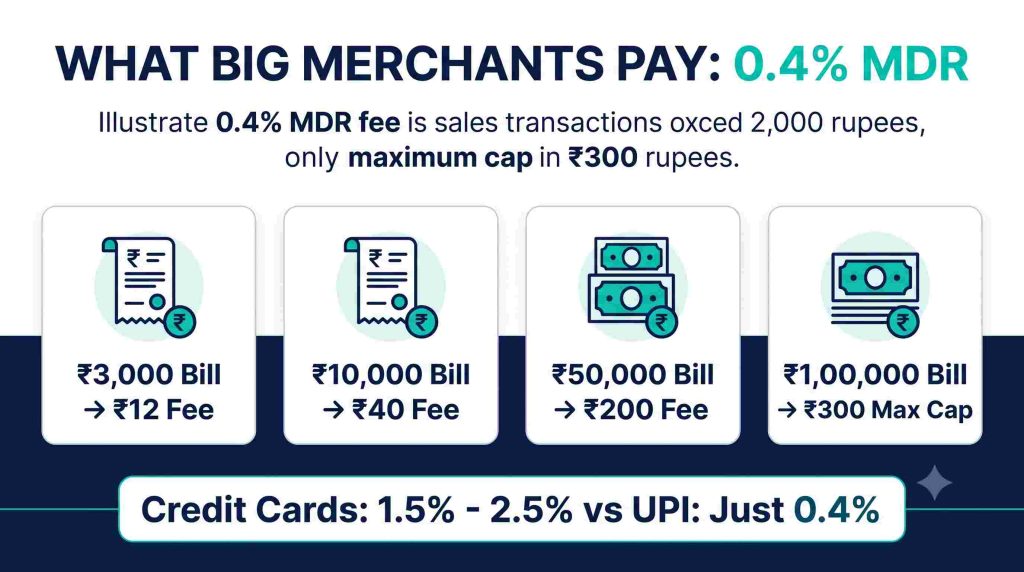
When you make a larger purchase at these businesses, the merchant pays a modest rate of 0.4%.
To make sure this does not become an unfair burden on retailers selling high-value goods—like refrigerators, smartphones, designer clothes, or jewellery—the government has put a firm ceiling on the fee: it is capped at a maximum of ₹300 per transaction. Once a bill reaches ₹75,000, the fee stops growing completely.
Here is what that looks like in practical terms:
- On a ₹3,000 purchase: The store pays a small fee of ₹12 (₹3,000×0.4%).
- On a ₹10,000 purchase: The fee comes out to ₹40.
- On a ₹50,000 purchase: The store pays ₹200 to process the payment.
- On a ₹75,000 purchase: The fee reaches the exact cap of ₹300.
- On a ₹1,00,000 purchase: Standard math would suggest ₹400, but because of the safety cap, the merchant still pays only ₹300, saving ₹100.
To put this in perspective, traditional credit card networks typically charge merchants anywhere between 1.5% and 2.5% on every swipe. A ₹50,000 purchase on a credit card can cost a merchant ₹1,000 or more in fees. Compared to that, paying ₹200 on UPI is still remarkably cheap for business owners.
5 Essential Categories with a Flat ₹5 Fee
There are some payments in life that naturally cross ₹2,000, but are essential public services rather than luxury retail shopping. If electricity boards or fuel bunks had to pay a percentage on every customer bill, it could push up operational costs for public utilities.
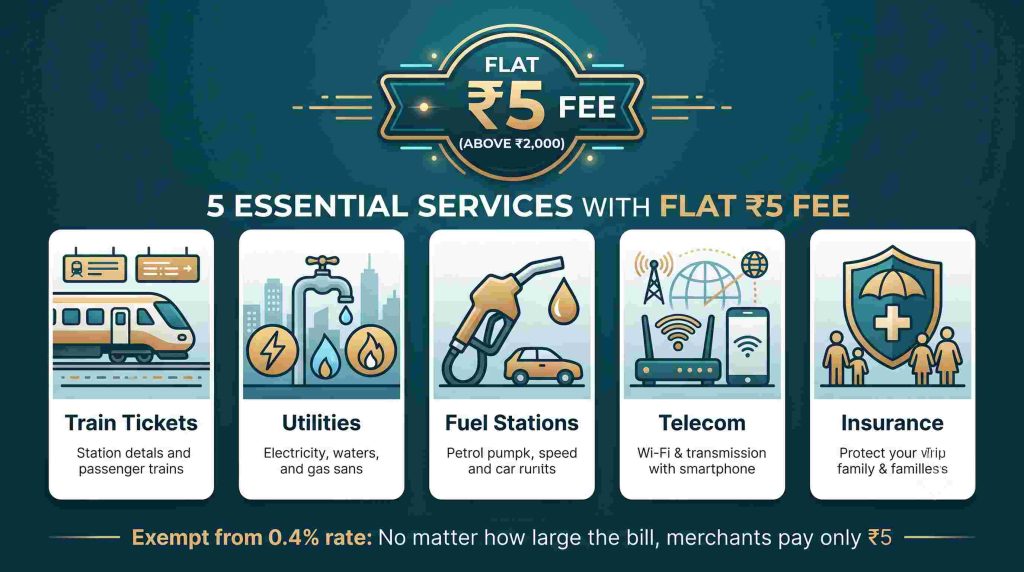
To protect these critical services, five key sectors skip the 0.4% rule entirely. For any transaction over ₹2,000 in these areas, the service provider pays just a flat ₹5 fee, no matter how large the bill happens to be:
- Train tickets: Booking travel through railway reservation portals and ticket counters.
- Utilities: Paying your monthly household electricity bills, water supply charges, or piped cooking gas connections.
- Fuel stations: Filling up petrol, diesel, or CNG at local fuel pumps.
- Telecom services: Paying broadband internet bills, landline bills, or monthly postpaid mobile connections.
- Insurance premiums: Paying annual life insurance, term plans, vehicle coverage, or family health insurance policies.
Whether you pay an annual car insurance premium of ₹12,000 or settle an office electricity bill of ₹8,000 through UPI, the receiving company pays just ₹5 to process your payment.
Investing in the Stock Market: A Tiny 0.02% Fee
Over the past few years, millions of people across India have started investing in financial markets directly from their smartphones. Whether setting up monthly mutual fund SIPs or adding funds to stock trading platforms like Zerodha, Groww, or Angel One, digital payments have made building wealth much more accessible.
Financial trading operates on very thin margins, and money moves back and forth constantly. If regular commercial fees were charged on investment deposits, it would discourage people from investing small sums digitally.
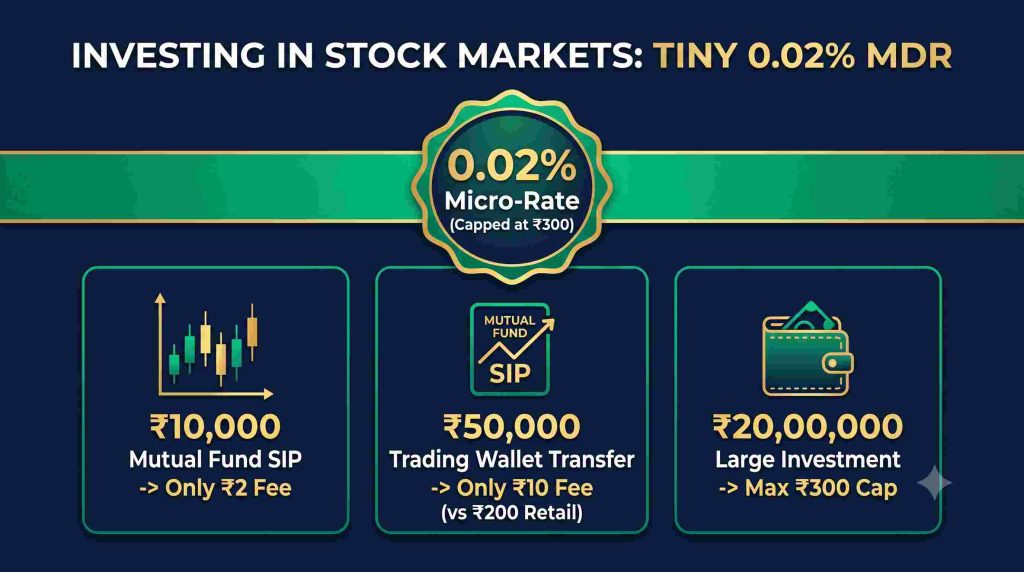
Because of this, payments made to SEBI-registered brokers, mutual fund houses, and investment platforms attract an ultra-low micro-fee of just 0.02%, also capped at ₹300:
- If you invest ₹10,000 in an equity mutual fund, the platform pays an MDR of just ₹2.
- If you transfer ₹50,000 into your stock trading wallet, the fee is merely ₹10 (instead of ₹200 under general retail rates).
- Even if an investor transfers a substantial sum of ₹20,00,000, the total fee is strictly capped at ₹300.
Why Was This Change Necessary?
It is natural to wonder why these changes were needed if UPI was already working so smoothly without them.
The reality is that India’s digital payment ecosystem has grown at a breathtaking pace. UPI processes hundreds of millions of transactions every single day. Handling that massive volume requires world-class computing infrastructure, dedicated cloud servers, round-the-clock fraud surveillance teams, and continuous software engineering to prevent server crashes and failed payments.
For years, banks and fintech startups absorbed these operational expenses while the government provided temporary subsidies to encourage everyone to go cashless. However, as the network expanded, continuing with zero income became unsustainable for the banks maintaining the underlying servers.
This updated framework creates a healthy middle ground. It gives banks and fintech platforms a predictable, sustainable income stream to keep investing in world-class security and system reliability, while ensuring that the common citizen never pays a single rupee to send money or buy daily necessities. UPI stays safe, modern, and completely free for the people who rely on it most.

- Explore more insights on WisdomGanga
- Share this article with your circle to spread wisdom and light
- Join the conversation on social platforms:
Your support helps us build a community of seekers who value meditation, consciousness, and inner growth. Together, we can make wisdom a living practice.