
MakeRacks Review: Inside the Recycled “Clone Farm” Scam Syndicate
Quick Verdict: MakeRacks is not a functional or legitimate online work platform. It is an off-the-shelf clone operating within an organized network of turnkey fraud sites. Designed as an exact replica of platforms like CapBucks, MakeRacks exploits user labor via Cost-Per-Action (CPA) offers, harvests personally identifiable information (PII), and enforces impossible payout conditions. Engaging with this website poses immediate data privacy risks, device security concerns, and financial hazards.
1. The Carbon-Copy Clones: Unmasking the Syndicated Template
A visual and technical audit of MakeRacks immediately reveals a telltale signature of syndicated cyber fraud: it is a carbon-copy clone.
From the identical vector illustration of a celebrating worker surrounded by confetti, to the specific cash-and-coin logo styling and the side-by-side badges for Venmo, Cash App, Zelle, and PayPal, MakeRacks is identical to CapBucks and historical scam syndicates like KashTree, Paid4Clout, and Bumble-network iterations.
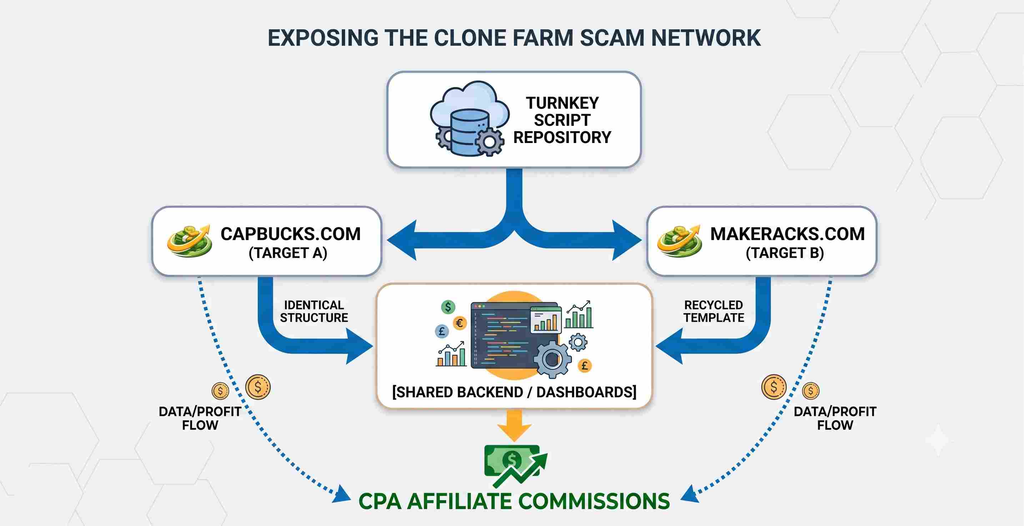
The “Whack-a-Mole” Domain Strategy
Why do operators launch distinct domains with matching graphics?
- Circumventing Anti-Spam Blocks: When viral spam on TikTok, Instagram, and X flags an earlier domain (like CapBucks) as malicious, social platforms block the URL. The operators instantly deploy MakeRacks to keep referral links circulating uninhibited.
- Evading Search Engine De-indexing: As consumer advisories warn search engines about one domain, launching new domains allows the syndicate to catch new search traffic before security vendors compile comprehensive trust scores.
- Targeting Slang & Cultural Subsets: Naming the platform “MakeRacks” leverages urban slang (“racks” referring to thousands in cash) specifically calibrated to attract younger demographics, gig economy workers, and students searching for flexible income.
2. Superficial Credibility: The “Academy” and “Blog” Shells
In earlier iterations of these task sites, users were met solely with a crude landing page. MakeRacks introduces top-level navigation tabs labeled “Academy”, “Blog”, and “More” to simulate an established educational or gig-economy brand.
However, an inspection of these sections exposes them as superficial facades:
- Placeholder Architecture: The linked sections host thin, generic, or AI-generated filler articles discussing vague “digital marketing tips” or remain incomplete boilerplate text with broken internal navigation.
- Review-Screening Camouflage: CPA networks and merchant providers periodically conduct automated and manual compliance reviews. These cosmetic tabs exist to convince ad network compliance teams that MakeRacks is a genuine content-publishing site rather than a deceptive referral trap.
- Absence of Real Ownership: The “About Us” and terms pages omit any verified corporate identity, parent organization, business registration numbers, or verifiable operational headquarters in Tier 1 jurisdictions (US, UK, Canada, Australia).
- Other similar Sister Sites: Rubybucks, RevFargo, EarnPals, CapBucks, hunnypop, hunny5, hunnypay, hunnyrich, billracks, hunnyme, goldhunny, hunny7, rambuzz, buzzbread, Supabread& honeyram.
3. The Psychological Trap: Exploiting the Sunk Cost Fallacy
The engine driving MakeRacks is psychological entrapment rather than financial commerce.
- The Massive Sign-Up Incentive: Upon registration, users are greeted with a fabricated account balance—frequently starting at $100 to $300. This immediate visual reward triggers dopamine and creates a sense of instant ownership.
- The Sunk Cost Fallacy: Users spend hours completing survey forms, downloading mobile games, and posting referral links across social forums because they believe they are protecting a real balance. The more effort an individual invests, the harder it becomes psychologically to walk away.
- The “Moving Goalposts” Payout Lock: When a user requests a withdrawal, the system creates secondary hurdles:
- Minimum threshold requirements (e.g., must hit $500).
- Mandatory referral quotas (e.g., invite 5 to 10 active friends).
- High-risk task wall requirements (e.g., complete 5 “premium” sponsor offers).
Once these quotas are met, accounts are placed in an indefinite “review” status, terminated under fabricated accusations of “fraudulent traffic,” or solicited for upfront “processing fees” to expedite payout delivery.
4. Technical Audit & Domain Red Flags
| Evaluation Metric | MakeRacks.com Evidence | Industry Standard (Safe GPT Platforms) |
| Domain Longevity | Newly registered; concealed WHOIS contact records via privacy proxies | Multi-year operational history; publicly verifiable ownership |
| Payment Logic | Claims fixed payouts of $50/signup and $2/click | Micro-earnings scaled to advertiser payouts ($0.20 to $3.00/task) |
| Data Encryption & Handling | Direct lead generation harvesting emails, phone numbers, and payment handles | Strict GDPR/CCPA consumer disclosures, opt-out mechanisms |
| Outbound CPA Routing | Redirects users through affiliate ad networks and unvetted APK/app downloads | Direct partnerships with recognized research entities and ad sponsors |
| Trust Score Rating | Ranked critically dangerous across major security validation databases | High trust ratings verified by Better Business Bureau or Trustpilot |
5. Mitigation Protocol: Securing Your Accounts & Devices
If you have already created an account or engaged with the MakeRacks task catalog, execute this defensive protocol immediately:
- Credential Segregation: If you used a primary email password on MakeRacks, change that password across all connected services (email, banking, shopping) and activate app-based Multi-Factor Authentication (MFA).
- Mobile Permissions Audit: If you downloaded external profiles, files, or applications via the Task Wall, uninstall them immediately. Navigate to your device settings to revoke third-party app permissions (SMS access, Contacts, Accessibility).
- Monitor Inbound Communications: Be alert to smishing (SMS phishing) and spear-phishing emails. The personal details gathered by MakeRacks are routinely consolidated into marketing and lead-generation lists sold on unregulated data forums.
- Report the Infrastructure:
- Domain Registrar Abuse: File an abuse report with the domain’s registrar (frequently Namecheap) citing deceptive practices and phishing.
- Regulatory Complaints: Submit formal fraud complaints to the Federal Trade Commission (FTC) at reportfraud.ftc.gov (US) or the Internet Crime Complaint Center (IC3).
Final Verdict
MakeRacks is not an employment portal, a micro-task network, or an honest side-income option. It is a recycled clone script designed to exploit user time for third-party affiliate revenue while compromising sensitive consumer data. Do not register, do not share referral links, and do not engage with its Task Wall.
About the Author
Suyesh Gusain is an investigative digital researcher and consumer protection writer specializing in cyber fraud, CPA arbitrage scams, and online security. With an analytical background in Physics and Mass Communication, he audits deceptive digital platforms to safeguard consumers from online financial traps.
Every safe click counts. If this post helped, a coffee gesture fuels more scam‑busting investigations.

Call to Action
Please share this article to spread awareness. Follow us on Facebook, Twitter, and Instagram for more scam alerts. If you doubt the legitimacy of any website or investment plan, DM us on social media — we’ll help you verify.
“Scammers evolve daily. Subscribe to our scam‑alert list and stay one step ahead.”
Frequently Asked Questions (FAQ)
Is MakeRacks real or a scam?
It is an outright scam. It utilizes a recycled template clone identical to platforms like CapBucks to generate affiliate revenue for anonymous operators through deceptive tasks and fake referral incentives.
Why does MakeRacks look exactly like CapBucks and other earning sites?
The site operators utilize off-the-shelf turnkey scripts. When one domain is blacklisted by web filters or social platforms for spamming, the creators launch an identical site under a new name to continue harvesting clicks and user registrations without changing the underlying architecture.
Will I actually receive the money shown in my MakeRacks dashboard?
No. The balance displayed on your MakeRacks dashboard consists of arbitrary vanity metrics coded into the website’s front-end. No funds are transferred to PayPal, Venmo, Cash App, or Zelle.
What are the main risks of signing up on MakeRacks?
The primary dangers include credential harvesting (stealing passwords for use in credential-stuffing attacks), phone and email spam harvesting, malware exposure from unverified app downloads, and unauthorized credit card charges incurred during sponsor trial sign-ups.
How do legitimate GPT sites differ from MakeRacks?
Legitimate platforms (such as Swagbucks, Prolific, or Freecash) provide modest, economically viable compensation (usually $1 to $5 per completed study or task), feature fully transparent corporate ownership, enforce clear and reachable payout thresholds, and never require users to recruit others before receiving payment.