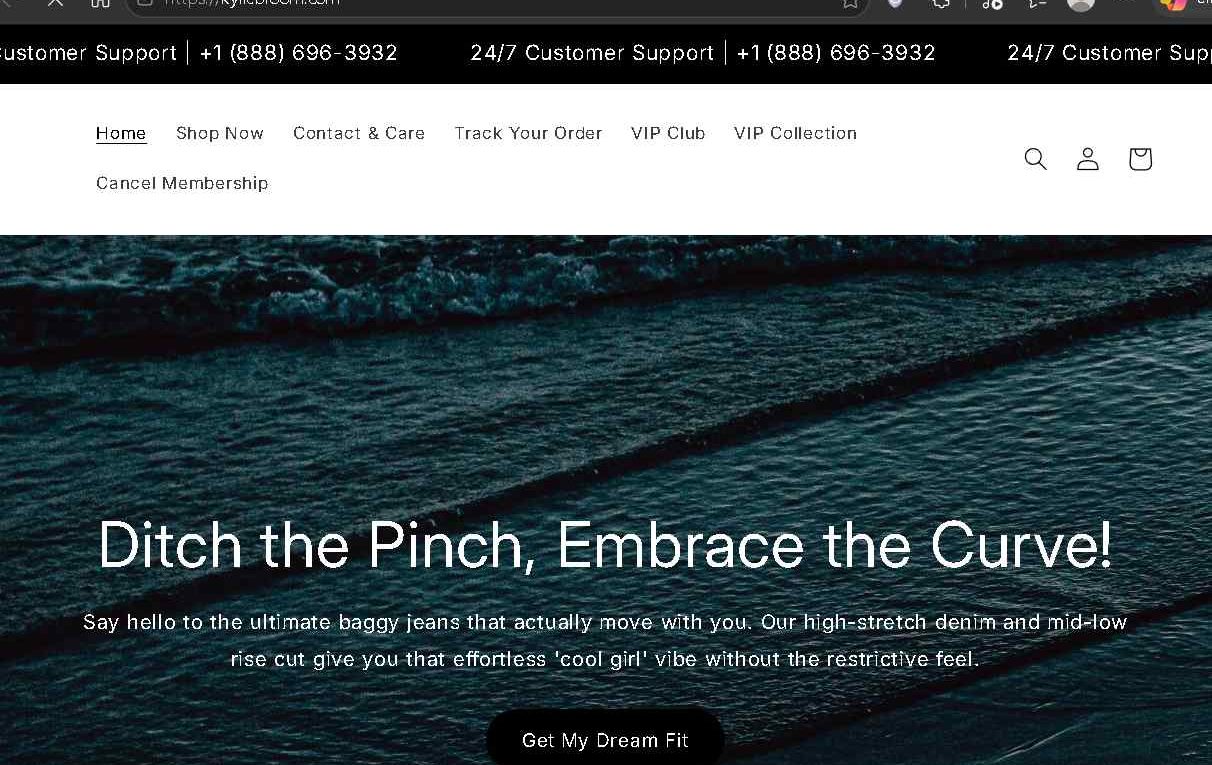
The Hidden Subscription Trap: Why Kyliebloom Is Not Just Selling Jeans
Direct-to-consumer fashion should be simple: you find an article of clothing you like, enter your billing details, pay a clear price, and wait for your package to arrive. In recent years, however, a deceptive e-commerce tactic known as Deceptive Subscription Billing (or Negative-Option Continuity Fraud) has gained traction across the online retail landscape.
Rather than relying on honest retail margins or building brand loyalty, bad actors build visually appealing online storefronts solely as a vehicle to capture credit card information. Once captured, that card data is leveraged to initiate unauthorized, recurring memberships buried deep within the site’s fine print.
To illustrate how these traps operate, we conducted a forensic investigation into Kyliebloom—a trendy women’s apparel website that appears to sell flattering denim jeans, but functions under the hood as a hidden recurring membership funnel.
The Fundamentals of Deceptive Subscription Billing
In consumer protection and financial cybercrime frameworks, deceptive subscription billing is classified as a “negative-option” scheme. The Federal Trade Commission (FTC) and major payment networks (such as Visa and Mastercard) have established strict rules regarding how subscription services must be disclosed. Legitimate subscription companies require clear, upfront, affirmative consent before charging recurring fees.
Deceptive continuity networks, by contrast, rely on deliberate friction and psychological diversion:
- The Compelling Impulse Bait: Operators build an online storefront around a high-demand, trending lifestyle item—such as viral shapewear, custom denim, or wellness supplements. The product is marketed at a standard, accessible retail price.
- Pre-Checked Checkboxes and Buried Terms: During the checkout flow, the merchant quietly bundles a “VIP Club,” “Priority Membership,” or “Buyer Rewards” program into the purchase. The notification is often hidden behind collapsed dropdown menus, greyed-out micro-text, or buried dozens of pages deep inside a generic Terms of Service agreement.
- The Compressed Trial Clock: The purchase includes a brief trial window—frequently 10 to 14 days. Because standard ground shipping for dropshipped goods often takes longer than the trial itself, the trial expires before the consumer even receives the physical product.
- Automated Recurring Billing Cycles: Once the trial window elapses, the billing system charges the customer’s card a recurring fee—typically between $40 and $60. To maximize extraction, these operators often bill every 28 days rather than once a month, sneaking 13 billing cycles into a single calendar year.
- Deflection Customer Support Lines: Continuity merchants deliberately operate dedicated toll-free phone lines or cancellation forms. Their primary goal is not customer satisfaction, but chargeback deflection. By offering to cancel future billings while insisting that past charges are “strictly non-refundable,” they keep their merchant chargeback ratios beneath the critical thresholds enforced by payment card networks.
Case Study: The Inner Workings of Kyliebloom
To an everyday shopper browsing social media feeds, Kyliebloom appears to be a stylish boutique catering to women seeking casual, comfortable everyday wear. The storefront focuses heavily on wide-leg, relaxed-fit baggy jeans, utilizing engaging body-positive marketing hooks like:
- “Ditch the Pinch, Embrace the Curve!”
- “High-stretch comfort engineered for real bodies.”
- Promising the look of vintage structured denim with the flexibility of loungewear.
The storefront is clean, modern, and mobile-optimized, complete with size charts, lifestyle imagery, and standard e-commerce navigation. But beneath this boutique veneer, the true monetization engine has little to do with selling apparel.
Modus Operandi: How the Kyliebloom Trap Unfolds
The real business model of Kyliebloom is engineered around turning one-time apparel shoppers into involuntary continuity subscribers.
1. The 10-Day VIP Trial Stealth Funnel
When a shopper places an order for a pair of jeans on Kyliebloom, the fine print on the site binds them to an automated VIP Club trial.
- The buyer is given a 10-day trial window.
- Once the 10 days pass, the card on file is automatically hit with a recurring fee of $49.95.
- The recurring charge repeats every 28 days indefinitely until the buyer notices the charge and takes proactive steps to stop it.
Because international shipments from unverified direct-to-consumer sites often take 12 to 20 days to arrive, a customer’s trial has typically already expired—and their card billed—before their parcel has even arrived at their doorstep.
2. The “Non-Refundable” Lock-In Clause
If a consumer spots the unexpected $49.95 charge on their credit card statement and contacts Kyliebloom for an explanation, the merchant points to their rigid membership terms:
“VIP membership fees are strictly non-refundable once billed.”
This rigid clause is designed to shut down refund demands immediately. The operators rely on the consumer believing that because a policy was written down on a webpage, it is legally binding—even though negative-option enrollments lacking explicit, affirmative consent violate global consumer protection standards.
3. The “We Replace, We Don’t Refund” Retail Shield
The trap extends to the physical product itself. In its official refund documentation, Kyliebloom employs an aggressive dispute shield:
“KylieBloom replaces. We don’t refund.”
If the jeans you receive are ill-fitting, damaged, or poor-quality synthetic knockoffs, the company refuses to issue a monetary refund, offering only to ship another low-cost replacement item. This tactic is intentionally deployed to drag out customer disputes. As long as an exchange is marked as “in progress,” banks may hesitate to process an immediate chargeback, allowing the recurring $49.95 membership cycles to continue billing uninterrupted.
4. Chargeback Deflection Infrastructure
The site prominently lists a dedicated toll-free phone number (+1 888-696-3932) along with an on-site “Cancel Membership” portal. This infrastructure exists to handle panicked calls from consumers who discover recurring charges on their statements. Support agents are trained to immediately cancel future billings while refusing to refund the money already drawn, effectively keeping the user from escalating the complaint directly to their bank’s fraud department.
Forensic Red Flags Found on Kyliebloom
A technical and legal review of the website reveals multiple unmistakable red flags:
1. Young, Disposable Domain Registration
Domain records confirm that kyliebloom was registered on August 13, 2026. Having operated for only a matter of weeks, the domain has no established commercial footprint, no verified brand pedigree, and sits on privacy proxy servers that completely hide the true owners and physical operators.
2. Extremely Low Domain Trust Rating
Global cybersecurity and fraud monitoring platforms have assigned Kyliebloom exceptionally low trust scores (e.g., 12 out of 100 on major fraud detection indices), citing hidden WHOIS data, proximity to suspicious registrar networks, and signatures identical to known recurring-billing syndicates.
3. Fabricated Social Proof and Performance Statistics
To disarm cautious consumers, the product pages showcase manufactured survey metrics:
- “98% of customers reported all-day comfort”
- “94% agreed the shape holds wash after wash”
These statistics, alongside generic reviews from names like “Jessica R.” and “Mia K.,” are hardcoded static page elements. They are accompanied by zero verified third-party review syndication, zero video unboxings, and no independent social footprint across platforms like YouTube or Reddit.
4. Total Lack of Verifiable Corporate Entity
The website displays no corporate registration numbers, no formal LLC or Inc. disclosures, and no verifiable physical corporate address. Consumers have no way of knowing what business entity is handling their sensitive financial data.
Final Verdict
Verdict: High-Risk Deceptive Subscription Trap / Avoid Entirely
Kyliebloom is NOT a conventional, trustworthy apparel boutique. It is an e-commerce storefront operating a negative-option billing trap designed to convert one-time denim buyers into unauthorized $49.95 monthly continuity subscribers.
Shoppers who enter their card details on Kyliebloom face significant financial risks:
- Silent enrollment into a recurring $49.95 charge billed every 28 days.
- Strict “no-refund” policies specifically written to block return attempts.
- Low-grade dropshipped garments that rarely match promotional imagery.
- Potential exposure of sensitive payment credentials to unvetted merchant gateways.
Recommendation: Do not purchase from Kyliebloom. If you already placed an order on the site, do not wait for the 10-day trial to expire. Contact your card issuer immediately to report unauthorized recurring charges and request a card replacement.
Frequently Asked Questions (FAQ)
Is Kyliebloom a Scam?
Yes, Kyliebloom operates using deceptive subscription billing tactics that fit the definition of an e-commerce membership trap. While the site presents itself as a standard denim store, transactions quietly enroll consumers into an ongoing VIP Club that bills $49.95 every 28 days without upfront, explicit consent.
Is Kyliebloom Legit?
No, Kyliebloom is not an established, legitimate fashion brand. The domain was registered in August 2026, hides its ownership behind proxy services, provides no verifiable corporate headquarters, and utilizes fabricated customer review counters to project false credibility.
Why does Kyliebloom bill every 28 days instead of monthly?
Billing every 28 days is a classic technique used by negative-option continuity schemes. It shifts the billing date slightly each month to avoid routine calendar checks and extracts 13 payments per year from the consumer instead of the standard 12.
How do I cancel the Kyliebloom VIP membership?
You can attempt to cancel future billings by using their on-site cancellation page or calling their customer service number (+1 888-696-3932). However, because their internal policy states that fees are non-refundable once charged, you should immediately contact your credit card company or bank directly to block future transactions from this merchant.
What should I do if Kyliebloom charged my card $49.95?
If an unexpected recurring charge from Kyliebloom appears on your statement:
- Call Your Bank’s Fraud Department: Explain that your card was enrolled in an unauthorized negative-option recurring subscription without clear, affirmative consent during checkout.
- File a Dispute / Chargeback: Request a formal chargeback under “Deceptive Billing” or “Unauthorized Recurring Transaction.”
- Cancel and Reissue Your Card: Have your financial institution cancel the compromised payment card and issue a new card number to prevent the merchant from continuing to push recurring tokens through your account.
For more shady sites exposed, check our Shopping Scam Directory — your quick guide to staying safe online.
Every safe click counts. If this post helped, a coffee gesture fuels more scam‑busting investigations.

Call to Action
Please share this article to spread awareness. Follow us on Facebook, Twitter, and Instagram for more scam alerts. If you doubt the legitimacy of any website or investment plan, DM us on social media — we’ll help you verify.