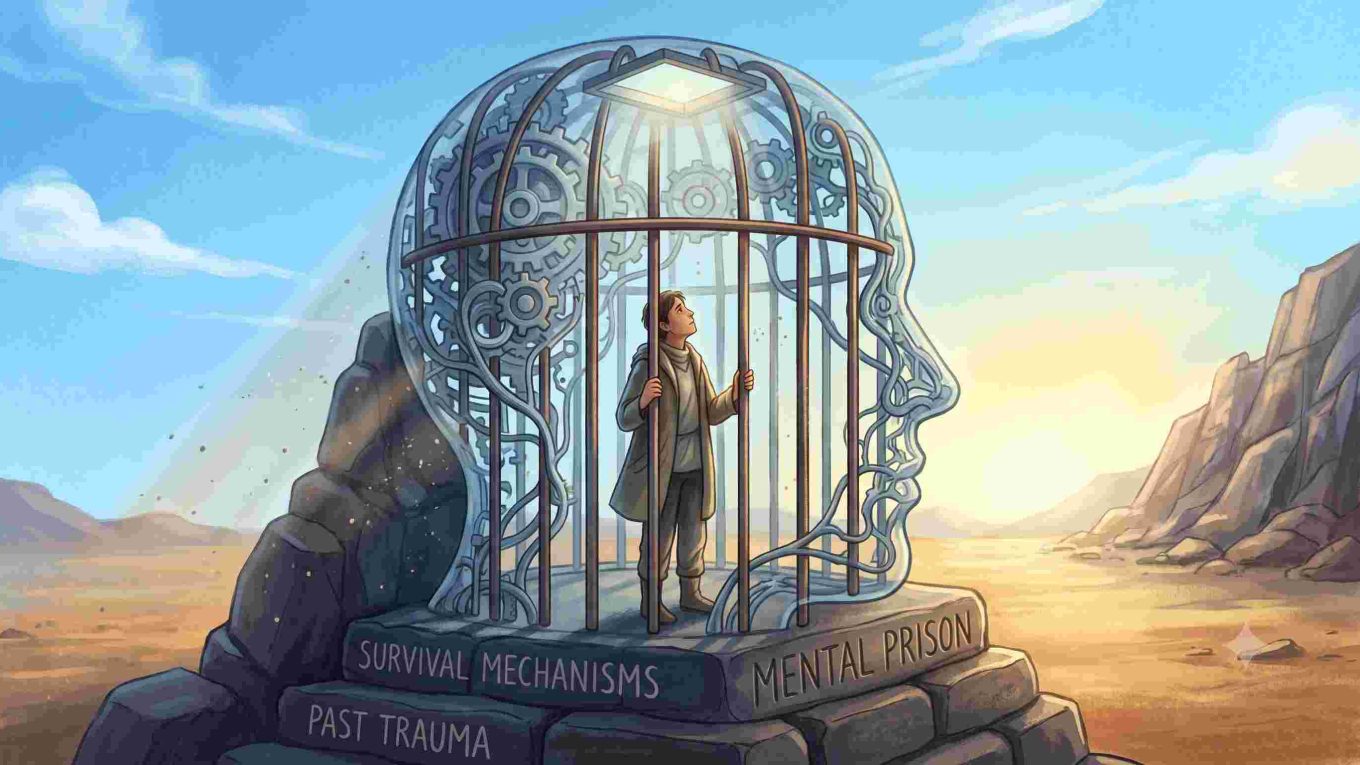
Chapter 1: The Foundation — How a Mental Prison is Built
The Coat in the Desert
Imagine a traveler caught in a sudden, blinding blizzard high in the mountains. The wind cuts like broken glass, the temperature plumlits below zero, and every breath burns his chest. In a desperate bid to survive, he pulls on a thick, dense coat made of boiled wool and lined with heavy hide.
The coat is stiflingly heavy and limits his stride, but it does something miraculous: it traps body heat, deflects the razor-sharp sleet, and saves his life. Without it, he would have frozen solid before morning.
Days turn into weeks. The traveler keeps walking, descending from the crags into lower valleys, and eventually emerging onto the floor of a sun-scorched, arid desert. The heat beats down from above, radiating off the cracked clay beneath his boots. Sweat pours from his temples, his skin blisters under the wool, and his shoulders ache under the crushing weight. Every step is an agonizing drain of energy.
A passerby stops, squinting in disbelief. “Why don’t you take off the coat?”
The traveler clutches the collar tighter, his knuckles white with fear. “You don’t understand,” he rasps, his eyes scanning the cloudless horizon. “This coat is the only reason I am alive.”
He is not irrational; he is simply remembering. To his intellect, the desert is obvious. But to his nervous system, the memory of the freezing wind remains immediate and absolute. Removing the coat does not feel like shedding extra weight—it feels like stepping naked into an executioner’s frost.
And so he marches forward under the blistering sun, dying of exhaustion inside the very thing that once saved him.
The Architecture of a Mental Prison
Most people never truly grasp what it means to live inside a mental prison. Or perhaps everyone knows it intimately, but spends an entire lifetime trying not to think about it.
When the walls close in, our immediate impulse is to escape. We reach for quick exits: late nights, social gatherings drenched in alcohol, or recreational drugs to manufacture an artificial sense of peace and happiness. But these are temporary sedatives. They exact a heavy toll in the long run, eroding physical resilience and leaving the underlying psychological state worse than before.
When we refuse to confront our internal conflicts head-on, neither the mind nor the body builds genuine immunity to them. The mind and somatic muscle memory must learn to process the tension of the imaginary ghosts that haunt us the moment we attempt to sit in quiet awareness. These shadows strike hardest late at night—when physical energy is depleted, emotional defenses are down, and our thoughts are at their weakest. That vulnerability draws us directly toward counterfeit cures and chemical escapes.
The central paradox remains: your mental prison was never built to punish you. It was built to protect you.
The human brain is not primarily wired to produce calm, fulfillment, or creative joy. It is wired to ensure the survival of a fragile biological organism in an unpredictable world. When you experience emotional turbulence—instability, rejection, chronic criticism, or unexpected loss—your nervous system constructs a bunker.
You do not retreat into a mental prison because you dislike freedom. You retreat because artillery was falling.
If you grew up in an environment where volatility flared without warning, you developed hypervigilance. You learned to decode footsteps in the hallway and read subtle shifts in tone like barometric pressure. That vigilance kept you out of the line of fire. It was adaptive.
If speaking your mind invited humiliation, you forged an iron barrier of silence. If validation depended on flawlessness, you wore the armor of perfectionism—working past exhaustion to prevent anyone from finding a reason to reject you.
The tragedy is not that you created these defenses. The tragedy is that the storm passed, but your nervous system never received confirmation that the environment was safe again. What began as essential armor gradually hardened into a mental prison.
The Three Cornerstones of the Cell
While the specific layout of every mental prison differs from person to person, most are anchored by three core behavioral patterns:
1. The Vigilance Trap (Catastrophizing as Control)
Inside a mental prison, the brain treats chronic worry as an active defense. It runs on a silent premise: If I imagine every worst-case scenario in advance, nothing can catch me off guard. You rehearse confrontations that have not occurred and scan daily interactions for signs of betrayal. Yet chronic worry does not neutralize risk; it merely forces you to live through a crisis repeatedly before it ever arrives.
2. The Moat (Isolation and Premature Withdrawal)
To avoid the pain of vulnerability or rejection, the mind builds an emotional moat. It reasons that if no one is allowed close, no one possesses the leverage to hurt you. You pull back from community, mask vulnerability behind humor or detachment, and exit promising situations prematurely. The moat succeeds in keeping danger out, but it also locks out genuine connection, leaving you isolated inside your own defenses.
3. The Unbreakable Rulebook (Rigidity and Perfectionism)
When external circumstances feel chaotic, the mind attempts to impose order through inflexible internal standards:
- I cannot afford to make a mistake.
- I must stay productive at all costs.
- I am responsible for managing everyone else’s emotional comfort.
Perfectionism is rarely an ambition for excellence; it is a mechanism for emotional safety. It operates on the assumption that flawless performance shields against shame. However, living by zero-tolerance rules leaves zero room for error, rest, or authentic growth.
Breaking the Foundation
You cannot shame yourself out of a mental prison built on fear.
Scolding yourself for overthinking or feeling frustrated by your anxiety is like yelling at the traveler in the desert for sweating. He knows he is overheating; what he needs to understand is that the freezing wind has passed.
Dismantling a mental prison starts by replacing self-condemnation with objective observation. Instead of asking, “Why am I broken?” ask, “What specific threat was this behavior originally developed to protect me from?”
When you recognize these cognitive loops not as personal failures, but as an outdated security protocol running on old data, your relationship with your thoughts changes. You stop fighting the mind and begin retraining the nervous system to recognize that the climate has changed, the ground is stable, and the door can be opened safely.
Practical Step: Auditing Your Mental Prison Walls
Take a notebook and write down direct answers to these four diagnostic prompts:
- Identify the Barrier: What automatic thought pattern or avoidance habit makes you feel most trapped inside your mental prison right now (e.g., reaching for a drink to unwind, withdrawing from friends, overanalyzing minor decisions)?
- Trace the Origin: Looking back honestly, in what period of your life did this response serve as a necessary defense mechanism? What past pain did it help you avoid?
- Audit the Long-Term Cost: What does relying on this defense mechanism cost you today in terms of physical energy, emotional clarity, and real-world progress?
- The Grounding Statement: Write down this straightforward reminder:“This pattern kept me safe when I lacked other options. It served its purpose. But that season has passed, and I can begin developing the strength to face reality without it.”
Suyesh Gusain is a writer and researcher exploring mental resilience, behavioral psychology, and the hidden mechanics of human decision-making. Through deep self-inquiry and practical frameworks, his work focuses on deconstructing internal cognitive traps and helping readers cultivate genuine mental clarity and emotional autonomy.
Did this perspective resonate with you?
Break the Silence
The walls of a mental prison thrive in isolation. If this piece brought up a memory, a shift in perspective, or an armor pattern you’re working to set down—join the conversation.
Drop your reflections in the comments below, or send us a direct message if you’d prefer to share your thoughts privately. We read and value every word.
Chapter 2: The Iron Bars
Recognizing that your armor was forged for survival is the first step toward freedom, yet knowing the storm has passed does not automatically make you step outside. Over time, the bunker installed its own internal security system—a web of rigid, unquestioned rules that dictate where you can walk and what you are allowed to believe. In the next chapter, we examine how these invisible cognitive distortions convince you the cell is still locked, and how to begin bending them back into perspective to reclaim your open water.