
Blessed are those Soul Who Love their Work
In the 21st century, a new trend has taken over: the idea of “doing what you love.” Many middle-class individuals have started questioning their careers, searching for jobs that align with their true passions. However, only a few people ever truly figure out their passion and make a living from it. For the vast majority, working a “dream job” remains just that—a dream.
Historically, loving your job is a very rare phenomenon. Not everyone can turn their hobby into a career because doing so requires extreme sacrifices. The people who have achieved greatness in any field have paid a heavy price for it, often struggling to balance their personal and professional lives. This does not mean they are bad people; it simply highlights a tough reality. The real question we must ask ourselves is: how are we choosing to spend the limited time we have?
When we see someone genuinely enjoying their work, it is usually in the arts, like music. We are naturally drawn to people who love what they do. Watching someone completely drowned in their craft is a beautiful experience. The best part is that, to them, it doesn’t even feel like work. Because they are enjoying the process, the final result naturally turns out great.
The State of ‘Malang’: Losing Yourself in Your Work
There is an Urdu word, ‘Malang’, which carries a beautiful tone and deep meaning. It is often used in Sufism to describe a disciple who loses their worldly senses and enters a pure consciousness of love. A Malang is a person so deeply absorbed in their actions that they forget everything else around them, sometimes even God.
After a certain point in life, money loses its ultimate importance. While it is essential for fulfilling our physical world needs, money cannot satisfy the soul. This is why people who have an abundance of wealth often turn to charity—helping others makes them feel good and brings a sense of inner peace.
Helping others is a wonderful deed, but true satisfaction comes from our daily actions. Doing the work is in our hands, and we must learn how to enjoy it, regardless of whether it is our dream job or not. If you truly cannot find joy in it, you must have the courage to leave and try something else.
The Dilemma of Love and Duty
Doing a job you love is not easy, and learning to love the job you already have is even tougher. Because of this, many of us feel an emptiness inside. We go to work every day, but that deep satisfaction is missing.
The legendary poet Faiz Ahmad Faiz beautifully captured the dilemma of the common man, who struggles to dedicate himself fully to either his passion or his duties:
Wo log bahut khush-qismat the, Jo ishq ko kaam samajhte the, Ya kaam se aashiqui karte the. Hum jeete-ji masroof rahe, Kuch ishq kiya, kuch kaam kiya. Kaam ishq ke aade aata raha, Aur ishq se kaam ulajhta raha. Phir aakhir tang aa kar hum ne, Dono ko adhoora chhod diya.
English Translation: Those people were incredibly fortunate, Who considered love as their duty, Or who were deeply in love with their work. I remained occupied my entire life, I loved a little, and I worked a little. Work kept getting in the way of my love, And love kept tangling with my work. Then finally, out of sheer frustration, I left them both incomplete.
This poem reflects the reality of most people: leaving things incomplete. It takes immense effort to complete a task you dislike. But when you love what you are doing, the effort feels effortless. That is simply human psychology. Have you ever noticed that when you play a game you love, time flies at the speed of light? Yet, the moment you are forced to do something you hate, time moves at a snail’s pace.
Blessed are those souls who love their work. When you love the process, the final result does not matter. The action itself (Karma) becomes the reward (Fal).
Why Are We Here?
Whenever I think deeply about life, I struggle to find a clear answer to what we are actually doing on this Earth. It sometimes feels like we are all just passing time until we die.
There is an elderly man who lives in my neighborhood. He has a nice, large house all to himself. His children live far away, and his wife recently passed away. He is retired and has nothing to do all day. Whenever I look at him, I find it intriguing and a bit sad. What is the end goal of all our running around? Ultimately, there is nothing.
We are just living and trying to keep ourselves busy. We often trick ourselves into thinking we were born for some grand, special purpose. But I have realized that if I don’t do the work I am supposed to do, someone else will. The cremation grounds are filled with important VIPs who once believed the weight of the entire world rested on their shoulders.
So, what is life? Why do we do the things we do? I do not have all the answers. But I have realized that the past and the future exist only in our minds. The only thing we actually have control over is the present. Whatever we need to do can only be done right now. Life is flowing, and so are we. The best approach is to flow with it—working daily on the things we can control, preparing ourselves, and waiting for our time to come.
Becoming an Artist in Whatever You Do
Life is not constant for anyone. The only constant in the world is change. However, as humans, we shouldn’t just change; we should evolve. What does that mean? Change can be random, but evolution means moving forward and becoming a better version of who we were yesterday.
To evolve, all we have to do is become conscious of our actions. The more consciously we apply ourselves to a task, the more fluent we become at it, and eventually, we start liking it. Think about riding a bicycle. When you first learn, it takes all your concentration. But after enough practice, you can ride with your arms wide open, turning the cycle without even holding the handlebars. When we put enough effort into mastering a skill, the work becomes effortless.
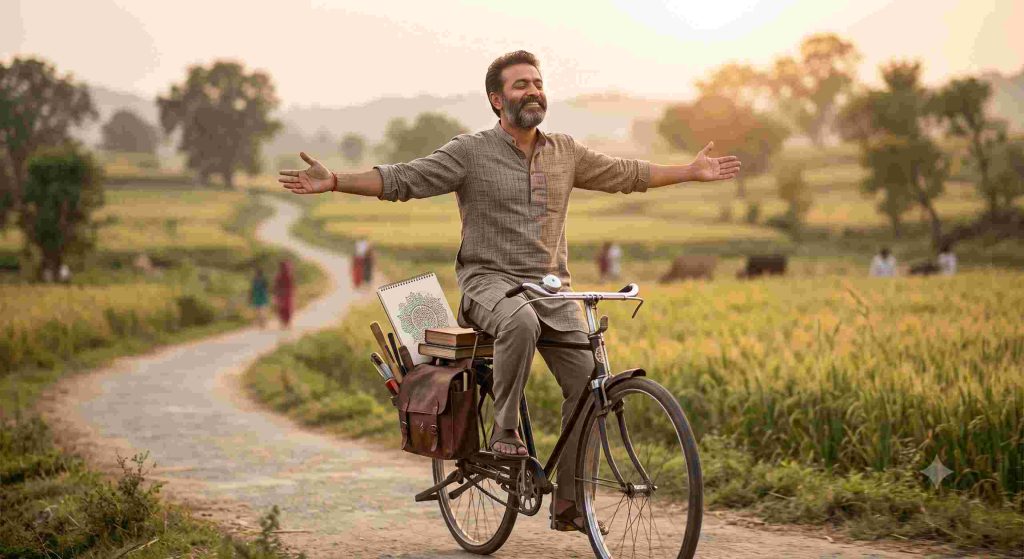
When we reach that level of mastery, time ceases to exist. We enter a flow state, just like the Malang.
A common fallacy in our society is the belief that only painters, musicians, or actors can be “artists.” In reality, an artist is simply anyone who is a master of their field and performs their work seamlessly, without friction. An engineer who writes beautiful, clean code is an artist. An accountant who manages the books with perfect precision turns their ledger into a piece of art.
This level of artistry only happens when we learn to love the work we do. In the beginning, everything is difficult. But with time and focus, things become so easy that your old mistakes disappear. It is hard to find a job you love, but you can choose to start liking the work currently in your hands. Put every ounce of effort you have into the present moment, let the results take care of themselves, and keep working on becoming the best version of you.
Be Happy!
If you like the article, please share it with others and do share your thoughts in the comment box.