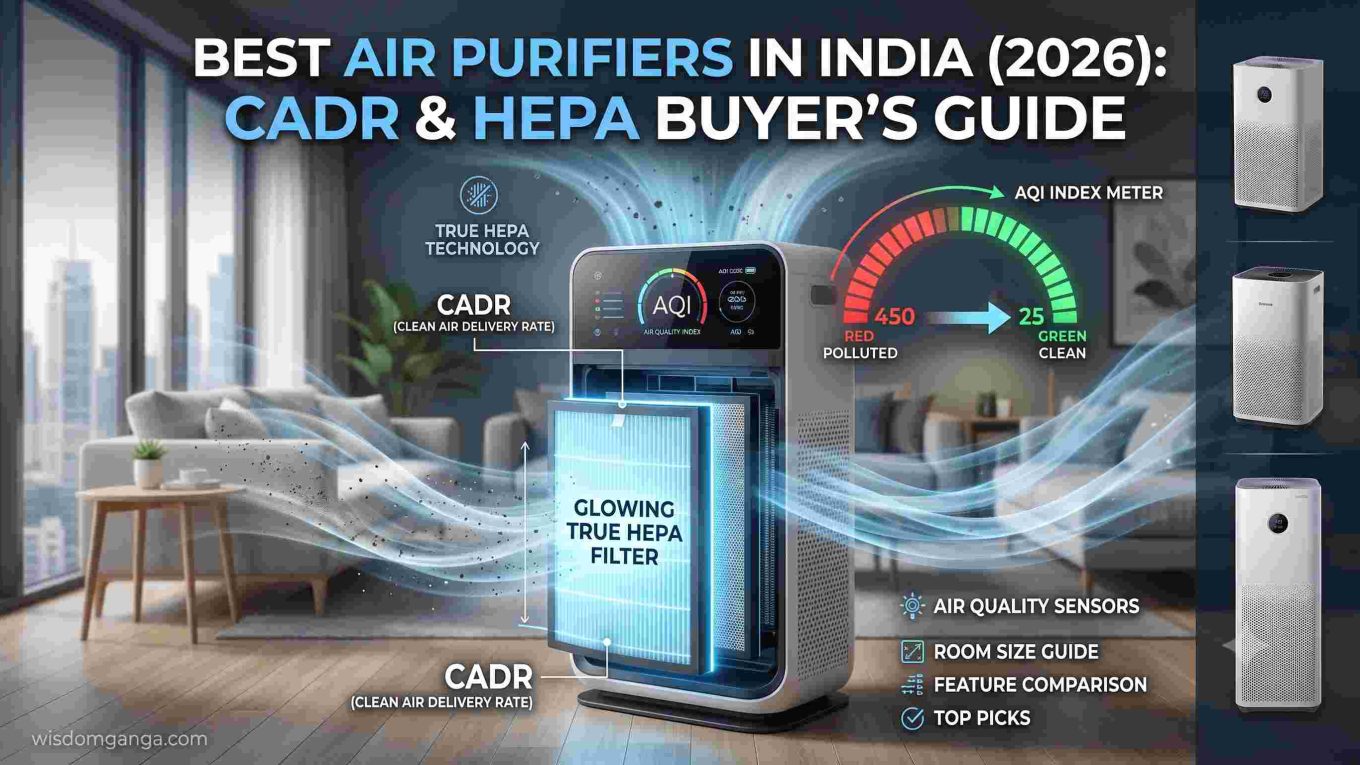
Best Air Purifiers in India (2026): HEPA Ratings, CADR Reality & Festive Buying Guide
Over the past few years, a new product has gained popularity in India—air purifiers. Earlier, we had never even heard of them in our localities. But today, they can be found easily in many urban households.If you live anywhere across Delhi-NCR, Uttar Pradesh, Punjab, or Haryana, you know the exact week every autumn when the air turns thick, acrid, and metallic.
By mid-October, when seasonal crop burning collides with stagnant winter inversion and festival firecrackers, indoor AQI monitors routinely breach 400+. At that point, clean air stops being a wellness luxury—it becomes basic respiratory self-defense. And Air Purifiers comes into picture.
Yet walk into an appliance store or scroll through e-commerce banners right now, and you’ll encounter shameless marketing gimmicks. Brands throw around meaningless buzzwords like “HEPA-type,” “Swiss design,” or “Ozone Freshness,” slapping 500 sq. ft. room coverage stickers on machines that move barely enough air to clear a small pantry. A purifier is essentially a fan strapped to a sealed filter; if the CADR is weak or the filter seals leak, you are just recirculating toxic PM2.5 and paying for the electricity to do it.
Affiliate Disclosure: As an Amazon Associate, wisdomganga.com earns from qualifying purchases at no additional cost to you. We do not accept sponsored brand placements or free review units; our teardowns are based strictly on filter density, independent CADR testing, and long-term cartridge replacement costs.
Quick Comparison: Top Tested Air Purifiers Picks
| Category | Product Pick | Filter Grade | CADR (m3/h) | Ideal Room Size | Price Check |
| Best Overall (Zero Gimmicks) | Coway Airmega 150 | True HEPA (Green Anti-Virus) | 303 | Up to 355 sq. ft. | Check Price on Amazon.in |
| Best for Master Bedrooms | Philips Series 2000i (AC2958/63) | NanoProtect True HEPA | 380 | Up to 480 sq. ft. | Check Price on Amazon.in |
| Best Budget Smart Purifier | Xiaomi Smart Air Purifier 4 Lite | High-Efficiency Particle Filter | 360 | Up to 460 sq. ft. | Check Price on Amazon.in |
| Best Bladeless & Sealed | Dyson Purifier Cool Gen1 / TP10 | Fully Sealed HEPA H13 | ~290 | Up to 400 sq. ft. | Check Price on Amazon.in |
The Smart Buyer’s Checklist: 4 Hard Rules Before Buying
Before checking out during festival sales, run any shortlisted model through these four mechanical checks:
- Demand a Certified True HEPA (H13 or Equivalent): True HEPA standards guarantee the capture of 99.97% of particulate matter down to 0.3 microns. If a spec sheet says “HEPA-grade,” “HEPA-style,” or “dust-trap mesh,” walk away. Those filters let ultrafine PM2.5 blow straight through the exhaust.
- The 4x Air Changes per Hour (ACH) Rule: Never trust manufacturer coverage claims. To calculate your required Clean Air Delivery Rate (CADR), multiply your room volume by 4:Minimum Required CADR ($m^3/h$) = Room Length × Width × Ceiling Height (in meters) × 4
- The True Cost of Replacement Filters: An air purifier is an ongoing subscription. A cheap ₹8,000 purifier requiring a ₹4,000 filter cartridge every 5 months costs far more over two years than a ₹13,000 machine with an annual ₹2,200 filter replacement.
- Avoid Uncontrolled Ionizers: Steer clear of standalone negative ion or “plasma” modes unless they can be toggled completely off. Low-quality ionizers emit small amounts of ozone, an irritant that can inflame bronchial airways and trigger asthma attacks.
“Securing clean indoor air is only half the equation for urban households dealing with winter pollution and erratic infrastructure. Just as airborne PM2.5 requires True HEPA extraction, fluctuating post-monsoon tap water requires calibrated membrane filtration. If you are auditing your home’s seasonal health setup, check our tested guide on the best water purifiers in India to avoid toxic heavy metals and high TDS without reckless water wastage.”
Detailed Reviews of Top Air Purifiers in India
1. Coway Airmega 150: The Clean Filtration Benchmark
The Coway Airmega 150 remains our default recommendation because it avoids smart-gimmick clutter in favor of heavy, sealed filtration. Its front-loading pull-out cartridge tray is a design triumph: you can slide out the plastic pre-filter and wash it under a tap every two weeks without pulling the machine apart or touching the sensitive HEPA layer.
- Filtration Architecture: 3-stage filtration—washable pre-filter, granular carbon deodorization filter, and Coway’s Green Anti-Virus True HEPA filter.
- Pros:
- Exceptional filter longevity (easily lasts 8,000+ hours in real Indian home tests before requiring full replacement).
- Replacement filters are widely available on Amazon India at reasonable prices (~₹2,500).
- Highly responsive real-time air quality sensor that shifts color within seconds if someone burns toast or dusts a mattress nearby.
- Cons:
- No Wi-Fi connectivity, app integration, or remote control.
- At full fan speed, the wind noise is noticeable (run it on high for 30 minutes before sleep, then drop it to Silent mode).
- Verdict: The most reliable, fuss-free medical-grade air purifier for standard Indian bedrooms.
- Check Latest Price & Reviews on Amazon.in
2. Philips Series 2000i (AC2958/63): The Large-Room Workhorse
While many brands settle for a vague 3-color light ring, the Philips 2000i features an accurate numerical display showing real-time PM2.5 counts. In testing across smoggy winters, it drops an indoor PM2.5 level of 320 down to under 25 in less than 15 minutes in a closed 16×14 master bedroom.
- Filtration Architecture: NanoProtect HEPA composite filter with active carbon honeycomb.
- Pros:
- Robust CADR of 380 $m^3/h$, ideal for large living rooms, master suites, or open-plan apartments.
- Reliable Clean Home+ mobile app allows scheduling so you can start purification an hour before heading home from work.
- 360-degree cylindrical air intake pulls air evenly across all sides.
- Cons:
- The barrel replacement filter is bulky and relatively expensive (~₹3,500–₹4,200).
- The unit is physically large and requires dedicated floor real estate away from walls.
- Verdict: The heavy-duty pick for larger living spaces and homes where you need visible, numerical verification of air quality drops.
- Check Latest Price & Reviews on Amazon.in
3. Xiaomi Smart Air Purifier 4 Lite: The Best Smart Value
Xiaomi continues to dominate the budget tier by offering high volumetric airflow and rich smart home automation under ₹10,000. If you are building a smart home with Google Home or Alexa, the Mi Home app lets you set automation rules (e.g., “Turn fan speed to Max if PM2.5 exceeds 100, and drop to Silent at 10:30 PM”).
- Filtration Architecture: Integrated 3-in-1 cylindrical high-efficiency composite barrel filter.
- Pros:
- Outstanding CADR ($360\ m^3/h$) relative to its sub-₹10,000 price point.
- Compact square footprint that slides neatly into room corners.
- Full integration with Google Assistant, Alexa, and automation routines.
- Cons:
- The filter is an all-in-one assembly; you cannot replace the carbon layer independently from the particle filter.
- The rear laser sensor can accumulate fine silt over time, requiring you to blow it clean with compressed air or a hair dryer on cold setting every few months.
- Verdict: The top value-for-money option for tech-savvy users and budget-conscious buyers.
- Check Latest Price & Reviews on Amazon.in
4. Dyson Purifier Cool Gen1 (TP10): Bladeless Tech & Guaranteed Sealing
Let’s be candid: Dyson purifiers carry a substantial design premium. On a pure CADR-per-rupee basis, Coway and Philips beat it easily. Where Dyson earns its keep is whole-machine acoustic dampening, continuous airflow projection, and certified H13 hermetic sealing—meaning zero unfiltered air leaks through the chassis seams back into your room.
- Filtration Architecture: 360-degree glass HEPA H13 filter combined with activated carbon media.
- Pros:
- Entire machine is sealed to HEPA H13 standards, preventing micro-particulate leaks.
- Bladeless fan architecture provides strong air throw and 350-degree oscillation.
- Whisper-quiet operation on lower modes.
- Cons:
- High upfront price and expensive replacement filters.
- Lower air throughput speed compared to box-style purifiers in the same space.
- Verdict: A luxury, high-aesthetic machine for modern interiors where bladeless fan cooling, premium aesthetics, and silent operation outweigh raw budget math.
- Check Latest Price & Reviews on Amazon.in
Frequently Asked Questions (FAQ)
Q: Do air purifiers eliminate kitchen smells and gas leaks, or just dust?
A: True HEPA filters only capture physical particles (PM2.5, dust, pet hair, pollen). They cannot absorb gases. To tackle cooking odors, formaldehyde, paint fumes, and vehicular exhaust ($NO_2$), you must choose a unit with a thick, granular Activated Carbon Filter.
Q: Where should an air purifier be placed in an Indian bedroom?
[HUMAN ANCHOR: PRACTICAL WORKAROUND]
Keep the purifier at least 1.5 to 2 feet away from walls and wardrobes so the intake vents aren’t blocked. Never place it right beside an open door or balcony window; the unit will waste energy attempting to scrub incoming outdoor pollution instead of circulating clean air around your bed.
Q: How long do filters really last during peak winter pollution in North India?
A: Brand marketing often claims “12 months filter life,” but that is based on clean lab air running 8 hours a day. Under severe Indian winter conditions (AQI 350–500+ with 16+ hours of daily usage), expect HEPA filters to saturate within 6 to 8 months. Clean your pre-filter every fortnight to preserve the life of the inner HEPA layer.
Q: Can you wash a True HEPA filter to reuse it?
[HUMAN ANCHOR: CRITICAL SKEPTICISM]
Never wash a True HEPA filter. Water permanently matts down the sub-micron glass microfibers, tearing holes in the microscopic mesh and destroying its electrostatic charge. Once washed, the filter is ruined. You should only ever vacuum or wash the removable plastic pre-filter screen.
Q: Will running an AC air filter replace the need for an air purifier?
A: No. Standard split AC mesh filters are only designed to keep coarse dirt from clogging the aluminum cooling fins. They have zero capability to capture microscopic PM2.5 particles or hazardous vehicular gases.
Q: How should I run the purifier at night to sleep without noise?
A: Close all bedroom windows and doors 30 minutes before bedtime. Run the purifier on its maximum turbo setting to rapidly clear the room’s air volume down to safe thresholds (AQI < 30). Once you get into bed, toggle the machine to “Night Mode” or Fan Speed 1. It will maintain low AQI silently throughout the night.
Final Verdict
For 90% of Indian households, the Coway Airmega 150 is the smartest financial and technical choice: it cleans air quietly, avoids unnecessary smart-gimmick failures, and keeps annual filter replacement costs low. If you have a large living room, go with the high CADR volume of the Philips Series 2000i. If you prioritize budget and smart-home automation, the Xiaomi 4 Lite delivers unmatched value per rupee.
Track festive discounts, bank card checkout offers, and filter bundle deals directly on Amazon India.