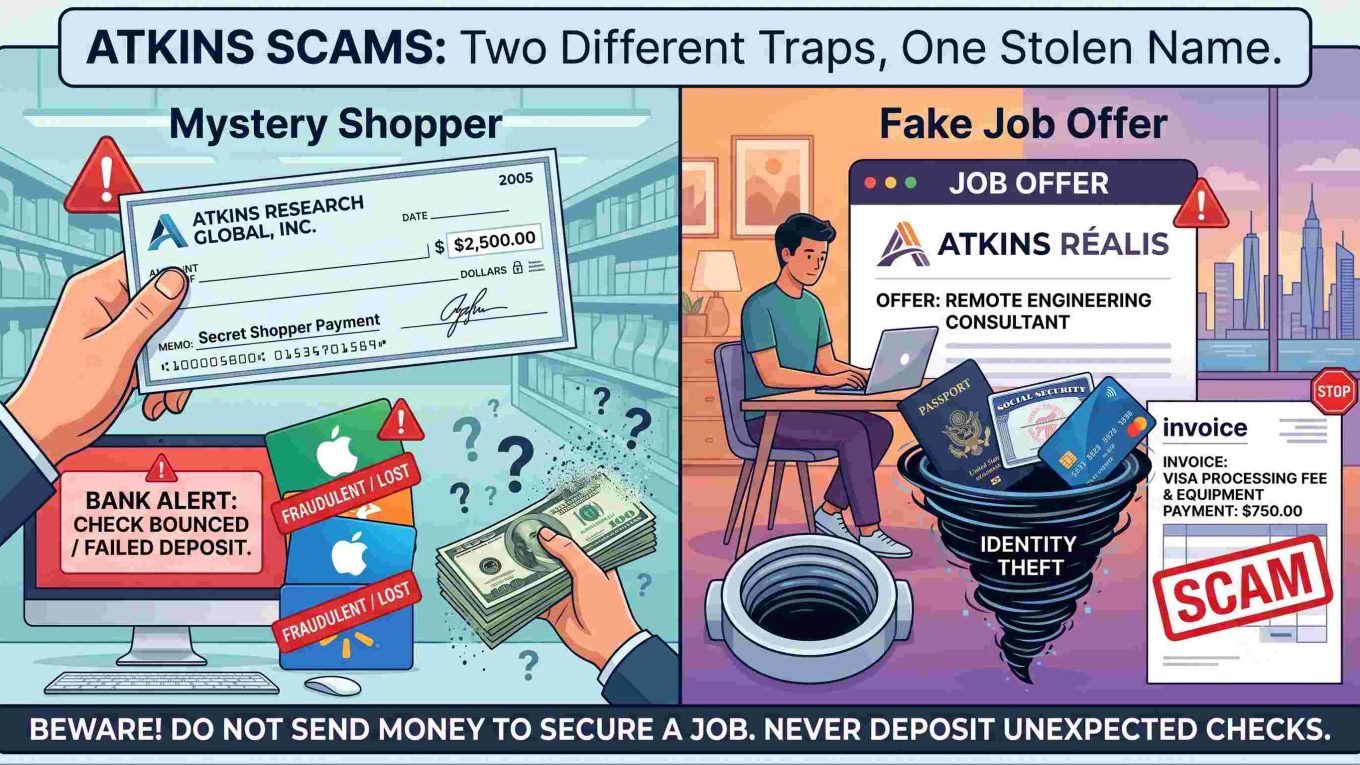
The Truth About the Atkins Research Global Scam: Two Traps You Need to Avoid
A new kind of scam has been arrived on the internet that is tricking a lot of hard-working people lately. The name of the scam is ‘Atkins Research Global Scam’. If you are searching about it then you might have feeling of mix of confusion, excitement and suspicion. Most of the people receive mail and found a surprisingly large check waiting for them. Or an email regarding high paying remote job that seems to be too good to be true.
Here learn this point clearly that if something is free then you are the product and same goes for Atkins Research Global Scam.
This article is written with an intention to help people untangle the truth, protect their bank account and keep their personal identity safe form scammers. The most important thing to remember is that it is not just one scam out in the market. There are two completely different scams working in the name of ‘Atkins Research Global’. Both scams use the name of real, legitimate companies to build trust, and both end with victims losing a lot of money.
Let us break down exactly how both of these scams work in simple English, step by step, so you can spot the warning signs before it is too late.
Scam Number 1: The “Atkins Research Global” Mystery Shopper Trap
The first scam we need to look at is the mystery shopper fake check scam. In this scenario, the scammers are impersonating a real market research company based in Los Angeles called Atkins Research Global.
This scam preys on our desire to make a little extra money on the side. Here is the step-by-step breakdown of how they pull it off.
The Bait
It usually starts with a random text message or a letter in the mail. The message will say something like, “Congratulations, you have been selected to be a secret shopper in your area!” They will promise to pay you a flat, easy rate—usually a few hundred dollars—just to visit local stores like Walmart or Target, buy a few small items, and review the customer service. It sounds like a fun and easy way to earn cash.
The Hook
If you agree to do the job, the scammers will mail you a physical check. This is where people get fooled, because the check looks entirely real. It might be written for a large amount, such as $2,500 or even $3,500. It will have a real bank logo, routing numbers, and a professional-looking signature. The scammers will give you very specific instructions: they want you to deposit this check into your personal bank account.
The Trap
Once you tell them the check is deposited, they will give you your first “assignment.” They will tell you to keep $300 or $400 for your own salary. Then, they will instruct you to take the rest of the money and buy things like Apple gift cards, or ask you to wire the money through a service like Western Union to a “vendor.” They might say this is to test the wire transfer service or to buy supplies for your next shopping task.
The Ugly Truth
Because banking laws require banks to make funds available to you quickly, your bank account will likely show that the money is there within a day or two. You will feel safe going out to buy those gift cards or wire that money.
However, about a week later, your bank will discover that the check you deposited was completely fake. The bank will immediately take that massive amount of money back out of your account. If you already spent the money on gift cards and sent the codes to the scammers, that money is gone forever. Your bank will hold you legally responsible for the missing funds, and you could be left thousands of dollars in debt.
Scam Number 2: The “AtkinsRéalis” Fake Job Offer
Now, let us switch gears and look at the second scam. This one has nothing to do with mystery shopping. Instead, it targets people who are looking for a good, honest career. In this trap, the scammers are impersonating a massive, multi-billion-dollar global engineering and design company called AtkinsRéalis (which used to be known as Atkins Global).
This scam is incredibly cruel because it plays on the hopes of people who need a job to support their families.
The Bait
The scammers post fake job listings on popular websites, or they might just email you directly saying they found your resume online. The jobs they offer are usually fantastic. They might offer a high salary, the ability to work from home, or even the chance to relocate internationally. To make it look real, the scammers will use the names of actual employees or recruiters who work for AtkinsRéalis.
The Hook
The hiring process will feel incredibly rushed and far too easy. You might be asked to do a quick “interview” through a text-based app, an email questionnaire, or a simple phone call. You will not have to go through the difficult, multiple-round video or in-person interviews that a major global company would normally require. Very quickly, they will send you an official-looking offer letter with the company logo on it.
The Trap
Once you celebrate getting the job and accept the offer, the real scam begins. The scammers will tell you that before you can start working, you need to handle some paperwork and expenses.
They will ask you to fill out “human resources” forms that demand your most sensitive personal information. They will want a copy of your passport, your Social Security number, and your full bank account details (claiming they need this to set up your direct deposit for payroll).
Then, they will ask you for money. They might say you need to pay a fee to process your work visa, pay for a background check, or buy a specific laptop and software from their “approved vendor” for your home office. They will promise that the company will reimburse you for these costs on your first paycheck.
The Ugly Truth
There is no job. If you send them money for equipment or visas, they will just take your cash and disappear. Worse yet, if you gave them your passport, Social Security number, and banking details, they now have everything they need to steal your identity. They can open credit cards in your name or drain your existing accounts.
How to Protect Yourself from Both Scams
I know reading about these scams can be frightening, but you have the power to protect yourself. By learning a few simple rules, you can spot these fraudsters from a mile away. Here is my personal checklist for staying safe.
Never pay money to get a job.
This is the golden rule. A real, honest company will never ask you to pay them for the privilege of working for them. You should never have to pay out of pocket for a background check, a visa, or your own office equipment through a “special vendor.” If a job asks you for money upfront, walk away immediately.
Do not trust random checks in the mail.
If a stranger or a company you barely know sends you a check and asks you to send some of that money back to them, it is a scam. It does not matter what story they tell you. Do not deposit it. Real companies do not overpay you and then ask for a refund via gift cards or wire transfers.
Check the email address carefully.
Scammers are great at making emails look professional, but they cannot fake the domain name perfectly. If someone from AtkinsRéalis is emailing you, their email address will always end in @atkinsrealis.com or @atkinsrealis.ca. If the email comes from a Gmail, Yahoo, or Hotmail account, it is a scammer. Even if the email looks like “@atkinsrealiss.com” (notice the extra ‘s’), it is a fake domain bought by a thief.
Watch out for the “too good to be true” feeling.
If you are offered a high-paying job without a real, face-to-face or video interview with a human being, be suspicious. Major global corporations do not hire people just by looking at a questionnaire. If it feels too easy, it is probably a trap.
What to Do If You Have Been Targeted
If you realize you are in the middle of one of these scams right now, do not panic, but act quickly.
If you just deposited a fake check for the mystery shopper scam, do not spend a single penny of it. Call your bank’s fraud department immediately. Explain to them that you think you deposited a fraudulent check from a scammer. By warning them early, you can often save your account from being frozen or closed.
If you gave your personal information to the fake job recruiters, you need to protect your identity. Contact your bank to secure your accounts, and reach out to the major credit bureaus to place a freeze on your credit report so the scammers cannot take out loans in your name.
These scammers rely on people feeling embarrassed or keeping quiet. The best way we can fight back is by shining a light on their tricks. Stay safe out there, trust your gut, and always double-check who you are really talking to.
Did you or someone you know recently receive one of these sketchy job offers or a surprise check in the mail? Drop a comment below to share your story—your experience could be the exact warning someone else needs to read today before they pull the trigger. If you found this breakdown helpful, please share this article with your friends, family, and job-seeking groups to keep our community safe from these hidden financial traps!