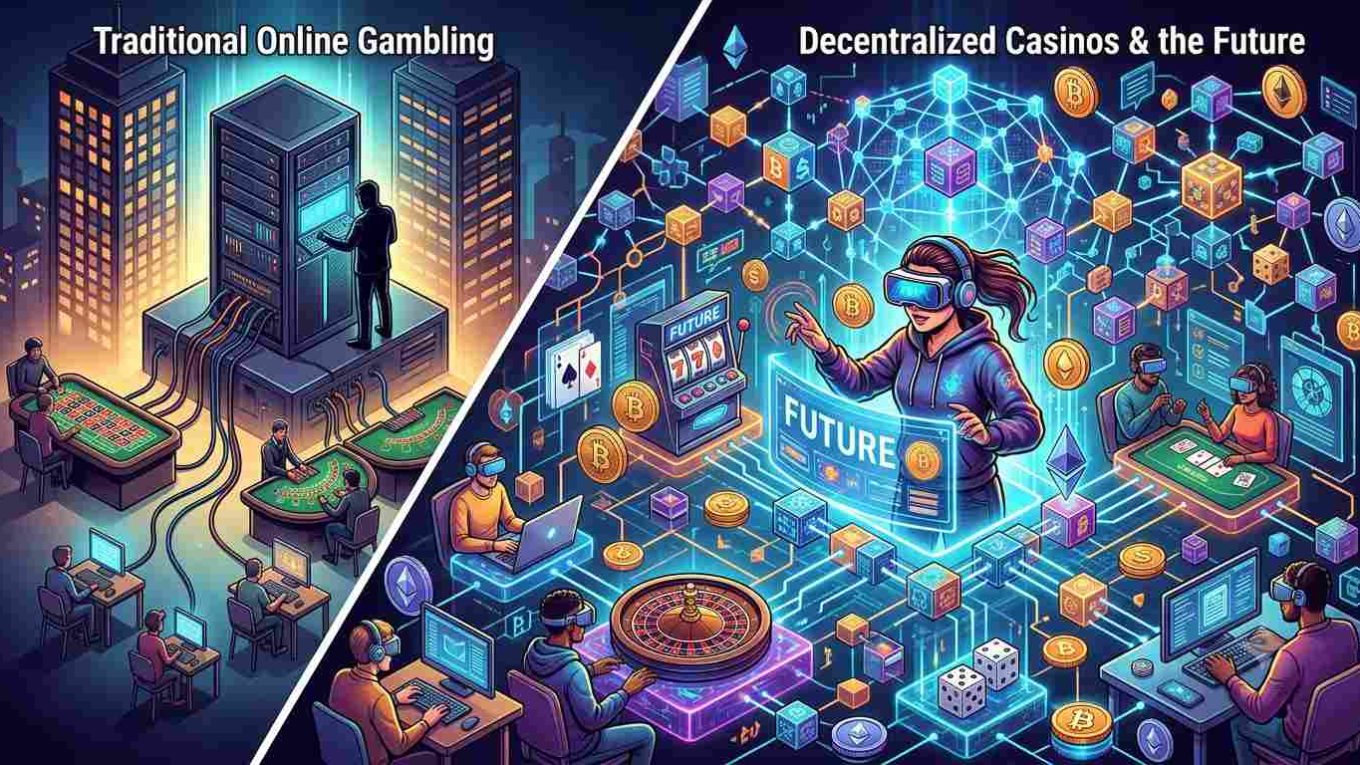
Are Decentralized Casinos the Future of Online Gambling?
After writing about crypto casinos scams that has covered the whole internet these days, made me curious about the concept of decentralized online casinos. All the websites we reviewed or mentioned in our crypto casino scam list, they have used terms like Decentralized Web3 Gaming, Provable Trust and Crypto casino based on Blockchain.
One thing is clear here the gaming scene is going to change for sure. The new technology is going to make major difference from the traditional system.
Decentralized casinos (often grouped under the GambleFi banner) are one of the fastest-growing segments in online gaming, but they aren’t likely to destroy traditional online casinos entirely. Instead, they are driving a hybrid future where blockchain features become standard across the entire iGaming industry.
Here is a look at why decentralized casinos are disrupting the market, where they hit friction, and what the future actually looks like.
Why Decentralized Casinos Are Gaining Ground?
Traditional online casinos majorly run on black-box system. The person has to trust that company random number generators (RNGs) are fair. People trust that company won’t delay withdrawals, and that the funds are safe in their bank accounts. Now the gaming scene is going to flip due to decentralization, using blockchain technology.
- Provably Fair Gaming: Algorithms allow players to cryptographically verify that the outcome of a roll, spin, or deal was truly random and unmanipulated after the fact.
- Instant, Non-Custodial Payouts: Winnings are settled directly via smart contracts to your wallet. You don’t have to wait 3–5 business days or submit endless paperwork to withdraw your money.
- “Be the House” Mechanics: Many GambleFi platforms allow users to stake tokens into liquidity pools that act as the house bankroll, letting regular users earn a cut of casino revenues.
- Borderless Access & Stablecoin Boom: The widespread adoption of stablecoins (like USDT and USDC) has given players globally a way to wager without worrying about the daily price swings of Bitcoin or Ethereum.
The Roadblocks Keeping Them From Total Dominance
Despite their massive growth, decentralized casinos face major hurdles before they can fully capture mainstream gamblers:
| Feature | Decentralized Casinos (GambleFi) | Traditional Online Casinos |
| User Onboarding | Requires crypto wallets, seed phrases, and gas fees. | Simple email, password, and credit card setup. |
| Regulation & KYC | Operates in grey regulatory zones; under increasing legal pressure. | Licensed locally, offering legal protections and recourse. |
| Customer Protection | Smart contracts are final — hack or misclick means funds are gone. | Chargeback options, account recovery, and customer support. |
| Live Dealer Games | Slower to adopt; mostly digital/arcade formats (crash, dice). | Dominated by high-production live human dealer tables. |
What are the main differences between fully decentralized casinos (dApps) and hybrid crypto casinos like Stake?
While platforms like Stake use cryptocurrency for payments, they operate on a fundamental structure distinct from fully decentralized casinos (dApps). The differences rest on where funds are kept, how games run, and who holds regulatory responsibility.
Core Differences
1. Fund Custody & Deposits
- Hybrid Casinos (Stake): Use a custodial model. You deposit crypto from your personal wallet into an account controlled by the casino. The platform holds your funds in their wallet until you request a withdrawal.
- Decentralized dApps: Use a non-custodial model. You connect a web3 wallet (like MetaMask or Phantom) directly to a smart contract. Wagering and payouts occur directly between your wallet and the contract code on-chain, meaning the casino never holds your funds.
2. Game Execution
- Hybrid Casinos (Stake): Game mechanics, house edge logic, and outcomes run on centralized web servers. While many hybrid casinos offer provably fair games using cryptographic seeds, the overall game environment is hosted off-chain.
- Decentralized dApps: Games run entirely via on-chain smart contracts. The logic for payouts, RNG seeds, and payouts is executed publicly and transparently on the blockchain.
3. User Onboarding & Identity (KYC)
- Hybrid Casinos (Stake): Function like traditional online platforms. They require account registration with an email and password and enforce Know Your Customer (KYC) identity verifications based on local laws and licensing requirements.
- Decentralized dApps: Require no account registration or personal verification. You simply approve smart contract permissions using a wallet address, offering anonymity.
4. Game Catalog & Features
- Hybrid Casinos (Stake): Feature thousands of games, including high-production live dealer tables (e.g., Evolution Gaming), sportsbook betting, and traditional slot providers.
- Decentralized dApps: Usually focus on simpler, Arcade-style games (like Crash, Dice, Plinko, or roulette) because complex, real-time live video streams are difficult to run purely via on-chain smart contracts.
Comparison Table
| Feature | Hybrid Crypto Casinos (e.g., Stake) | Fully Decentralized dApps (e.g., Rollbit, EarnBet) |
| Custody of Funds | Casino holds your deposited funds | Non-custodial (self-custody in your wallet) |
| Payout Process | Manual or automated via casino server approval | Immediate, automated via smart contract code |
| Verification / KYC | Account registration & identity verification required | Web3 wallet connection only (No KYC) |
| Game Selection | Slots, live dealers, and comprehensive sportsbooks | Arcade games, simple table games, and peer-to-peer bets |
| User Experience | Smooth, Web2-style interface; easy navigation | Requires managing gas fees and Web3 transactions |
| Licensing | Regulated under traditional gaming licenses (e.g., Curaçao) | Operates without a central license via open-source smart contracts |
The Verdict: A Hybrid Future
Decentralized casinos won’t completely replace traditional platforms; rather, traditional online gambling will absorb the best parts of decentralization.
In the coming years, expect to see:
- Traditional brands adopting “provably fair” standards and offering instant stablecoin payouts on the backend.
- Decentralized platforms adding lighter KYC options and account abstraction (social logins that create crypto wallets automatically behind the scenes) to make the user experience as smooth as Web2.
- Regulatory convergence, where regimes like Europe’s MiCA and updated licensing frameworks push decentralized platforms to operate with clear licenses.