The Anatomy of a Retail Clone: An Investigative Breakdown of Leonorhen.shop and Major Brand Impersonation Scams
Moving into a new home, furnishing an apartment, or simply redecorating a bedroom is an exciting milestone. Home goods and furniture shopping used to mean long weekends wandering through cavernous retail showrooms, testing mattresses, and hauling flat-packed boxes.
Today, the vast majority of homeowners and renters browse for sectionals, wooden dressers, and accent lighting online, relying on trusted retail titans like Wayfair to ship bulky items straight to their doorsteps.
Because authentic furniture involves significant financial investment, finding a steep discount feels like an incredible win. Bargain hunters actively scour search feeds, seasonal sales, and social platforms for promotional codes and limited-time clearance events.
Unfortunately, cyber fraud networks are well aware of this shopping behavior. They construct elaborate online traps designed to hijack the visual identity, brand loyalty, and goodwill of household retail giants.
One storefront that has recently surfaced in cyber threat analysis queues is Leonorhen.shop. Presenting itself with the signature purple hue and familiar logo of home goods behemoth Wayfair, the platform attempts to project immediate retail credibility. Yet, an inspection of its domain registry, promotional mechanics, and technical architecture reveals an aggressive brand impersonation campaign.
This investigative report breaks down the mechanics of modern brand impersonation storefronts, analyzes the specific operations of Leonorhen.shop, identifies critical security red flags, and provides a clear verdict to keep your financial assets and personal identity protected.
Fundamentals of High-Risk Brand Impersonation Scam Storefronts
To navigate the digital marketplace safely, one must understand how modern retail impersonation networks operate. Gone are the days when online scams were limited to broken English and crude web pages. Today’s fraud syndicates deploy sophisticated mirroring techniques tailored to deceive even attentive online shoppers:
- Complete Brand Identity Theft: Deceptive networks do not merely mimic a style; they copy exact trademarks, registered logos, signature brand color schemes, and proprietary typography. They scrape real marketing materials, photography of physical brick-and-mortar storefronts, and national advertising campaign slogans directly from authentic corporate servers.
- Exploiting Cognitive Familiarity: When an online shopper sees a globally recognized logo like Wayfair, their brain experiences an immediate feeling of safety. Scammers rely on this cognitive bias, knowing that many consumers shopping on mobile phones will focus entirely on the familiar header and fail to look closely at the URL address bar.
- Manufactured Urgency and Scarcity: Brand impersonation operations thrive on haste. By plastering pages with artificial flash sales, 24-hour countdown clocks, and sitewide clearance banners, they push buyers to check out rapidly before conducting basic verification.
- Disposable Top-Level Domains (TLDs): Setting up unauthorized stores on mainstream extensions like
.comoften triggers trademark enforcement takedowns. Fraud rings frequently turn to budget, high-turnover domain extensions such as.shop, which can be registered for pennies, exploited for a brief blitz of social media ads, and abandoned as soon as payment gateways shut down.
📧 Need Legal Assistance?
Contact the author for legal consultations, case evaluations, and professional inquiries.
Case Study: Deconstructing Leonorhen.shop
When auditing Leonorhen.shop, forensic analysis reveals a classic brand impersonation funnel designed to deceive home decor shoppers.
Storefront Layout and Visual Presentation
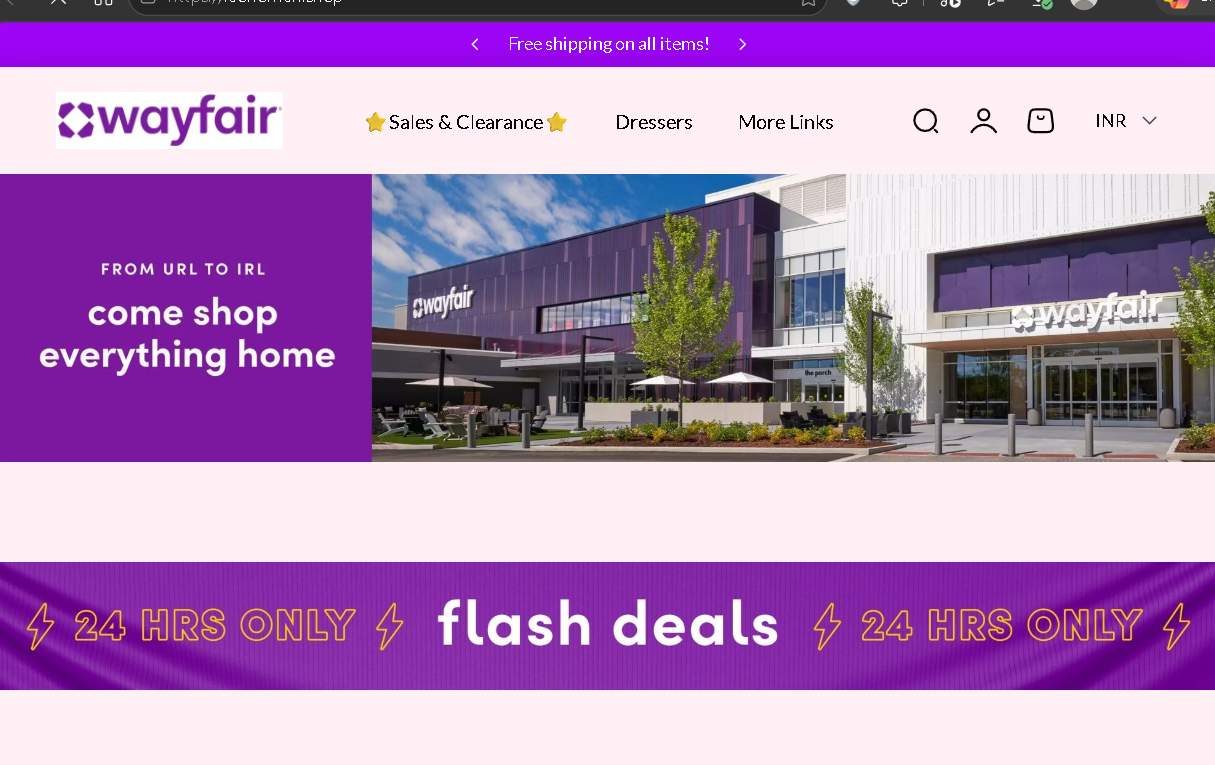
The landing page of Leonorhen.shop displays an unauthorized clone of the Wayfair online shopping experience. In the primary desktop header, the site showcases the registered Wayfair wordmark and pinwheel logo in its authentic purple and white branding.
Below the main navigation, the hero banner features an official high-resolution photograph of an actual physical Wayfair brick-and-mortar store building, overlaid with the genuine corporate retail tagline: “FROM URL TO IRL: come shop everything home”. The site includes search bars, account icons, and shopping carts arranged to mirror an authorized corporate retail portal.
Products Promoted and Marketing Claims
The product catalog on Leonorhen.shop focuses on high-ticket home furnishings:
- Bedroom Dressers & Storage: Substantial storage units and hardwood dressers that typically retail for hundreds or thousands of dollars are promoted under dedicated category tabs like “Dressers”.
- Sitewide Liquidation Claims: The header navigation features eye-catching links like “⭐️ Sales & Clearance ⭐️” alongside a prominent, pulsing purple ribbon declaring: “⚡ 24 HRS ONLY ⚡ flash deals ⚡ 24 HRS ONLY ⚡”.
- Frictionless Shipping Incentives: Across the uppermost announcement bar, the storefront advertises: “Free shipping on all items!” Freight delivery for heavy wooden furniture normally costs substantial fees, making unconditional free shipping an enticing psychological hook.
Underlying Modus Operandi
Behind its borrowed corporate aesthetic, Leonorhen.shop operates via deceptive harvesting and non-fulfillment mechanisms:
- Targeted Social Advertising: Scammers drive traffic using sponsored posts on social media networks, displaying images of high-end dressers and sofas at steep clearance discounts.
- Credential and Financial Harvesting: When an unsuspecting consumer completes an order, the checkout screen captures their full legal name, shipping address, telephone number, and payment card details (including primary account numbers, expiration dates, and CVV security codes).
- The Non-Delivery Trap: Because the operators possess no furniture inventory or logistics infrastructure, the purchased products are never dispatched. Alternatively, the store issues fabricated tracking numbers that trace phantom shipments to delay chargebacks.
- Data Exploitation: Stolen financial data may be used for unauthorized recurring charges, while personal consumer information is often packaged and traded across illicit dark-web brokerages.
The Anatomy of the ‘Wayfair’ Brand Mimicry Scam: Why Counterfeit Networks Target Home Decor
The deceptive setup observed on Leonorhen.shop is not an isolated incident; it represents a textbook execution of an increasingly aggressive cyber-fraud trend: the Wayfair Brand Mimicry Scam. Over recent months, international fraud rings have aggressively targeted home furnishings and decor platforms, building automated replica stores that impersonate household retail giants to exploit everyday shoppers.
Why Do Fraud Networks Target Wayfair Specifically?
Scammers intentionally choose brands like Wayfair for specific psychological and commercial reasons:
- High-Ticket Catalog Appeal: Furniture, patio sets, modular sectionals, and bedroom dressers inherently carry hefty price tags ($500 to $2,500). When fraudsters advertise these luxury catalog items at steep “clearance” rates of $39 to $89, the perceived discount creates an overwhelming sense of urgency that bypasses ordinary consumer skepticism.
- Widespread Brand Trust: Because Wayfair is widely recognized for frequent promotional events (such as “Way Day” and seasonal flash sales), shoppers are already primed to believe that massive markdowns and clearance blitzes are legitimate.
- Bulky Freight Disconnect: In normal retail, moving heavy dressers or multi-piece sofas requires costly freight logistics. Fraud networks capitalize on this friction by offering “Free Worldwide Shipping,” making the fraudulent deal appear too enticing to pass up.
How the Wayfair Impersonation Funnel Operates
The operational framework behind these cloned storefronts follows a predictable, highly automated assembly line:
- Automated Asset Scraping: Rogue networks deploy automated web scrapers across genuine Wayfair product pages, siphoning high-definition lifestyle photography, authentic customer review stars, and exact catalog descriptions (such as sideboards, recliners, and storage sheds).
- Deploying on Arbitrary Throwaway Domains: Rather than risking high-cost lookalike domains that face rapid DMCA takedowns, syndicates purchase cheap, arbitrary domains in bulk—such as
leonorhen.shop. They paste the iconic purple-and-white Wayfair branding across the header, relying on the fact that mobile shoppers rarely scrutinize the full address bar. - Targeted Social Media Arbitrage: Fraudsters run cloaked advertisements on platforms like Facebook, Instagram, and TikTok, promising “Overstock Warehouse Liquidations” or “Closing Store Clearance.” The ads direct users straight into the checkout funnel without ever displaying the true underlying URL.
- Phantom Tracking and Silent Capital Exit: Once payment details are captured, the victim is either charged by an unrelated shell merchant account or provided with a fake, non-functional tracking number. Weeks later, when the consumer realizes nothing is arriving, the domain is shuttered or shows a server error, only for the same operators to redeploy on a new web address.
How to Differentiate the Real Wayfair from Counterfeit Networks
| Verification Factor | Official Wayfair Store | Counterfeit Mimicry Stores (e.g., Leonorhen.shop) |
| Primary Domain | Strictly wayfair.com (or official regional TLDs like wayfair.co.uk, wayfair.ca) | Unrelated, nonsensical strings on cheap extensions (e.g., leonorhen.shop, topfurniture-clearance.store) |
| Discount Distribution | Balanced promotions (15% to 50% off MSRP depending on sales events) | Sitewide 80% to 95% markdowns across all heavy furniture items |
| Payment Gateways | Major secure cards, verified PayPal, Wayfair Credit, Klarna, Affirm | Unsecured third-party merchant fields, offshore processors, or direct peer-to-peer transfers |
| Customer Support | 24/7 dedicated support lines, legitimate ticket centers, verifiable corporate addresses | Generic web forms or free webmail addresses (e.g., support@outlook.com) with zero phone contacts |
Critical Red Flags Found on Leonorhen.shop
A forensic inspection reveals unmistakable indicators of fraudulent operation:
- Severe Domain Mismatch: While the site headers, logos, and promotional graphics boldly read “Wayfair,” the actual URL is
leonorhen.shop. Wayfair operates through its primary domainwayfair.comand authorized national subsidiaries (e.g.,wayfair.ca,wayfair.co.uk), never through disconnected third-party.shopdomains. - Nonsensical Domain Prefix: The string “leonorhen” has no connection to furniture retail or corporate filings. Fraud networks routinely purchase arbitrary pre-registered domain names in bulk and deploy cloned retail scripts onto them.
- Disposable
.shopExtension: Authentic multi-billion-dollar enterprise brands maintain established.comweb properties. Fraud rings rely heavily on cheap.shopTLDs to bypass enterprise brand monitoring and facilitate quick shutdowns. - Aggressive, Unrealistic Urgency Tactics: Flashing 24-hour flash deal ribbons and claims of sitewide clearance on bulky goods are classic hallmarks of high-pressure retail fraud.
- Absence of Corporate Transparency: Despite copying Wayfair imagery, the backend terms of service, merchant contact details, and registered corporate identification numbers are completely missing or entirely disconnected from genuine corporate filings.
| Platform | Product Claim | Primary Red Flags | Risk Level | Action |
|---|---|---|---|---|
| Mavoreliqa.shop | Women’s Fashion, Apparel & Accessories (Clearance Storefront) | Stolen boutique catalog imagery, disposable .shop domain, and unrealistic 70%–85% sitewide discounts. | High Risk |
Final Verdict
Taking into account the blatant trademark infringement, total domain name disconnect, and use of disposable website infrastructure, the conclusion is clear.
Leonorhen.shop is an illegitimate, high-risk brand impersonation scam storefront. It is not affiliated with, endorsed by, or connected to Wayfair LLC in any capacity. Submitting information on this website puts you at severe risk of financial loss, credit card fraud, and personal identity harvesting.
Do not attempt to purchase items, create accounts, or enter sensitive financial details on this platform. If you wish to shop authentic Wayfair inventory, navigate directly to wayfair.com.
If you have already submitted payment credentials on Leonorhen.shop, take defensive action immediately. Contact your card issuer or banking institution to cancel the compromised card, dispute any unauthorized transactions, and monitor your credit profile for suspicious activity.
Frequently Asked Questions (FAQ)
Is Leonorhen.shop a Scam?
Yes. Leonorhen.shop is a confirmed brand impersonation scam that illegitimately displays Wayfair’s corporate logos, physical store imagery, and trademarked branding to trick consumers into submitting payment card details.
Is Leonorhen.shop Legit?
No, Leonorhen.shop is not legitimate. It has no authorization or commercial partnership with Wayfair LLC, holds no genuine furniture warehouse inventory, and operates on an unrelated disposable domain.
Why is the domain Leonorhen.shop using the Wayfair logo?
Rogue e-commerce rings scrape corporate logos, color schemes, and high-definition marketing materials from major retailers like Wayfair to establish instant trust and deceive shoppers browsing on mobile devices.
What happens if I make a purchase on Leonorhen.shop?
Because the website is an unauthorized front with no inventory, orders are not fulfilled. Your submitted payment card information is compromised and can be used for fraudulent transactions or shared on dark-web databases.
What should I do if I entered my credit card on Leonorhen.shop?
Contact your bank or card issuer immediately. Inform their fraud department that your card details were submitted to an impersonation website, request that the card be canceled and reissued, and initiate a chargeback for any debited amounts.
How can I verify that a furniture sale is really from Wayfair?
Always examine your browser’s address bar. Legitimate Wayfair transactions occur exclusively on the primary domain wayfair.com or its verified regional properties (wayfair.ca, wayfair.co.uk), never on arbitrary .shop domains.
How do fake furniture clearance stores advertise on social media?
Scam operators purchase sponsored advertising slots on platforms like Facebook and Instagram, using scraped imagery of discounted living room sets and dressers to route users directly into cloned payment portals before moderation teams can detect the fraud.
For more shady sites exposed, check our Shopping Scam Directory — your quick guide to staying safe online.
Every safe click counts. If this post helped, a coffee gesture fuels more scam‑busting investigations.

Call to Action
Please share this article to spread awareness. Follow us on Facebook, Twitter, and Instagram for more scam alerts. If you doubt the legitimacy of any website or investment plan, DM us on social media — we’ll help you verify.