Why Fear Is Actually a Sign You’re Going the Right Way
From childhood, fear is often used as a tool to discipline us. As a result, most people carry this emotion into adulthood, viewing it as purely negative. But is fear really a bad thing, or is it just a warning signal?
No human emotion is useless. The so-called “negative” emotions often act as a compass, pointing directly toward something in our psychology that needs attention. Living a good life requires us to listen—to truly tune into our body and mind. Changing your perspective changes everything.
Normally, we view fear like a fire alarm. Our automatic conditioning kicks in: put out the fire, run in the opposite direction, and find a safe place.
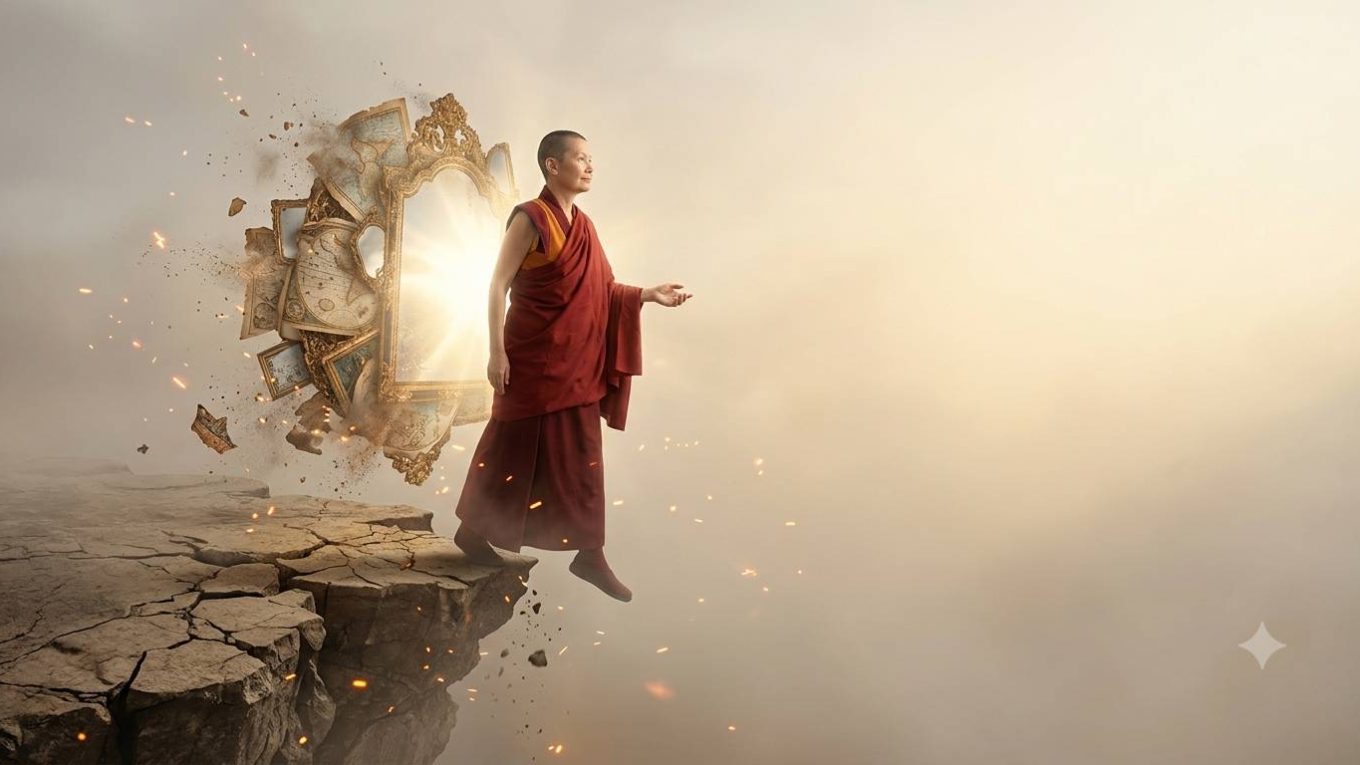
But what if we take a pause? What if we stop seeing fear as a warning of danger, and instead hear it as the sound of our old, comfortable illusions burning away? What if fear is simply the feeling of our false identity breaking down?
Recently, I’ve been reading When Things Fall Apart by Pema Chödrön, and I wanted to share some of her transformative insights. Pema Chödrön is an American Tibetan Buddhist nun who has spent decades reframing how we handle anxiety, uncertainty, and those chaotic moments when life seems to fall apart.
Her core takeaway is universal. Outer circumstances vary across cultures, but our inner emotional worlds are remarkably similar. Chödrön dissects fear for us, flipping our standard approach to it entirely upside down.
Fear as a Compass, Not an Enemy
Usually, when we feel fear—say, about leaving a draining job, ending a relationship, or admitting a hard truth about ourselves—we assume it means we are doing something wrong. We view fear as an obstacle to overcome or a weakness to push past.
Chödrön suggests something radical: fear is a natural reaction to moving closer to the truth.
We build our lives on comfortable stories that act as psychological armor. When you start moving toward the truth, you aren’t just gaining new information; you are dismantling the illusion that kept you feeling safe. The fear you feel is just your brain’s natural resistance to losing its established map of reality. Fear isn’t a sign to stop; it’s a sign that you’ve reached your “edge”—the boundary between what is comfortable and what is real.
The Illusion of Solid Ground
We spend immense energy trying to create a predictable life: stable jobs, permanent plans, fixed identities. But Buddhist philosophy teaches that everything is constantly changing. The solid ground we seek doesn’t actually exist.
Chödrön talks about “groundlessness“—that terrifying free-fall feeling you get when a long-held belief or dynamic collapses, and you don’t yet have a replacement structure. You are floating in the middle.
Her counterintuitive insight is that our suffering doesn’t come from the groundlessness itself. The pain comes from our desperate, exhausting attempts to grasp onto something solid while we are falling.
Learning to Stay Put
When we feel this groundlessness, our instinct is to escape. Chödrön calls this shenpa, a Tibetan word translated as “getting hooked.” It’s the immediate urge to reach for our phones, open the fridge, pick a fight, or numb out the second discomfort appears.
Her solution is simple, though far from easy: Don’t take the hook.
When fear or uncertainty arises, she advises against running. Instead:
- Notice the hook: Recognize the exact moment you want to distract yourself.
- Pause: Interrupt the automatic reaction.
- Stay with it: Sit with the raw physical sensation of fear in your body for just a few seconds without judging it or acting on it.
By leaning into the fear rather than running from it, we stop fighting reality. We realize that groundlessness isn’t a mistake we need to fix; it’s simply the way things are. And once we stop grasping for solid ground, the free-fall isn’t quite as scary anymore.